Showing posts with label First in a Series Challenge. Show all posts

Saturday, February 6, 2010

Review: Barely a Bride by Rebecca Hagan Lee


A Regency-set historical romance featuring a marriage of convenience is nothing new. A hero who has sworn not to marry until duty forces it of him is also nothing new. A heroine who is unlike the other girls of the ton, wanting to have the freedom to pursue her own interests is, you guessed it, still nothing new. And yet Lee has managed to create a rather charming story with these common elements.

Griffin and his cronies at school formed the Free Fellows League vowing to not only stay unmarried as long as possible but to never let a wife interfere with their desire to serve their country or to worm her way into their hearts. To this effect, they drew up a contract and each signed it. Fast forward years to a short time after Griffin has accepted a commission in the Guard to go and fight Napoleon. His father, the Earl of Weymouth, demands that he marry and at least attempt to sire an heir before he goes off to be shot at. Griffin gives in to this request unwillingly but he eventually meets and appreciates Alyssa, the youngest daughter of the Earl of Carrington, who is completely uninterested in marriage and all its trappings. Alyssa just wants to be left in peace to design and care for gardens but her parents are determined to marry her off. She and Griffin have an immediate attraction. She has no objection to the idea of her new bridegroom heading off to war and he has a large neglected garden in need of rejuvenation. A match just waiting to be made. A large part of the book deals not only with the two of them getting to the altar, but also with them learning all about each other in the brief space of their two week marriage. They find that they have been serendipitous in their choice of each other both in terms of physical attraction but also in their similar thinking. And then Griffin goes off to war, experiences the horrors he never imagined, and realizes that he only wants to go home and love and be loved by his wife. But love was never in the bargain they made.

It was refreshing to read a story where the conflict between the characters was not an issue of misunderstanding or lack of communication. And although neither character wants to admit to their love for the other because of the Free Fellows' pledge (which Alyssa is not supposed to know about but does), their hearts are always obvious. The Free Fellows' League was a bit of a silly conceit but perhaps there's more substance to it in the following two books of the trilogy. Also, the charter itself was a bit sophisticated in understanding for boys of their age and would have been more likely to come from almost teens but that's a negligible complaint. I was pleased to see that the villain in this book was not a cut and dried villain and one who did not wish either the hero or heroine bodily or emotional harm and who actually turned out to be a decent guy. The fact that Lee neatly sidesteps many of the common plot devices found in Regency-set romances these days made this an enjoyable read.

Wednesday, January 20, 2010

Review: Cheaper by the Dozen by Frank Gilbreth, Jr. and Ernestine Gilbreth Carey


I am probably going to be flayed alive by fans of this classic bit of kiddie lit, but I didn't love it. As a matter of fact, far from wondering what it would have been like to have grown up in their family, I was beyond grateful that I didn't. Usually I am all for daydreaming and inserting myself in the appealing, old-fashioned world but not in this instance. I do understand that writing this book was probably a labor of love on Gilbreth and Carey's parts. And I am quite certain that they would be horrified to know that I found their father, at least as depicted here, to be an unpleasant sort. The idea of running a family as a factory or business might seem quaint and entertaining from a distance but it struck me as distasteful. I was particularly interested in the assertion by the authors that he respected children and that's why so many children liked him. Then, completely without irony, they said that he would cut off their dinner conversation by declaring it "not of general interest" and go on to expound on whatever had fascinated or consumed him that day. Respectful? Wow. That's not my understanding of the word.

But the look at the times and the inner workings (even if unusual) of a large family was interesting. Mother Lil was really rather marginalized in this book but I suspect she takes center stage in the next book so perhaps the pair are intended to be seperate portraits of their parents in the milieu that the children knew them best: the family. It is also worth noting that there was only about one year in which all 12 children were at home since the age span between the first and the twelfth is great enough. And since Frank Sr. died when the youngest was merely two, his jovial response to people's wonder at so many children that they come cheaper by the dozen was really only true at the very tail end of his life. The book is almost episodic in nature, with the interesting bits recounted, leaving the narrative flow a bit choppy. And figuring out who all the children were? Don't count on it as they aren't described distinctly enough to differentiate amongst them. But this is a classic and people do love it so perhaps I was just in a terrible mood or completely missed the elusive something that draws readers to a book. The family antics were occasionally entertaining but I had a hard time getting past my dislike of the not quite so genial patriarch. Heresy, but I prefer the movie versions.

Thursday, January 7, 2010

First in a Series Challenge


How many series do I have here collecting dust? Countless numbers I'm sure. And if I just delved into them with the first book, I'd probably be hooked enough to whip through at least a few of them (or so I hope given my penchant for collecting the entire series before starting to read it--it's an anal retentiveness thing). So the First In a Series Challenge is perfect for me to dip my toe in and try out everything I have stashed on shelves and in corners and under beds around here.

Challenge Guidelines:
1. Anyone can join. You don't need a blog to participate.
--Non-Bloggers: Include your information in the comment section.

2. There are four levels:

-- Curious– Read 3 novels that are first in a series.

-- Fascinated – Read 6 novels that are first in a series.

-- Addicted – Read 12 novels that are first in a series.

-- Obsessed – Read 20 novels that are first in a series.

3. Any genre counts.

4. You can list your books in advance or just put them in a wrap up post. If you list them, feel free to change them as the mood takes you.

5. Challenge begins January 1st thru December, 2010.


I've listed three books but have a short list of more firsts that would fit as well. And I'll try to add to the supplemental list as I go along so I can easily see which books start series when I am in the mood for a good consecutive reading binge. Here's my list as it stands now:

1. Emily of New Moon by L.M. Montgomery
2. The Secret Diary of Anne Boleyn by Robin Maxwell
3. An Assembly Such As This by Pamela Aidan

The Virgin in the Garden by A.S. Byatt, Cooking With Fernet-Branca by James Hamilton-Paterson, The Town House by Norah Lofts, Cheaper By the Dozen by Frank Gilbreth, The Many Lives and Secret Sorrows of Josephine B. by Sandra Gulland, Barely a Bride by Rebecca Hagan Lee

Wednesday, November 11, 2009

Review: Reed City Boy by Timothy James Bazzett


A very conversational memoir, this slim book traces Tim Bazzett's early childhood through high school growing up Catholic in small town Michigan. The first in a series of books (a trilogy so far), this book tells the everyday experience of Bazzett's growing up years. It introduces the reader to his family and to the friends and acquaintances who were important in forming the boy he was. He shares his Catholic school upbringing, his role in the family hierarchy, and the ordinary existence of a boy doing his chores, tackling his homework, and discovering girls in mid-twentieth century small town America.

Bazzett acknowledges his debt to his youngest brother and his mother in recreating his story but even so, he has an amazing recall of events and people from his past. The memoir is mostly chronological but also organized thematically in chapters that tackle things as varied as the way he and his brothers played in their free time to extended family visits to driving to seeing his first (nearly) naked woman. The writing is well done and this nostalgic reminiscence of a book, this personal letter to his children, will definitely appeal to readers who remember this innocent time in their own lives as well as in the country. For those a bit younger, the evocation of time and place and the delights of childhood and growing up have a more historical flavor but personalize that history and offer a peek into daily life that our history books in school ignored.

Thanks to author Tim Bazzett for sending me a copy of this book to review.

Friday, August 21, 2009

Review: Mr. Darcy's Daughters by Elizabeth Aston


As Pride and Prejudice fans the world over know, there is only one Jane Austen and she did not write a follow-up to her beloved novel. So we are left with modern authors trying to take pen in hand (keyboard in fingers just doesn't sound as good, does it?) and explore the world so many of us are loathe to leave once the last page is turned.

This isn't properly a sequel really as it takes on a whole raft of new characters in the persons of Darcy and Lizzie's five daughters but it does include some of the characters from the original. Wait, you say. You think you've read something before about five unmarried daughters, some of whom get into scandals or scrapes. Yes, Aston has tried to mimic the form of the original. However, she has done this to the detriment of the original Austen characters. Darcy and Lizzie have left for a diplomatic posting in Constantinople, leaving the chaperonage of their five daughters to Colonel Fitzwilliam and his wife. This diplomatic posting means that we don't get to see our favorite hero and heroine at all. And amazingly, the Darcy daughters are as silly or flighty or rigid as the Bennet sisters were. Colonel Fitzwilliam is nothing like his character in the original, nor are the other Austen creations.

As an entry into the "following in Austen's footsteps" canon, this is a disappointment. However, if you can read this without connecting it to Pride and Prejudice, this is rather an entertaining story. The Regency setting is well-researched and generally a favorite historical time of mine. The girls are perhaps a bit risque for genteel society but many other Regency-set stories use this same convention to point up the rigidity and hypocrisy of the age. There are some obvious deviations from the parallels to Pride and Prejudice, in the unravelings and outcomes of the scandals but they are generally acceptable and only a little far-fetched. Although I am certainly no Jane Austen purist, I still don't think this will satisfy fans unless they can read this purely as a novel set some 20 years after the setting of Pride and Prejudice and really unrelated in most every way from it.

Friday, July 10, 2009

First in a Series Challenge


And another challenge I blithely joined way back when without ever joining up officially. Obviously I am feeling the need to recitfy this omission for a few challenges today. The First in a Series Challenge is also hosted by J. Kaye of J. Kaye's Book Blog. She's going to be mighty tired of my solving the procrastination problem by the time I'm finished today but I love how easy going she is about all of this!

So here are the rules for this one:
1. Anyone can join. You don't need a blog to participate.

2. Read 12 books that are the first in any series. You may read & list your chosen books any time during the year.

3. Challenge begins January thru December, 2009.

4. You can join anytime between now and December 31, 2009.

And because I am the list queen, I, of course, have a list and have already been reading from it.

1. The Alphabetical Hook-Up List A-J by Phoebe McPhee
2. Merry Hall by Beverley Nichols
3. Mates, Dates, and Inflatable Bras by Cathy Hopkins
4. Emily of New Moon by L.M. Montgomery
5. Cordelia Underwood by Van Reid
6. 44 Scotland Street by Alexander McCall Smith
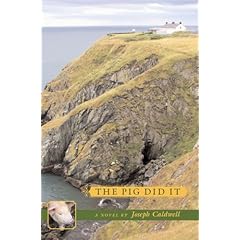
7. The Pig Did It by Joseph Caldwell
8. The Secret Diary of Anne Boleyn by Robin Maxwell
9. An Assembly Such As This by Pamela Aidan
10. The Virgin in the Garden by A.S. Byatt
12. Mr. Darcy’s Daughters by Elizabeth Aston
13. Cooking With Fernet-Branca by James Hamilton-Paterson

Sunday, July 5, 2009

Review: The Pig Did It by Joseph Caldwell


Aaron McCloud has been disappointed in love. Well, not exactly. But he thinks he should mourn the loss of a girl he never won anyway and he sets off to his aunt's house in Ireland, the place he spent his childhood summers, in order to best mope and sigh and grieve this quasi-love spurned. But before he can properly sink into the requisite melancholy, a farce breaks out with him and the pig who follows him to his aunt's house squarely at its center. Vowing to return the pig in the morning, he is greeted by the sight of total destruction, the pig having torn up his aunt's garden and shed. More troubling, the pig has uncovered a skeleton in the cabbages. Aunt Kitty knows who the murdered man is and she has a very convincing tale of who might be the murderer, naming Lolly, the woman to whom it is assumed the pig belongs. The plot thickens when Lolly disavows any knowledge of the pig and furthermore, points a convincing finger at Sweeney as murderer. When Sweeney is apprised of the conjecture, he, in turn, spins a tale that indicts Kitty. In the meantime, Declan Tovey's skeleton has been unearthed, brought into the house, and starts to cause all sorts of antics to ensue. And through none of this can Aaron muster up the oomph needed to properly suffer over the demise of a love affair that was only all in his head.

While a short novel, there is a hog-load of Irish blarney here. In the grand story-telling tradition, each character has the opportunity to make his or her case for what really happened to Declan Tovey while poor Aaron and the reader are only certain of one thing: that the pig unearthed the skeleton. Aaron, as an American, despite his familial ties to Kitty, doesn't understand the resolve of the three suspects to not involve the police nor can he quite figure out who among them has done in Declan. Regardless of his confusion, he is thoroughly involved by the time possessing the skeleton of a murdered man becomes a comedy of errors.

The monologues by the main characters are a bit long but when they lead to such hilarity as they do here, they are well worth the effort to read through. I think I spent as much time as Aaron did, completely baffled by the trio of other characters and I wondered how they were going to come to terms with each other and their unstated (or perhaps mentioned in a roundabout, sideways sort of way) desires. Watching Aaron try, unsuccessfully, to wallow in self-pity was highly entertaining. And the other characters were equally quirky and enchanting. Eccentric and offbeat, this comedy about love and life and a skeleton unearthed by a pig will probably have you scratching your head but ultimately wondering what the pig could possibly be up to in the second book.

Wednesday, June 3, 2009

Review: 44 Scotland Street by Alexander McCall Smith


Once The No. 1 Ladies' Detective Agency became popular, it seems like everyone raced out to read all the rest of what Alexander McCall Smith had written. So that probably means I am the last person on the planet to read this first book in the Scotland Street series. Interestingly though, I haven't heard much talk about this series and that's too bad. Because as charming as the Botswana books are, I liked this one even a shade more.

This novel has a varied, colorful, and extensive cast of characters populating its pages and the reader gets to know each and every one of them as individual characters. Most of the characters live at 44 Scotland Street in Edinburgh. Pat is having her second gap year because of vaguely alluded to circumstances. She moves into a flat with Bruce, a good looking but rather narcissistic, somewhat lazy young man. Neighbor Domenica, a widowed former academic becomes friends with Pat. Five year old genius Bertie lives with his domineering mother and father in the building as well. As the lives of these tenants, and a few outside characters, intertwine, the reader is treated to mundane lives and events written in a most delightful and engaging way. Unrequited love, failed set-ups, therapy, and misunderstandings abound in the daily lives of our characters. But far from being boringly domestic, this gives the book a comfortable and familiar and pleasing feel.

I thoroughly enjoyed my time at 44 Scotland Street and hopped right out to make sure I had all the subsequent books in the series because I am curious to see where the vagaries of fate will take our characters next. And I fully expect to be introduced to the people alluded to but missing from this installment. There is a serial feel to the book itself so there are natural stopping places throughout if you find yourself enchanted by this one too late at night as I did. The characters are all very complete in themselves, feeling as if they could be your very own next door neighbors. And the descriptions of Edinburgh are intriguing and wonderful. This book and the city it represents are both wonderful to visit (although I think I'd stay out of the old train tunnels given my slight claustrophobia, thanks) and I look forward to future visits to Scotland Street.

Wednesday, May 13, 2009

Review: Cordelia Underwood: Or the Marvelous Beginnings of the Moosepath League by Van Reid


Originally written in serial format, this novel of Victorian Maine is chock full of characters, plot lines, and just plain fun. As the subtitle implies, this is the first book in a series about the Moosepath League. However, instead of starting out focused on the creation of said club, it opens with Cordelia Underwood, a sweet, young, redheaded woman, finding out that she has inherited a parcel of untamed land land well to the north of Portland from her ship's captain uncle. This inheritance starts a whole crazy chain of events, including some that are ridiculously coincidental but somehow work in this wacky, madcap adventure story.


The Underwood family meets and befriends many strangers along the way as they travel north to examine Cordelia's property. Those strangers meet and befriend their own plethora of strangers and the connections and characters grow and grow. There are three goofy male characters who seem to be the literary equivalent of the Three Stooges. There's Tobias Walton, who becomes the leader de facto of the Moosepath League (not that this comes into existence until late in the book). There's the charming and ever-present John Benning. There's a circus bear who stands on her head, an ascentionist in a hot air balloon and an "attractive suit of tights." There's attraction and love. There's the rumor of buried treasure, a kidnapping, and a runaway horse carrying illegal booze. In short, this book is chock full of action and entertainment.

Because of the serial nature of the book, the chapters are short and often end with a teaser. Subsequent chapters often skip to another of the many characters in the book and to start with, this makes it very hard to differentiate between storylines (the characters themselves are all very different from each other) and to become fully engrossed in the story. But upon perseverance, the reader is richly rewarded as the climax of the novel nears and the seemingly disparate plot lines coem together to finish a delightful romp. Unlike many series books, this one feels complete in and of itself, not requiring the reader to go on to further books to feel a sense of closure. But I suspect that the main characters (Cordelia and her family) do not reappear in later Moosepath books, unless tangentially, and so their stories are full and satisfying when you come to the end of this first book. Walton and the three bumbling musketeers surely appear in later books but that doesn't detract from the wrap-up here. I will be eager to read the following books now that I've gotten into the groove of this one. I'm very interested to see what happens to the Moosepath League members next.

Wednesday, April 8, 2009

Review: Mates, Dates, and Inflatable Bras by Cathy Hopkins


A cute YA book about 14 year old Lucy, who feels awkward when everyone else around her seems to have their lives together and on track to become the adults they want to be. She not only doesn't know what she wants to be when she grows up, but she thinks she's losing her best friend, Izzie, to the new and infinitely more glamorous than Lucy, Nesta. She doesn't look 14 and she has had the misfortune to fall head over heels with Nesta's older, more sophisticated brother before she knows who he is. Definitely all the makings for teenaged drama here but Hopkins handles it deftly and without losing the naivete that makes her heroine sweetly entertaining. Less comedic than some similar books but also less world weary than others, this book fits in that small niche that makes this appropriate for my pre-teen daughter but also equally worthwhile for slightly older teens to read as well. This is the first in a series and while I'm not sure I'll follow the series any further, I will be offering it to the girl-child who likes real life sorts of books and I'd be happy for her to read the series if it does capture her interest.

Thursday, March 26, 2009

Review: Merry Hall by Beverley Nichols


The first in a trilogy, this lovely book chronicles Nichols' search for and purchase of a country freehold not too far from London where he can garden. Taking place not too long after the end of the Second World War, not only is this a delightful and enchanting book about plants and gardening, but it is awonderful snapshot of a time long since past. Nichols' garden is his main focus but he also introduces the reader to his eccentric neighbors, his elderly gardener, and various other people about the place. He discusses the folly and joys that came with purchasing his estate. And he generally injects enough light humor in all areas that this was a wonderful, completely appealing read. There are certainly instances that firmly place this in its time period but it has aged well and was a wonderfully diverting book to cozy in with for an afternoon. I have to actually physically restrain myself from jumping immediately into the second book in the trilogy, wanting to draw out the pleasure a bit by savoring the anticipation of an equally lovely amount of time spent with it. And don't skip over this book thinking that you aren't a gardener and don't want to read about gardening. Anyone who lights a hedge on fire on purpose and scorches the heck out of his new albeit slightly dilapidated home should be able to entertain any and all non-fiction readers with ease.

Monday, March 23, 2009

Review: The Alphabetical Hookup List A-J by Phoebe McPhee


Oh my gawd. I, like, think I'm, like, too old for this book. Young adult literature can be just as appealing to adults as adult literature can be but this one made me grateful I'm not an angsty teen just starting college and that I was never as clueless and shallow as these characters seem to be. Three girls, who all requested singles (because freshmen ever score singles--duh) end up as roommates. They are, of course, as different as chalk and cheese and whatever third thing would be equally as different. Only, they aren't nearly as different as they think. When all of their love lives crash and burn almost immediately after stepping foot on campus (cheating boyfriend for one, dumped by long distance boyfriend for another, and clueless attraction to gay boy for the third), they band together and come up with the alphabetical hookup list where each one of them is going to try and kiss at least one guy for each letter of the alphabet, in order. The girls' friendship waxes and wanes as each one tries to fulfill her list amidst all the other distractions of college (although attending class really doesn't seem to be much of a distraction). As the title implies, this is the first in a trilogy and apparently I need to have my head examined because I bought all three of them without trying the first one. Now I have two more vacuous teen reads to slog through (I bought them and having spent money on them, I'm too anal retentive to give them away without reading them). And give them away I will because the characterization is superficial, the plot is pretty darn non-existent, and really, despite the semi-redeeming moral moment at the end of this first book, I don't think I want my daughter to read these, even when she reaches an appropriate age.

Popular Posts