Showing posts with label TBR Challenge. Show all posts

Friday, February 18, 2011

Review: The Lost Dog by Michelle de Kretser

Tom Loxley is a divorced, childless, Jamesian scholar who is stalled at the end of writing his book. He takes his dog to a friend's cabin in the bush in order to find the inspiration to finish but on a long tramp with the dog, the dog runs away and doesn't return. Tom's sometimes frantic and sometimes desultory search for his lost dog then weaves in and out of the other plot threads, flashbacks all: his childhood in India and then Australia, his marriage and its ultimate failure, his sexually frustrated obsession with his artist friend Nelly Zhang, and (the only non-flashback) of his mother's aging diminishment.

There are a wealth of themes weaving throughout the tale. There's that of the immigrant and the outcast; there's familial duty and the inheritance of the past. Loss and redemption as well as desire and denial play their own enormous roles as the story builds to its climax. Despite the small action guiding the story, the search for the dog keeps the reader engaged and slightly tensed wanting an outcome even as Tom's life up until the loss of his dog unfolds slowly and with great deliberation reflecting the alternating hope and futility of the search itself.

The writing here is often times dense and rich in meaning with de Kretser showing her deftness with apt metaphors. Her descriptions are minute and startlingly accurate, a decided strength in a story with such an insubstantial plot driving the tale. If there's a weakness here, it's in the characters. Tom himself is hard to like, aimless and as stuck in his life as the conclusion of his scholarly research. Nelly Zhang is eccentric but stand-offish, even to the reader, exploiting her racial identity when it suits. And the long intervening amounts of text between when hints of mystery and understanding are dropped and when their threads are finally reintroduced into the story can induce a sense of frustration in a reader more accustomed to a straightforward writing style. But even with these considerations, it is clear that de Kretser is an accomplished and stylish writer. In the end, while I found it hard to sympathize or care for any of the characters, I wanted to know what happened to the dog, was impressed by the calibre of the prose, and amazed by the dexterity of keeping all the disparate plots going and ultimately interconnected. I look forward to reading de Kretser's other works.

Thanks to the publisher for sending me a copy of this book for review.

Monday, January 24, 2011

Review: Ragtime by E. L. Doctorow

Ragtime is called one of the best books of its time. It was apparently a trailblazer in terms of the way the novel has evolved. It is included on the lists of 1001 books that will make you a well read person. Obviously I missed something substantial here because it didn't impress me, draw me in, or engage me in any real sort of way. In actuality, I found it to be rather a mess. Then again, my critical facilities may be going haywire or, conversely, it could be an emperor has no clothes kind of situation here. I know which scenario I think it is. Draw your own conclusions.

This historical fiction novel is a pastiche. Ostensibly following several very different characters, Doctorow has woven real historical figures and actual events from the turn of the 20th century (right up until the eve of WWI) into his narrative. A plethora of characters is introduced and then seemingly dismissed in the early stages of the novel, only to reappear on the page later, making coincidental connections with each other. The almost vignette like narratives highlight the major ideas and enthusiasms of the time: Coalhouse Walker's quest for justice highlights rampant racism, Houdini's acts underline the public's fascination with death defying escapes and their interest in the occult, Father's trip to the North Pole emphasizes the way in which exploration still captured the imagination, the trial of Harry Thaw chronicles the birth of the celebrity culture through his actress wife Evelyn Nesbit's role in Stanford White's murder, the pow-wow between Henry Ford and J. P. Morgan showcases the rising industrialization and mechanisation of the time, and so on. Perhaps there's just entirely too much going on in the novel, too many characters, too many themes, and a superficiality to both.

The combination of fictional and real characters resulted in a short-shift approach to both and I found myself lacking sympathy for anyone. Late in the book when one character finally reappears, I just didn't care. And the coincidental intersections of the characters, real or imagined felt too contrived and intentional. This was, of course, a fascinating time period with so much nascent but I felt as if Doctorow had just missed the mark in depicting it. Having read it, I am that much closer to being "well-read" but I'm not any closer to understanding why.

Thursday, December 10, 2009

Review: Eve's Ransom by George Gissing


Maurice Hilliard is a young man who is given some money long owed to his late father and with this unexpected windfall, he determines to spend a year, or as long as the money holds out, truly living his life. He quits his job, bids farewell to his friend, and strikes out to do just this. But after determining that he is as aimless in Paris as he was in England, he decides to search out a young woman with whose portrait he'd become enamoured at his former landlady's home. Once he tracks down Eve, he pushes to know her and her friend Patty, becoming a major player in their lives. He falls for the sometimes unapproachable Eve, taking on a sort of benefactor's role in her life. Eve has known real penurious hardship and so she allows Maurice to buy his way into her life, all the while knowing that Maurice's windfall is temporary. She cannot see her way to living a life on the edge of poverty again and so she continues to hold herself slightly aloof from Maurice.

Gissing, a Victorian author, has drawn a realistic and challenging portrait of a man who is in love with a woman who cannot force herself to love him, feeling gratitude but nothing deeper. Although this is a short book, his descriptions of dreary, dingy, industrial age London, Paris, and Birmingham is instructive. He has captured the reality and result of grinding poverty on the soul and the limited prospects available to the lower class of the time. Only Maurice and Eve are completed characters and neither is totally likeable, both grasping and desperate in their own ways. I was disappointed in the ending of the book. The tone changed very drastically and the characters seemed so changed without the reader seeing that change that the conclusion just felt off. It almost seemed as if at the last minute Gissing felt as if his intended ending was too depressing to foist on the serial reading public and so whitewashed things. Other than that caveat though, I enjoyed this and would recommend it to other readers who enjoy the realism so often found in Victorian fiction.

Saturday, May 16, 2009

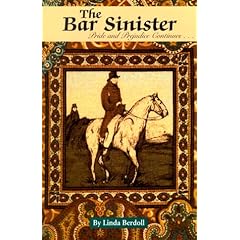
Review: The Bar Sinister by Linda Berdoll


I am a Jane Austen addict. Pride and Prejudice is my favorite book ever. And I cheerfully buy any and all sequels to it, knowing without a doubt that there's no way on the planet that they will live up to the original. But I can't help myself. I may not read them in a timely manner, as proved by this particular book which I bought years ago, never read, and only rediscovered languishing on my shelves when it was re-released a couple of years ago under a different title (which I also promptly bought and had to return) but I buy them nevertheless. After reading this, I am a little sorry about my blanket Austen sequel reading policy.

An unattributed blurb on the back tells readers to "Hang on to your bonnets, this isn't Jane Austen. Reader discretion advised." Truer words were never spoken (and I'm a veteran romance reader so graphic desciptions don't bother me but this book is completely over the top. Opening with Darcy and Elisabeth [sic] jolting down the road towards Pemberley following their wedding night, we find the new Mrs. Darcy ignoring the pillow Mr. Darcy has so kindly offered her to give her lower bits respite from their aching. And this is just the beginning. We are treated to scene after scene of our newlyweds thinking lewd thoughts about each other or engaged in vigorous romping throughout the entire estate. Somehow the plot seems tangential to all the steamy (adn quite frankly fairly laughable) sex. We are told of Darcy's discreet exploits when he was younger and see further into his character as he snubs a neighbor who legitimized his bastard son as his heir. We meet Elisabeth's sisters again and get to encounter the still slimy Wickham as he makes a pass at Elisabeth. In addition we are treated to bad guys (why didn't Austen write about a kidnapping?) and another illegitimate child about whom speculation is rife. Elisabeth has trouble getting pregnant despite the constant sex. And Darcy continues to learn that his pride is misplaced as he discovers things about his own family that disappoint him.

With as much going on in this novel as there is, the chaos and the sex aren't the things that bothered me the most. Instead it was the stilted and unintentionally hilarious writing. I know that Berdoll was trying to mimic Austen's writing but it would probably have been better to just claim her own voice instead of producing this awkwardness. In addition to this, the book was incredibly poorly edited, with sentences trailing off into nothingness or making absolutely zero sense, even after several re-readings. The characters were as static as possible, perhaps in a nod to trying to stay true to Austen's original depiction, but since so much else of the story was as Austen would never have imagined it, why bother to try and keep them slotted into their familiar molds when circumstances should have dictated growth? And even at that, some of the characters are more true to the BBC production than to the original book. I really can be forgiving of a well-done sequel, after all; who hasn't wanted to know what happened after the happily ever after wedding in P&P but this is not that sequel. Really, it's fairly egregious.

Tuesday, April 28, 2009

Review: The River of Doubt by Candice Millard


Subtitled Theodore Roosevelt's Darkest Journey, this tells the story of Roosevelt's trip into South America to map an unknown Amazon tributary after his defeat for a third Presidency. Equal parts true life adventure story, biographical portrait of a larger than life politician, and South American history, this is a generally interesting, sometimes gripping story I had never heard before. I will admit that my knowledge of long dead presidents is fairly sketchy and generally limited at best to their major accomplishments (or failures) in office, but I did have some inkling of the adventure-junky aspect of Roosevelt's character. After all, which school child hasn't heard about the hunting trip that resulted in the naming of the teddy bear or about his African safaris or about his Rough Riders? But about the expedition down an uncharted tributary of the Amazon, nothing.

After his final defeat, Roosevelt obviously needed something to take his mind off the political failure and to test him physically, despite suffering from numerous ailments that would have kept a less determined man from the hardship and danger that faced him in the Amazonian jungle. The South American officer leading the expedition wanted to chart the course of the the River of Doubt. The museum naturalists accompanying the former president wanted to catalog new species of plant and animal. The Catholic father who had been the originator of the plan wanted a South American adventure. Kermit Roosevelt was along to make sure no ill came to his father. And the local men were there to paddle the inadequate log boats and do most of the hardest work of the journey. Like all good adventure stories, this has murder and hardship and ultimate survival only by the skin of the men's teeth. It has inadequate knowledge coupled with appalling risks and near starvation. And it has the larger than life figure of Theodore Roosevelt. Even with all of this, there are still times when Millard's narrative bogs down in details. The journey took far longer than anyone had anticipated and perhaps drawing the narrative out was intended to mimic the increasingly desperate slog down the river in a race against time but the end especially really dragged until the men emerge from the renamed Roosevelt River. Once the objective of conquering the river has been met, Millard speeds the narrative on, giving a quick overview of what happened to all the notable (or traceable) men of the party.

I didn't originally want to read this book when it was chosen by my bookclub but it certainly turned out to be more interesting that I had suspected. Ultimately I ended up liking it but I can see my friend's argument that it was dry. I will pass it along to my husband as he's a history buff for whom I suspect it will be a perfect read.

Thursday, March 26, 2009

Review: Merry Hall by Beverley Nichols


The first in a trilogy, this lovely book chronicles Nichols' search for and purchase of a country freehold not too far from London where he can garden. Taking place not too long after the end of the Second World War, not only is this a delightful and enchanting book about plants and gardening, but it is awonderful snapshot of a time long since past. Nichols' garden is his main focus but he also introduces the reader to his eccentric neighbors, his elderly gardener, and various other people about the place. He discusses the folly and joys that came with purchasing his estate. And he generally injects enough light humor in all areas that this was a wonderful, completely appealing read. There are certainly instances that firmly place this in its time period but it has aged well and was a wonderfully diverting book to cozy in with for an afternoon. I have to actually physically restrain myself from jumping immediately into the second book in the trilogy, wanting to draw out the pleasure a bit by savoring the anticipation of an equally lovely amount of time spent with it. And don't skip over this book thinking that you aren't a gardener and don't want to read about gardening. Anyone who lights a hedge on fire on purpose and scorches the heck out of his new albeit slightly dilapidated home should be able to entertain any and all non-fiction readers with ease.

Saturday, March 14, 2009

Review: Jim the Boy by Tony Earley

Jim is a young boy, heading into his teenaged years, who lives with his mother and three uncles in a rural North Carolina town during the Great Depression. It is a gentle coming of age novel in a more innocent time. There are no major cataclysmic events driving the plot. It is just (as if it could be "just" anything) a lovely, almost nostalgic look at a family and a place. My bookclub chose this book on one member's recommendation and because it is set not far from where we all live and we were split on how we felt about it. I would liken it to the creek meandering through my backyard. Small and seemingly insignificant, it brings wonderful wildlife to our backdoor and offers a quiet, peaceful and contemplative place to escape the street out front. This book felt the same way to me. One of the reviews on the back cover compares it to a folk ballad and that strikes me as appropriate too. This very quietness or ballad like feel was problematic for some of the readers in our group. But I appreciated the poignancy that is rare nowadays and I look forward to the newly released sequel that will let me slip back into Jim's life and coming adulthood.

Saturday, February 7, 2009

Review: Fingersmith by Sarah Waters

I've been sitting and stewing about this review for several weeks now because I have had a hard time deciding how to review a book that has so many plot twists that it resembles nothign so much as a DNA double helix. Obviously plot summary of any length would ruin the reading experience for the three people in the world yet to read this fascinating story of two Victorian era women who prove that appearances and even perceptions can be completely deceiving. I'm sure some other reviewer before me has labelled this a tour de force and it really is so I'll just echo their rather trite sentiment. I was happily accepting of the story that our first narrator, Sue, an abandonned child whose mother was hanged for thieving and who was subsequently raised and protected from the more sordid aspects of her situation by a loose gang of petty criminals, tells us. But this is a Rashomon of novels and nothing is as it seems, with each narrator building on previous accounts, and in some cases completely and totally turning what the reader knows to be true on its head. This could have been disconcerting except that Waters handles it well and never makes the reader think that she has thrown a twist in out of the blue. We are as surprised as some of the characters as they find out the truth of their lives and who they are, different in so many ways from their original perceptions of themselves. I wouldn't call this a thriller but it is definitely suspenseful, if only because you can't wait to see what's around the next bend or laying in wait for you on the next page. This will keep you up at night, racing to finish and find out all of it, even if you are generally an early to bed person.

Sunday, January 11, 2009

Sunday Salon: Review: I Wanna Be Sedated: 30 Writers on Parenting Teenagers edited by Faith Conlon and Gail Hudson


I found this one sitting in my stacks and added it to one of my challenge lists with the thinking that I have a child racing towards the teen years so I should start reading along and preparing myself. After reading this book, I can see a good reason to follow the adage "Ignorance is bliss." Yowza! I am not ready for some of the challenges in this book. Will I be ready in a year? Probably not. But I don't think I get to stop the train now. My own personal state of panic aside, this was an interesting read. Very few of the writers focused on the really big issues you see in the news so frequently: drugs, alcohol, teen pregnancy, etc. Instead, they mostly confined themselves to the everyday irrationality of teenagers. They detailed frustrations, challenges, hormonal swings, and heartbreaks but the essays in here gave equal time to the overwhelming love the writers all felt (feel) for their teens, who amidst strife and chaos, are untying the apron strings and emerging from the chrysalis of childhood. I suspect that it's still hard to see exactly who the teens will be as adults, but these famous writer parents seem, for the most part, to be enjoying watching the transformation. The essays do run the gamit from humorous takes on the moodiness we all expect of teens to the pain of watching as your two oldest run away again. In the first essay, W. Bruce Cameron writes, "Congratulations! You are now the proud new owner of a teenage daughter. Please read this manual carefully, as it describes the maintenance of your new daughter and answers important questions about your warranty (which does NOT include the right to return the product to the factory for a full refund)." This essay stands in sharp contrast to Debra Gwartney's heartbreaking essay about her struggles with her daughters. Her essay details her attempt to change the situation after her daughters run away the first time but towards the end, she writes, "In the end, they had to go and keep going until they decided to return. I must have known that on some level, hard as it was to accept. When they left the second time, I didn't try to stop them."

Obviously, experiences with teenagers are as varied as the teenagers themselves and this book doesn't make any claims to be a parenting manual or even to dispense advice (except in the most flip and humorous of ways). It isn't designed to scare the pants off of parents (although some essays did have that effect on me) nor is it designed to fool them into a sense of complacency about the trials of living with teens (no chance of that!). It is merely an entertainment, filled with well-written and interesting essays about a time of life that no parent escapes. And on that level, it fulfills its purpose. As in most collections, there were essays I enjoyed far more than others. Some were better written than others. And as is often the case with specialized collections such as this, I'm not convinced of its universal appeal but for parents who can stomach reading about the teen years, this is a pretty decent choice. For my own part, after reading this, I have decided that "Dee Nile ain't just a river in Egypt, baby." If I ignore it hard enough, maybe I won't even notice the teen years as we plow through them here, right?!

Monday, January 5, 2009

TBR Challenge


I am signing up for this one a little behind the usual time (story of my life these days). This is th TBR (to be read) challenge. Unlike most of my challenges, this one doesn't allow you to swap out books on your list once you create it so it takes some careful thinking. It does let you have a main list of 12 and a list of 12 alternates just in case though. In any case, I pondered my possibilities and finally created an eclectic list that should suit me all year long no matter what kind of reading mood in which I seem to be at any given moment. So with no further ado, here's the 2009 list I'll be tackling:

1. Our Mutual Friend by Charles Dickens
2. The Makioka Sisters by Junichiro Tanizaki
3. Fingersmith by Sarah Waters
4. River of Doubt by Candice Millard
5. Jim the Boy by Tony Earley
6. Merry Hall by Beverley Nichols
7. Eve's Ransom by George Gissing
8. I Wanna Be Sedated: 30 Writers on Parenting Teenagers edited by Faith Conlon and Gail Hudson
9. The Bar Sinister by Linda Berdoll
10. Dog Years by Mark Doty
11. Kartography by Kamila Shamsie
12. Don't Let's Go To the Dogs Tonight by Alexandra Fuller

alternates:
1. Cloud Atlas by David Mitchell
2. Independent People by Haldor Laxness
3. A Lady's Life in the Rocky Mountains by Isabella Bird
4. Twilight by Stephanie Meyer
5. The Tale of Desperaux by Kate DiCamillo
6. Firmin by Sam Savage
7. Bless Me Ultima by Rudolfo Anaya
8. Pure Dead Frozen by Debi Gliori
9. Eve's Ransom by George Gissing
10. Blue Highways by William Least Heat Moon
11. Short Fat Triathlete by Jayne Williams
12. Tallulahland by Lynn Messina

Popular Posts