Showing posts with label Chunkster Challenge. Show all posts

Thursday, September 30, 2010

Review: Honolulu by Alan Brennert

Regret is a Korean girl so named to reflect her parents' disappointment that she was not born a boy. She is also not a child who is eager to submit to the life that has been mapped out for her choosing instead to sign on as a picture bride in Hawaii, a place where girls can attend school. Embarking on a ship with other picture brides, Regret, renamed Jin, quickly realizes that she has exchanged one drudgery-filled existence for another with an abusive, alcoholic gambler of a husband.

This tale of Asian immigrants and Hawaiian history is epic in scope. The story sweeps from pineapple plantations to the city of Honolulu in all its grandeur and debauchery in the early and middle years of the twentieth century. There are prostitutes, the detective who inspired the character Charlie Chan, the origins of the Hawaiian shirt, and so much more. And Jin's entirely possible story is woven throughout these historical events as she participates in the events and meets the people involved. The book is peopled with colorful characters but it still takes on difficult topics like discrimination and abuse. Jin is a strong and vibrant character who learns to direct her own life, celebrating the good and enduring the bad.

I enjoyed this one but wasn't wowed by it. In some ways it was a bit stereotypical. I appreciated the history woven into it but the weaving was perhaps not as skillfull and seamless as it could have been or perhaps there was just a little too much of it. The plot galloped along (a good thing when a book is a bit of a chunkster as this one is) and I liked the characters well enough. Those people enchanted by the setting in Hawaii or the exotic idea, and decidedly un-exotic reality, of picture brides will enjoy the storytelling here.

Thanks to the publisher for sending me a copy of the book for review.

Friday, May 7, 2010

Review: The 19th Wife by David Ebershoff

One of my book clubs chose this book for last month. I was less than enthusiastic. I could list out all the reasons why it didn't appeal to me when it was being presented but the two biggies were that polygamy doesn't trip my trigger and the fact that the modern day parallel story line has at its center a plural wife who is accused of murdering her husband, well you've pretty much hit it out of the ballpark in terms of not interesting me in spending my reading time with the book. But I have always been the teacher's pet and that translates in adult life to me being a dutiful bookclub member. So I read the book. And it wasn't as brutal an experience as I'd thought. Don't get me wrong, I still have less than zero interest in books that contain murders and/or polygamy, but I am not sorry I read this one.

Ann Eliza Young was Brigham Young's 19th wife. Well, she was publicly known as his 19th wife. History is not clear on how many wives he actually had over his adult lifetime. But Ann Eliza was not happy as a plural wife and she ultimately sued for a divorce, crusading to end the practice of polygamy in the United States. A fictionalized history of her life makes up a good portion of this book. The other portion is a parallel story of modern day polygamists, the First Latter Day Saints, who broke away from the Mormon church over the issue of polygamy. In this second story, modern day 19th wife BeckyLyn has been accused of killing her husband. The case seems particularly cut and dried as he was online chatting when he was murdered and had mentioned that wife #19 had just walked into the room. Several states away, Jordan, BeckyLyn's long estranged son, sees the news clipping about the murder and knows he has to go and try to exonerate his mother despite the fact that she allowed the FLDS Prophet to kick Jordan out of the group and her life. Interspersed with Jordan's investigation, which he is uniquely suited to undertake, having been a former insider in this very secretive and closed society, is the story of Ann Eliza's determination to see polygamy criminalized.

The two stories obviously have something in common but they rub up against each other a tad less than comfortably. The historical sections are told in fictionalized documents, a wikipedia article, letters, and a graduate student's research. Because of this method of storytelling, there are more repetitions than necessary and it can be hard to read yet another account of the same span of time in Ann Eliza's life. Certainly a well rounded telling, complete with differing perspectives is a positive but there's just a bit of an excess here. The modern day story, while interesting, failed to hold my interest as much as the historical. In this, my opinion was counter to almost everyone else in the book group. They all far prefered Jordan's investigative quest. To me, however, this quest was unlikely and I'm not sure I ever understood Jordan's motivation for undertaking it. My interest in it was probably also colored by the fact that I thought this fictional man (Jordan's father and husband to a harem) was reprehensible and BeckyLyn was a dishrag or doormat. Perhaps it's a failure in imagination on my part but I had trouble mustering up interest in such lackluster characters and didn't much care to find out who the real murderer was.

I've made it sound as if I didn't like it at all, didn't I? That is certainly not true though. I found the history of the Mormon church fascinating, even if I find it less than credible personally. The idea to marry historical polygamy to the reality of latter day splinter sects, making sure the reader knows that this abhorent practice has not been stamped out, was theoretically a good one. I would have liked to see more of a connection between the stories though. A character driven story when discussing Ann Eliza's life, the book takes on a completely different tone, that of a plot driven murder mystery in the modern day Jordan sections. Definitely a novel cleft in two, this a long book that has an equal chance of appealing to historical fiction readers and mystery readers as well. But take note that it also has equal chance of alienating each group as well with its dichotomous rendering. As I said above, I'm not sorry I read it and I will be curious to see what Ebershoff does with a shorter, more straightforward story since I have long had his previous novel on my shelves.

Saturday, March 20, 2010

Review: The Girl With the Dragon Tattoo by Steig Larsson

I really don't read mysteries. My husband thinks it's because I am a book snob despite the fact that I weaned myself off thumbing my nose at all but highbrow "lit-ruh-chure" many years ago now. But that really isn't the truth of it. I don't read mysteries (or thrillers or true crime or paranormal or anything even remotely similar to any of these) because I am a class A coward. Make that a class A coward with a shockingly overactive imagination. Yes, Nightmares R Us. And so I steer a wide berth around any book that might feed into this little problem of mine. So it was with a sinking feeling and no little amount of dismay to discover that one of my bookclubs would be reading this for March. The only positive as I saw it was that we did already own the book since I gave it to my husband for Christmas based on all the rave reviews I saw around the internet for it. (He is either blessed with a less active imagination or a stronger constitution or both and thus does read and enjoy mysteries.) Being me, I procrastinated on picking the book up until the very last minute, hunkering down with other books not likely to upset my sleep patterns. And then I realized that I had one day, a mere 24 hours, to read this 608 page behemouth before the book club meeting. The good? It's a fast and easy read. The bad? I was up until 1 am finishing it. The ugly? My husband was out of town so I was too creeped out to turn out the lights when I finished.

I'll be upfront and say that I didn't love the book. I know this puts me in the minority. I thought it was a decent read (albeit one that scared me) but not one that was sublime. The prologue opens with an elderly man getting a framed, pressed flower delivered on his birthday. He views this annual birthday present as a taunt from a murderer but the yearly flowers have afforded no further clues as to what really happened to his great-niece 40 years prior when she went missing, presumed dead. Jumping then to the first chapter of the novel, the reader is introduced to Mikael Blomkvist, a financial reporter who has just been found guilty of libel against a large and powerful player in the Swedish financial market. He is trying to figure out where his life and career will go now when he is hired to investigate the 40 year old disappearance of Henrik Vanger's great-niece and to write a family history of the Vangers, long-time financial giants. Although he is not a crime reporter, he is intrigued enough to take the job when the bait dangled in front of him is not only a large sum of money, but some hidden information that will allow him to take down the man who successfully sued him.

Meanwhile, 24 year old Lisbeth Salander, a young woman who is a ward of the state, perhaps because of her Asperger's like personality (the diagnosis here is entirely mine) and who is a genius at private investigating thanks in large part to her incredible computer skills, has been hired to investigate both Mikael Blomkvist and his nemesis, Wennerstrom, also by Henrik Vanger. Ultimately because of this connection, she ends up pairing up with Blomkvist to work on the long-unsolved mystery of what really happened to Harriet Vanger. As Mikael and Lisbeth start digging, they uncover many dark and appalling secrets about the Vanger family. Grisly murders are described and lead to the ultimate, somewhat surprising denouement of this thriller.

In order to flesh out his characters, Larsson not only focuses on the main thread of the narrative, the investigation into Harriet Vanger's disappearance, but he also makes many side excursions into the lives of Mikael and Lisbeth. The reader experiences for him or herself what makes these characters tick and why they react in the ways they do. While this makes for multi-dimensional characters, it also adds to the sometimes confusing narrative hops. Larsson will go from one character to another within the same chapter and without any warning, making for occasionally choppy transitions. There are also some sloppy bits at the very end that have no good explanation, dialogue that makes no sense given the recent developments in the plot line and one character who is dropped entirely despite her long-time proximity to the baddie. These things bothered me far more than they are likely to bother others, especially mystery fans who will be a bit more engaged in the book than I was. Hovering above the story always magnifies any faults and I just couldn't find my way into the story more deeply. The themes of violence against women, obsession, desire, and truth and justice all play out at different times in the novel, overlapping, highlighting, and occasionally tangling together. I really can't speak to this compared to other mysteries but I do think that most mystery lovers will thoroughly enjoy this one. Meanwhile, I am not pleased to note that this same bookclub is reading yet another book with a murder in it. Do you think they're trying to tell me something?

Friday, March 12, 2010

Chunkster Challenge

I often find myself shying away from big fat books. And those times I do start a big fat book, I tend to shuffle it aside for another, less-wrist-pain-inducing volume. The Chunkster Challenge should inspire me to keep going with these bigger reads. At least that's my hope. I'm only committing to the Chubby Chunkster level (3 books) because I looked over my scheduled reading for challenges and review and so far not a one of the books I have in line to read fits the criteria of being over 450 pages. So I'm going to have to squeak wedge some longer reads into an already busting at the seams schedule in order to attempt this challenge. But I want to try.

Rght now, the first three rather hefty books I have close at hand are Drop City by T. C. Boyle, The Amazing Adventures of Kavalier and Clay by Michael Chabon, and The Golden Tulip by Rosalind Laker. The latter two are really quite big, especially after they soaked up half of Lake Huron last summer in the tragical boat sinking episode and expanded to twice their original size, which was no slender novella like thing either. Thes choices could certainly change but here's hoping they finally make it off of my "should read it someday" list.

Saturday, May 16, 2009

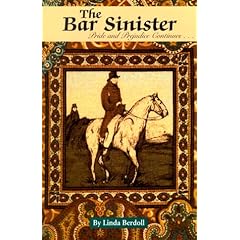
Review: The Bar Sinister by Linda Berdoll


I am a Jane Austen addict. Pride and Prejudice is my favorite book ever. And I cheerfully buy any and all sequels to it, knowing without a doubt that there's no way on the planet that they will live up to the original. But I can't help myself. I may not read them in a timely manner, as proved by this particular book which I bought years ago, never read, and only rediscovered languishing on my shelves when it was re-released a couple of years ago under a different title (which I also promptly bought and had to return) but I buy them nevertheless. After reading this, I am a little sorry about my blanket Austen sequel reading policy.

An unattributed blurb on the back tells readers to "Hang on to your bonnets, this isn't Jane Austen. Reader discretion advised." Truer words were never spoken (and I'm a veteran romance reader so graphic desciptions don't bother me but this book is completely over the top. Opening with Darcy and Elisabeth [sic] jolting down the road towards Pemberley following their wedding night, we find the new Mrs. Darcy ignoring the pillow Mr. Darcy has so kindly offered her to give her lower bits respite from their aching. And this is just the beginning. We are treated to scene after scene of our newlyweds thinking lewd thoughts about each other or engaged in vigorous romping throughout the entire estate. Somehow the plot seems tangential to all the steamy (adn quite frankly fairly laughable) sex. We are told of Darcy's discreet exploits when he was younger and see further into his character as he snubs a neighbor who legitimized his bastard son as his heir. We meet Elisabeth's sisters again and get to encounter the still slimy Wickham as he makes a pass at Elisabeth. In addition we are treated to bad guys (why didn't Austen write about a kidnapping?) and another illegitimate child about whom speculation is rife. Elisabeth has trouble getting pregnant despite the constant sex. And Darcy continues to learn that his pride is misplaced as he discovers things about his own family that disappoint him.

With as much going on in this novel as there is, the chaos and the sex aren't the things that bothered me the most. Instead it was the stilted and unintentionally hilarious writing. I know that Berdoll was trying to mimic Austen's writing but it would probably have been better to just claim her own voice instead of producing this awkwardness. In addition to this, the book was incredibly poorly edited, with sentences trailing off into nothingness or making absolutely zero sense, even after several re-readings. The characters were as static as possible, perhaps in a nod to trying to stay true to Austen's original depiction, but since so much else of the story was as Austen would never have imagined it, why bother to try and keep them slotted into their familiar molds when circumstances should have dictated growth? And even at that, some of the characters are more true to the BBC production than to the original book. I really can be forgiving of a well-done sequel, after all; who hasn't wanted to know what happened after the happily ever after wedding in P&P but this is not that sequel. Really, it's fairly egregious.

Sunday, March 1, 2009

Chunkster Challenge


I saw the Chunkster Challenge back in January but didn't get around to signing up until now, the day that sign-ups end. This last minute lateness is sort of par for the course for me right now for some reason. But at least I am squeaking in under the line in time to participate, correct?! So this challenge has multiple options and I think I'm going to go for the "Does This Book Make My Butt Look Big?" option. That means I'm committing (or perhaps it's should be committed) to reading 3-5 adult (and by that our host means grown-up, although adult content for 450 pages might be a stimulating reading experience ::giggle::) books of 450 or more pages. It's really just a shame that War and Peace, which I finally finished, won't count since I started it before January 1. Ah well! In lieu of the impressive W&P, I'll most likely be reading a selection from the following:

1. Fingersmith by Sarah Waters
2. Cloud Atlas by David Mitchell
3. Our Mutual Friend by Charles Dickens
4. Drop City by T. C. Boyle
5. The Amazing Adventures of Kavalier and Clay by Michael Chabon
6. The Makioka Sisters by Junichiro Tanizake
7. The Golden Tulip by Rosalind Laker

I could, of course, change my mind about any of the above but since I have already read Fingersmith and Cloud Atlas (I'm calling them legal since I read them after deciding I was going to do the challenge but before officially signing up) I am cookin' along with gas. Actually, if I get inspired, I might even try to level up to the next level of the challenge: Mor-book-ly Obese (6 or more books), which is why I've listed seven instead of the 3-5 towards which I'm aspiring.

Saturday, February 7, 2009

Review: Cloud Atlas by David Mitchell

What a cool concept for a book: nesting stories like Russian babushka dolls. I read a later book of Mitchell's and thoroughly enjoyed it but was still leary of this one given that I already knew that Mitchell pushed the time period of at least one (turns out it was two) of his stories into the realm of the future and I am not often happy to follow where speculative fiction leads. But this was a marvelous book that managed to keep me engaged even through the sections about which I initially worried. Mitchell takes us through the centuries and around the world in his amazingly inter-linked story novel. We start in the 1850's in the tropics reading the diary of an upstanding American notary traveling home from an assignment. The diary ends abruptly mid-sentence as we jump to letters written to a friend by a penniless English composer in the Netherlands. We leave our composer mid-story to detail a young female detective in California looking into the suspicious deaths of several people in connection with a power plant funding corporate greed and carelessness. Our detective in mortal peril, we move onto a disheartening modern day England where a small publisher fleeing the thug brothers of his most famous author is committed to an assisted living home by his brother. Onward to a Korea set in the future where bio-engineering and corporate dissimulation have reached new terrifying highs. And thence to an island in the Pacific where the remnants of civilization, starting over after an unnamed catastrophic event has almost completely decimated the human race, we come to the apex of the story. Each story ties into the previous story in inventive ways and the arc of the story, especially as it gains momentum, running back through the earlier stories and telling the tales originally left untold, is masterful. This was well worth the time I spent and once I understood and accepted the form, it moved along swimmingly.

Review: Fingersmith by Sarah Waters

I've been sitting and stewing about this review for several weeks now because I have had a hard time deciding how to review a book that has so many plot twists that it resembles nothign so much as a DNA double helix. Obviously plot summary of any length would ruin the reading experience for the three people in the world yet to read this fascinating story of two Victorian era women who prove that appearances and even perceptions can be completely deceiving. I'm sure some other reviewer before me has labelled this a tour de force and it really is so I'll just echo their rather trite sentiment. I was happily accepting of the story that our first narrator, Sue, an abandonned child whose mother was hanged for thieving and who was subsequently raised and protected from the more sordid aspects of her situation by a loose gang of petty criminals, tells us. But this is a Rashomon of novels and nothing is as it seems, with each narrator building on previous accounts, and in some cases completely and totally turning what the reader knows to be true on its head. This could have been disconcerting except that Waters handles it well and never makes the reader think that she has thrown a twist in out of the blue. We are as surprised as some of the characters as they find out the truth of their lives and who they are, different in so many ways from their original perceptions of themselves. I wouldn't call this a thriller but it is definitely suspenseful, if only because you can't wait to see what's around the next bend or laying in wait for you on the next page. This will keep you up at night, racing to finish and find out all of it, even if you are generally an early to bed person.

Popular Posts