Tuesday, August 18, 2026

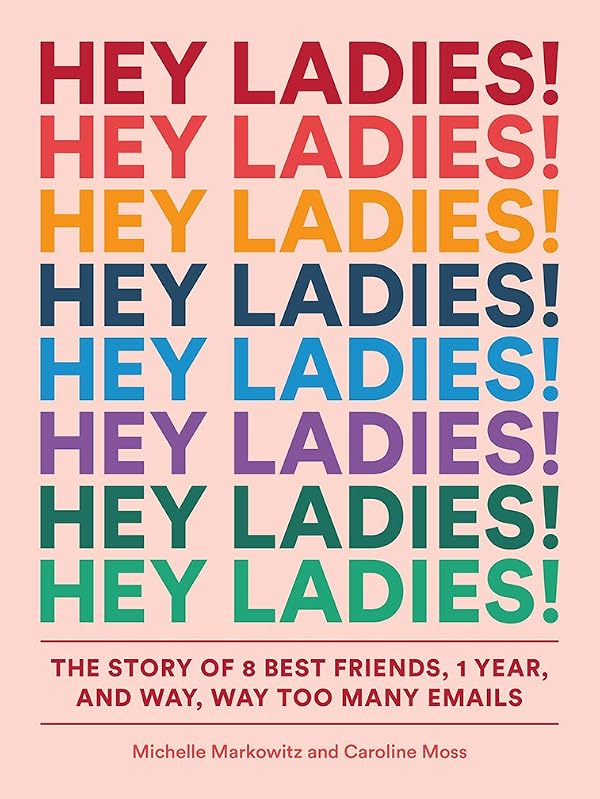
Review: Hey Ladies! by Michelle Markowitz and Caroline Moss

I love epistolary novels and I will have been mother of the bride and mother of the groom both in just over 2 years so this tale of a bride, her seven bridesmaids, and the year leading up to the wedding should have been exactly the kind of fluff and puff that I would devour right now. Instead, I hated it and forced myself to finish it. I am obviously not the age demographic (although neither are my daughter and soon to be daughter-in-law, Gen Zs that they are) but more importantly, I hope I'm not as snotty, self-centered, thoughtless, and, frankly, stupid as the characters in this book. And I certainly hope that there truly aren't women out there who are like these women, the worst one-dimensional caricatures of Millenials and bridezillas that I've come across.

Spanning a year of emails amongst a group of female friends, this novel in pieces is meant to show a humorous year of friendship, relationships, work, and general life. The emails start off with a New Years' Day message from Ali to her tribe offering up her resolutions for the year, squealing (you can practically hear it on the page) about her new boyfriend, and asking one of the group "if I go into [my new boyfriend's] bathroom and take photos of what's in his medicine cabinet, can you text your doctor friends really quick and tell me what his presciptions mean/what medical issues our potential children might have?" Clearly, I should not have persevered past this very first page. It is obviously exaggerated for comic effect, which might have been okay had it been done sparingly, but it wasn't. This made the novel unbelievable and annoying rather than funny. The women come off as dumb as stumps. Does one of them, who, incidentally, has a pretty impressive work title, actually believe that there's no wi-fi in Europe and therefore she won't be hearing from her boyfriend for the duration of his work trip? ::shudder:: In addition to coming across as airheads, these women are immature and awful. They are passive aggressive and competitive with each other. It boggles the mind why any one of them wants to be around any other one of them for any reason, never mind calling them the closest of friends, traveling together, spending obscene amounts of money on each other, and being in each others' weddings.

I would be horrified if my daughter or future daughter-in-law (or any of their friends, if I'm being honest) had any similarities with this entitled and ugly crew of women. It's hard to believe, but I did read every page of this, initially hoping it would smooth out and improve, and then in order to make sure my reaction was not outsized compared to the entirety of the story. It was not. This was not the read I hoped for. It was not cute. It was not funny. It makes complete sense that it has its origins on Twitter (and now I'm 100% skeptical of the quality of The Toast as well). Having finished this, I'm not entirely sure what to do with the physical book because I hate to to drop someone else's IQ with it or, at the very least, to doom them to such a terminally unfunny, ghastly read by putting it back out into the universe.

Tuesday, July 21, 2026

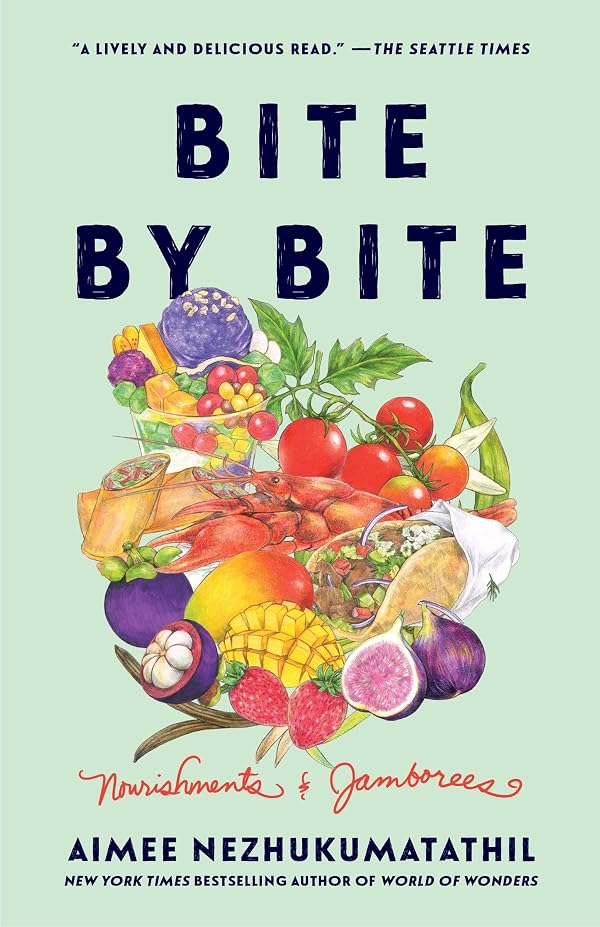
Review: Bite by Bite by Aimee Nezhukumatathil

We all need to eat. Some people experience food as necessary. Others revel in it as more, whether for the taste or the experience of eating a certain thing, or for the memories different foods inspire. Aimee Nezhukumatathil is obviously one of the latter people, as evidenced by her gorgeous collection of essays, each centered on a different food. Some of the foods she discusses are ones I've never eaten. Others are as common to my table as to hers. And each essay made me reflect on the food she was discussing, plumbing my own memories of that specific food or thinking of a food that conjures a similar response in me.

Nezhukumatathil is a beautiful writer and her turns of phrase are as delicious as the foods she's discussing. Most of the foods are just that, a singular food, not a dish or a recipe, although she does discuss where she has eaten each thing, sometimes in context of a larger dish. She weaves the histories of the foods, the people who first discovered or ate them, and the way they were dispersed around the world with very personal reflections on growing up as the American daughter of immigrant parents (a Filipina mother and an Indian father), as a young poet and teacher finding her place in the academic and literary worlds, and as a wife and mother with young, and then teenaged, children. Some of these foods are her heritage, passed down through the generations, and others are newer culinary experiences for her. There are some political moments here, usually tied to identity and to the personal, but they flow easily and organically as the essays unfold. The essays as a whole touch on the full range of emotion but center more on joy and nourishments (or as Nezhukumatathil calls them, jamborees) making this an immensely pleasurable read. Gorgeous full-page color illustrations by Fumi Nakamura show each food or drink discussed, which is helpful and interesting for readers who might be unfamiliar with certain of the foods she mentions. This is a charming, short collection any reader will enjoy consuming "bite by bite."

Wednesday, July 15, 2026

Review: Strangers by Belle Burden

When the pandemic hit in March 2020, Belle Burden, her husband of twenty years, and two of their three teenaged children retreated to their family home on the Vineyard. Their world was not only safe and insulated, but also generally happy despite the state of the world. Then Belle discovered that her husband was having an affair. Initially he said he wanted to fix their marriage. And then suddenly he didn't, walking away from Belle and their life, including their kids, as if they were strangers he'd never cared for.

This memoir is Burden coming to terms with the story of her marriage, the man she thought she knew, and the one she discovered during their divorce. That she navigated it all without any in-person support (as she refused to lean on her children in order to try and shield them from their father's seeming lack of care for them) because of the pandemic made it both harder and easier in certain ways. She discusses the way she had blithely allowed her husband to have total control of their finances, leaving her in financial ignorance of both their shared money and his own earned income. This is a cautionary tale, even as she acknowledges her great privilege (descendant of the Vanderbilts and famous socialite Babe Paley's granddaughter). Her background and her privilege though, cannot spare her the pain and suffering of the death of her marriage. She even considers whether it, in fact, contributed to the idea that she should just accept her husband's bad behavior as her due. Interestingly, she mentioned in an interview that she ran this book past him before publication and he only requested two changes, one she made and one she didn't.

The writing here is beautiful, incorporating memories of her marriage when it was good (or she thought it was), the raw pain and confusion of the divorce, and her remembrances of her parents' own brief marriage and their subsequent relationships. This is honest and thoughtful and far more grace-filled towards her ex-husband than he probably deserves. Of course, she examines him carefully, but also examines herself just as carefully to try and present as full and truthful a portrait as one of the interested parties possibly can.

Wednesday, July 8, 2026

Review: Aftertaste by Daria Lavelle

The front cover of this book asks, if you could have one last meal with someone you’ve loved and lost, would you? But this is not the sweet, heartwarming story this query might imply. It is a much harder, darker story than that.

Kostya Duhovny, the only child of Ukrainian immigrant parents, loses his father unexpectedly when he’s 10. This tragic and terrible loss changes him forever. Only months after his father’s death, Kostya has his first “aftertaste,” tasting something he hasn’t eaten, something, a dish, a meal, a drink, that brings with it the potent memory of a lost loved one. Kostya’s first “aftertaste” is a meal associated with his father. And then he starts to have “aftertastes” around other people, including perfect strangers. This gift/curse confuses, frustrates, and alarms him until it eventually mostly recedes into the framework of his life. Personally, he is adrift and floundering, working as a bartender when, one night, a patron comes in at the eleventh hour and tells Kostya to make him a drink. Kostya decides to make the drink he tastes in the “aftertaste” the man is accompanied by. Something magical happens. The “aftertaste” drink summons the man’s lost person for him and eventually a business is born for Kostya, literally invoking ghosts through memories and taste buds. Kostya’s strange talent earns him a girlfriend, a successful livelihood, and a measure of fame. But even as he gets more adept at cooking these memory dishes that conjure the dead, something more sinister is occurring beyond his notice, something that must be reckoned with, no matter what the cost.

This is a book about grief and love and the longing that death cannot conquer. The premise is unique and engaging and every time the reader thinks they know where the book is going, Lavelle turns them around. For reasons unknown to me, I feel shades of Somewhere in Time (the book, not as much the movie) here. The two books share a sensibility somehow. This book takes you on an unexpected journey, with revelation after revelation reframing the characters and the plot as you read on.

Monday, June 22, 2026

Review: The Mad Wife by Meagan Church

Lulu Mayfield is the perfect 1950s housewife. She is the neighborhood's reigning Queen of Gelatin Salads. Married for 5 years, she and her husband have a young son and Lulu has just given birth to a second baby, a daughter. She had severe post-partum depression after her first baby and is spiraling again. Her neighbors and friends are trying to keep an eye on her but they are busy with their own lives and their non-negotiable weekly schedules for shopping, cleaning, and other household tasks. When a new neighbor named Bitsy moves in, Lulu becomes obsessed with Bitsy and her family. Bitsy's husband seems controlling, their daughter is unnaturally quiet and compliant, and Bitsy herself is a little off.

This is a harrowing tale of the appalling state of health care, especially mental health care, for women in the 1950s but it has more than a few echoes today. The middle portion, as Lulu sinks further and further, is painful for the reader to witness. Given the limited third person narration focused solely on Lulu's thoughts and actions, the reader can only follow where Lulu leads, into her past on her family's farm, in her present with an overbearing and unsympathetic mother in law and an unobservant husband, and in the fixations of a mind trying to protect her amidst her unhealthy preoccupations. The ending of the book is absolutely unexpected and heart breaking.

Thursday, January 29, 2026

Review: The Cat Who Caught a Killer by L. T. Shearer

Lulu Lewis is a retired police detective who lives on a houseboat. She lost her husband unexpectedly and now spends time caring for his elderly mother, Emily, who suffers from dementia and lives in a nearby care home. Then Emily dies and Lulu finds herself investigating her death as a homicide. Just prior to Emily’s death, a large calico tomcat walks into Lulu’s life and makes himself at home on her boat. Not only is it unusual that Conrad the cat is a male calico, but astoundingly he can talk to Lulu and he accompanies her on her investigations.

If I had known there was a talking cat in this book, I likely wouldn’t have picked it up. I’m not a huge fan of anthropomorphized animals and this one didn’t really engage me any more than previous ones have. In addition to this plot point not working for me, there are a lot of small, unnecessary details scattered throughout the novel and there is some uncomfortable political commentary sprinkled in as well. Plus, the mystery is quite simplistic and easily figured out.

Wednesday, January 28, 2026

Review: Three Bags Full by Leonie Swann

Sheep who solve a murder? Yes, that is the premise of this mystery. Sounds crazy, right? It is but in a fun way.

Shepherd George Glenn cares deeply for his sheep. He even reads to them every day. His flock is very loyal to him in turn. When they find him dead in the pasture, killed by a spade, they decide that they need to figure out who killed him, using some of the knowledge they’ve gained from George reading them mysteries. The main sheep investigating the murder are Miss Maple, Othello, and Mopple the Whale. They are thoughtful and philosophical (there’s even a debate about whether human beings have souls or not) and they overhear a lot of information from the people around them. They are well drawn and have very distinct characters with their own foibles, strengths, and fears. Sometimes following the sheep’s reasoning is difficult and it’s hard to tell if that’s a translation issue or if it is meant to be written that way because, well, sheep. In general it was entertaining to be in the minds of the sheep, to watch them try to reason out the motive behind the murder, to try to understand the confounding humans, to get distracted by good grass and herbs, to try and connect the clues they’ve stumbled across, and in the end, to share their conclusion with the people who can bring the murderer to justice. The end was a little drawn out but overall it was a pleasing read.

Popular Posts