Showing posts with label Avid Reader's TBR Challenge. Show all posts

Friday, December 3, 2010

Review: Smart Girls Think Twice by Cathie Linz

Why is it that the smart girls are always the mousy, less attractive girls? Now certainly having a smart main character in a romance means that she will in the end get the guy (hope that wasn't a spoiler for any of you devoted romance readers out there) but is it necessary to always have her be outshown looks-wise by just about everyone? Why can't women be smart and beautiful? And if they are, why do they have to be insecure enough about their brains to downplay their looks by looking dowdy? Obviously I have an ax to grind over the usual portrayals of smart women and I had hoped that this book would turn that stereotype on its head. Unfortunately I was bound to be disappointed.

Our heroine Emma has come back to tiny Rock Creek, PA for both of her sisters' weddings. She is a professor of sociology at a small school in Boston and her job in academia epitomizes the publish or perish mindset. While she's in town for the weddings and playing peacemaker between her opinionated sisters and her loud and vibrant mother, she intends to capitalize professionally by researching the reasons for Rock Creek's rebirth. Examining the reasons means she needs the cooperation of newcomer Jake. He has no intentions of cooperating or allowing Emma to dig into his past and the two fence verbally whenever they see each other; and since Jake somehow ends up being pressed into service as Emma's date to the weddings, they'll see each other plenty.

The fact that the two of them are instantly attracted to each other is fine. It's a little odd though that within minutes of meeting each other for the first time both Emma and Jake fantasize about what the other would look like ready, willing, and in bed. Their chemistry comes off as more the high school obsessive lust variety than anything that would lead to a lasting relationship, the only thing missing is Emma driving by Jake's house with a friend to see if he's home. The plotline concerning Emma's research, while carried through the novel, is mostly fairly light and inconsequential as is the plotline with Emma as family mediator, the sane one if you will. An okay enough book for the most part, this is a fluffy and fairly forgettable book that does nothing towards breaking a stereotype that really gets my dander up.

Saturday, October 16, 2010

Review: The Miner's Daughter by Alice Duncan

Many years ago I read another Alice Duncan romance and I enjoyed it quite a bit. She seems to focus on period and place settings that don't saturate the book market. Having had a happy experience with that past book, I immediately searched out as many of her backlist as I could. And then they sat in Tupperware bins unread for months and then years. But I was recently inspired to dig one out and see what I thought about it now. Unfortunately I found this one far less enjoyable than the one from years ago. I don't know if my tastes have changed or if I was always destined to feel distinctly disgruntled reading this one but it was definitely a disappointment.

Mari is a young woman who is desperately trying to hold onto the mine her recently deceased father so loved. As a matter of fact, he might have loved the Marigold Mine more than he loved Mari, naming her after it rather than vice versa. But she's obstinate about her less than ideal relationship with her father and she's not about to give up on his dream and the last tangible connection she has to him. Unfortunately the mine is not producing and she's deeply in debt. Salvation comes in the form of a fledgling Hollywood movie company. They think they've located an abandoned mine to use in their silent movie but in fact it is Mari's mine. The offer of enough money to pay of her debts and continue to live on for some time is very appealing although slightly less so when director Martin Tafft insists Mari herself play the leading actress. And the offer becomes downright fraught with danger when Tony Ewing, whose sketchily-moralled father is a major financial backer of the studio, arrives on the scene, immediately clashing with Mari. As Mari and Tony bicker and strike sparks off of each other, dodgy and strange things start to happen on the set, leading to suspicions of sabotage. Mari has to trust that this buttoned up Easterner is not out to get her and Tony must understand Mari's Western pluck and determination before they can even think about the deeper meaning of their feelings for one another.

Hollywood during its infancy, silent movies and the early years of the twentieth century are certainly under-represented in historical fiction, even historical romance which by rights should recognize easily the fertile ground therein. And Duncan does indeed offer interesting tidbits about the history of the film industry and the mechanics of early movies throughout the novel. But the characters inhabiting this time are silly and stereotypical. Their dialogue is stilted and sometimes even cringe-inducing. Thankfully, Mari's dog Tiny steals the storyline with his antics whenever he is on the page. His presence helps to distract the reader from the lack of real attraction between Mari and Tony. Just having the characters muse to themselves that they are attracted to the other is not enough to convince the reader and frankly, I thought that what they really felt for each other was an irritation rather than an attraction. Now I realize that I seem to be the only person who felt this way as the amazon reviews are all glowing so perhaps romance readers should read it and draw their own conclusions. But for my money, there are other romances out there with characters who are equal in appeal to the time and place in which the story is set and that's sadly just not the case here.

Saturday, August 14, 2010

Review: South Beach Sizzle by Suzanne Weyn and Diana Gonzalez

I have a tween daughter who likes to read but isn't generally into the same books every other kiddo her age is reading. Vampires don't make her little heart go pit-a-pat. She's never been one for fantasy and book princesses (dressing as one herself as a small girl was another story entirely). She wants more reality but not those mean girl stories. Really what she wants is reality viewed comfortably through rose-colored glasses. She wants romance. I thought I'd pre-read a few books for her to see what she finds so very appealing. So this was the very first YA romance I've ever read, at least as far as I know. And I have to say that it was as cheesy and cringe-inducing as the Disney shows she's addicted to watching. But those are wildly popular too so what do I know anyway, old toad that I am.

Lula is starting college in the fall and she's convinced her mother to let her live with her father for her last summer before school starts. So she drives down to Miami with her gay best friend Jeff, discovers and forgives her father's immaturity, finds a job and an apartment, and falls for a guy who may or may not be trying to sabotage her in the local band competition. Lula's relationship with the gorgeous and distracting Enrique is completely predictable, from the doubts and tensions that pull them apart briefly to the expected denouement. And getting there didn't offer any surprises either. The character dialogue was flat and the characters themselves cliches. On the plus side, there aren't any adult situations to worry about for younger romance junkies. I didn't particularly enjoy the contrived plot and stilted writing but can't put up too many objections if my daughter wants to dip into this ultimately frothy and superficial read.

Thursday, May 27, 2010

Review: Hardly a Husband by Rebecca Hagan Lee

The third book in the Free Fellows series, this Regency-set romance tells the story of Jarrod, the fifth Marquess of Shepherdston and curate's daughter Sarah, who has had a crush on Jarrod her entire life. After Sarah's father dies, his living is given to an unpleasant man whose family thinks they can claim Sarah's possessions and use her as an unpaid governess. Lord Dunbridge, the nobleman with the power to grant the curacy, has intentionally put Sarah in this position to force her to marry him. But Sarah has other plans, fleeing to London with her aunt. She calls on Jarrod, asking him for help in becoming a courtesan, something she finds preferable to marriage with Lord Dunbridge. She has decided on this course because she refuses to marry of she can't marry the love of her life (Jarrod, of course). He, despite being completely and one hundred percent against marriage as a result of his own parents' disastrous union which scarred him deeply, finds he cannot tolerate the idea of Sarah in anyone else's arms. There is a brief and unsatisfactorily abrupt subplot between Sarah's aunt and Jarrod's godfather here as well but the bulk of the novel concentrates on the main romance. As Jarrod is a member of the Free Fellows League, there is also brief mention of his spying and his obligations to them.

This is not as well done as the previous novels in the series. The characters are not entirely believable in their decisions. Jarrod goes from not recognizing Sarah, who is described as a good childhood friend whose father taught Jarrod, to being wrapped in a pretty steamy embrace with her in a matter of minutes. Sarah, as the upstanding and moral daughter of a good man, seems to have no qualms about potentially becoming a courtesan. The sole nod to a conscience is that she didn't tell her aunt her plan, knowing that it would meet with disapproval. Not exactly the considered and difficult decision of the kind of character she's purported to be would be making. The Free Fellows League plot line felt much more forced and out of place in this novel than in the previous ones, as if it is merely a placeholder for the next to come. Over all I was disappointed in this one but those more engaged by the concept laid forth in the first two books will probably find this one to be perfectly fine.

Thursday, April 22, 2010

Review: Charming the Highlander by Janet Chapman

Grace Sutter's unmarried sister was returning to her boyfriend from Grace's house when she was in a terrible car accident. After the accident and giving birth prematurely to her tiny son, she succumbs to her injuries but not before extracting Grace's promise to return the baby to his father, the man Mary had fled before he knew she was pregnant. Grace puts her career as a rocket scientist in jeopardy to do just that despite her misgivings. And then the plane taking her back to the tiny and remote Maine village where she and her siblings grew up crashes on a mountainside. Grace and Baby survive because of the help of Greylen MacKeage.

Unbeknownst to Grace, or anyone else in the village, Greylen and his brothers are medieval Scottish warriors who have been tossed unceremoniously into the twenty-first century by a wizard eager to find and train his heir. Since Greylen is to father the babe with a modern woman, he has been brought foward in time although Greylen himself remains in ignorance of the reason. He feels an immediate connection to Grace and she to him, even before the crash. But the baby Grace claims is hers (what's a lie or two amongst destined lovers?) and with whom she is traveling will test their destined love. Baby is Mary Sutton's son by Greylen's sworn enemy Michael MacBain and she had initally fled Michael when he told her of the storm that transported him from the 1100's to present day. This fact is something that Greylen had never intended to share with anyone and that Grace thinks Michael is possibly insane because of his tale doesn't help matters. And while Greylen might admire Grace's spunk, intelligence, and drive, when she asks him to put aside his enmity to help out MacBain in return for her helping him, he is torn.

The tension between the main characters is pretty electric and although it is of the immediate, at first sight variety, the hardships that Grace and Greylen suffer together, bonding them closely, help to alleviate some of the skepticism that normally accompanies the love at first sight thing for me. I'm not a huge fan of time travel but it isn't overplayed here. I was disappointed in the dramatic, and somewhat nonsensical denouement as a result of Grace's highly charged job and the corporate secrets with which she and she alone seems to understand. That bit strained credulity even more than the time travel plot line. But overall, most romance readers who like a good Scottish warrior and fantasize about one living in the present day will appreciate this light and quick read.

Thursday, March 11, 2010

Review: Merely the Groom by Rebecca Hagan Lee

The second installment in Lee's Free Fellows League trilogy, this is the story of Colin McElreath, Lord Grantham, and Gillian Davies. The Free Fellows vowed as young boys to remain single and to serve their country above all else. And they do serve their country as spies and code breakers but they cannot escape the bonds of matrimony forever. Opening with Colin having just evaded an assassin while on assignment in Scotland, he sees the blurred outline of a woman waiting at a window in an inn no decent woman should patronize and is intrigued despite himself. When he discovers that he has unpleasant company awaiting him in his own room, he slips into the woman's room where she sleepily mistakes him for her new husband, Colin Fox. They spend a chaste few hours in bed holding each other and in the end, when Colin slips away, he leaves the woman the money to pay off the innkeeper and to return to her home, knowing that she has been abandoned.

The woman Colin thus rescued is Gillian Davies, who had run to Scotland to elope with the dashing Colin Fox. Of course, she is ruined but her family is trying to keep a lid on the scandal by claiming that she was visiting relatives in the country even while her father has engaged a Bow Street runner to investigate and find Colin Fox. The problem is that there is no such person, the name being a nom de guerre that Colin McElreath sometimes uses on his missions. And so the Bow Street runner's investigations are dangerously close to exposing important War Office work. Colin meets with Baron Davies and the runner to explain the problem and in the end, agrees to marry the ruined Gillian in order to call off the investigation despite not being the one to have ruined her. Colin needs to continue to search for the person using his alias, knowing that the man is more than just a despoiler of young women and is more than likely in league with Napoleon but he is also rather in need of the obscene amount of money that Baron Davies offers as Gillian's dowry. And while these circumstances seem as if they should make for a hostile bride and groom, they don't, with each of the characters accepting fate with equanimity.

Once this arranged marriage happens, rather than allowing a love to grow over time, our characters fall in love with unconvincing haste. Colin offers not to consummate their marriage until they know each other better, Gillian accepts with relief, and yet less than two pages later, they are all in. Apparently both of them were open books so the getting introduced phase didn't have to last even a day. In addition to this annoying trend in romances (deep abiding love based on nothing more substantial than air), Lee also has some niggling historical inaccuracies in here which will stick in the craw of sticklers. The narrative also suffers from unevenness, plodding in the beginning and warp speed in the end with no appreciable build to link the two. All in all, it's an awkward book. Since I have the third, I will be reading it to round out the series, but I'm hoping for more than I found in this one.

Saturday, February 13, 2010

Review: The Naked Duke by Sally MacKenzie


Yes, romances are fairly predictable. Yes, they follow strict conventions. Yes, they almost inevitably have a happy ending (we romance readers demand it, you know). But that is no excuse to use the most tired plot twists in what would otherwise perhaps be a decent story. In other words, I am sick to death of the bad guy kidnapping the heroine. I mean, if this sort of thing went on in the Regency as often as romance writers use it to add conflict into their novels, well, it's a miracle any young miss stayed out of the nefarious clutches of the baddies for more than an hour at a time. Please, authors, I am begging you, no more kidnappings! Constant abductions are making a mockery of the genre. Okay, with that off my chest, on to the actual book (which sadly, does indeed use the kidnapping ploy).

Sarah Hamilton has come to England upon the death of her father, intending to go to her uncle, the Earl of Westbrooke, whom she has never met. She ends up at an inn near the Westbrooke family home, without any belongings and being refused a room at the inn when she is taken under the wing of a drunken nobleman who shows her to "her" room. Exhausted from her journey, she climbs into bed, only waking in the morning to find herself in bed with the Duke of Alvord and being gawped at by quite a few people. Upon finding out who she is (and discovering that the drunken nobleman who ensconsed her in the Duke's room is her cousin, the current Earl of Westbrooke), James, the Duke offers to marry her. But Sarah is an American through and through and has republican ideas and a distinct distrust of titles and the aristocracy. She does, however, agree to be the James' houseguest and accompany his sister through her season. Meanwhile James has determined to marry her and sets himself up to court her, until his evil and nasty cousin threatens Sarah, much as he'd been threatening and actually attempting to murder James for years. So between Sarah's reluctance to marry into the hypocrisy and entitlement of the ton and James' desire to save her from his terrible cousin Richard, questions arise about whether or not the two of them will overcome the obstacles and end up together.

While parts of the storyline are fine, there are enough cliched and heavy-handed bits to detract from the overall. Cousin Richard is so angry and bitter about not being the Duke that he is completely stereotypical and not one ounce of goodness can be found in him. He enjoys sex with women only through rape and murder (and the scene that gives the reader this insight into his soul is very graphic) and has a longtime male lover through whom we are supposed, I think, to understand that he was once a decent human being whose anger has warped his soul to madness. And yet this isn't believable given his actions. Our hero, James, is nice but certainly not one to inspire heartfelt sighs. He is a virgin, certainly unlikely for a romance hero, but even this is a bit off given that he has never, until meeting Sarah, been interested in sex. He's thirty for pete's sake. And he's been completely *asexual* all that time, just waiting for the right woman to awaken his desires? Just a little far-fetched. Sarah is ridiculously wed to her notion that the aristocracy is all terrible contrary to what she witnesses and without reference to the fact that she is indeed one of the aristocracy herself as a result of being the Earl of Westbrooke's cousin. But despite her supposedly being an intelligent character, this never occurs to her at all.

Yes, there are significant problems in this romance but MacKenzie does take a darker tone than is usual in the genre and perhaps her desire to combine the darker with the lighter, more usual fare, helped to create some of these problems. As this is a debut novel, I'd be curious to see if these dichotomies and flaws are melded more seamlessly and smoothed over better in the later books in the series. I do already own the rest of the series and so will eventually read it otherwise I'd probably say that this is one I'd be more inclined to borrow from the library than anything else.

Saturday, February 6, 2010

Review: Barely a Bride by Rebecca Hagan Lee


A Regency-set historical romance featuring a marriage of convenience is nothing new. A hero who has sworn not to marry until duty forces it of him is also nothing new. A heroine who is unlike the other girls of the ton, wanting to have the freedom to pursue her own interests is, you guessed it, still nothing new. And yet Lee has managed to create a rather charming story with these common elements.

Griffin and his cronies at school formed the Free Fellows League vowing to not only stay unmarried as long as possible but to never let a wife interfere with their desire to serve their country or to worm her way into their hearts. To this effect, they drew up a contract and each signed it. Fast forward years to a short time after Griffin has accepted a commission in the Guard to go and fight Napoleon. His father, the Earl of Weymouth, demands that he marry and at least attempt to sire an heir before he goes off to be shot at. Griffin gives in to this request unwillingly but he eventually meets and appreciates Alyssa, the youngest daughter of the Earl of Carrington, who is completely uninterested in marriage and all its trappings. Alyssa just wants to be left in peace to design and care for gardens but her parents are determined to marry her off. She and Griffin have an immediate attraction. She has no objection to the idea of her new bridegroom heading off to war and he has a large neglected garden in need of rejuvenation. A match just waiting to be made. A large part of the book deals not only with the two of them getting to the altar, but also with them learning all about each other in the brief space of their two week marriage. They find that they have been serendipitous in their choice of each other both in terms of physical attraction but also in their similar thinking. And then Griffin goes off to war, experiences the horrors he never imagined, and realizes that he only wants to go home and love and be loved by his wife. But love was never in the bargain they made.

It was refreshing to read a story where the conflict between the characters was not an issue of misunderstanding or lack of communication. And although neither character wants to admit to their love for the other because of the Free Fellows' pledge (which Alyssa is not supposed to know about but does), their hearts are always obvious. The Free Fellows' League was a bit of a silly conceit but perhaps there's more substance to it in the following two books of the trilogy. Also, the charter itself was a bit sophisticated in understanding for boys of their age and would have been more likely to come from almost teens but that's a negligible complaint. I was pleased to see that the villain in this book was not a cut and dried villain and one who did not wish either the hero or heroine bodily or emotional harm and who actually turned out to be a decent guy. The fact that Lee neatly sidesteps many of the common plot devices found in Regency-set romances these days made this an enjoyable read.

Friday, December 18, 2009

Review: Christmas in Camelot by Brenda Jernigan


Arthur, Guinevere, and Lancelot are generally the central characters in Camelot stories but since we all know how badly that love triangle ends up, Jernigan has chosen to write her happily ever after about Nicholas the Dragon, knight of the Round Table not interested in Guinevere, and Lady Noelle, young woman being compelled to marry Sir Gavin, also a knight of the Round Table. Now Noelle is not thrilled with her brothers' interference in her unsuccessful search for true love and is even less pleased to discover that King Arthur himself has chosen Sir Gavin, a knight she's never met, for her. Given that Lady Noelle has a penchant for speaking her mind and doing as she wants, finding her the right match will definitely be difficult but she is convinced to at least give Sit Gavin the benefit of the doubt. And they will be married at Christmas if she finds no fault with the match. She wants to hold out for her true love and that's where Nicholas the Dragon comes in.

Nicholas survived a terrible, loveless childhood and as an adult left a trail of broken hearts in his wake, never wanting to open himself up to love and its possibilities. But he is captivated by Lady Noelle and despite the fact that she's bethrothed to one of his fellow knights, he can't stay away from her as he knows he should. The secondary plotline of Noelle's brother and the murderous knight who lays waste to her family castle seem destined to become the focus of a sequel to this book as they are not fully explored here.

While this seems like it should be a Christmas book based on the title, there's little to make it Christmas related. Noelle is to marry Gavin at Christmas if she finds him acceptable. And the women all decorate the hall, including with the requisite mistletoe. But in general, there are no Christmas traditions included or woven into the plot and the story could have as easily taken place any time of the year. Also, the narrative is very general and normal until Nicholas almost dies, at which point, Merlin, who had been absent from the story until now, is brought in and must use magic to bring Nicholas back from the dead in order to allow Noelle and her chosen knight to have their happily ever after. This is rather disruptive to the flow of the storyline and unnecessary to prove that Noelle is willing to chase after love. Over all, the story itself is all right if a bit choppy. However, not much about it really stands out. An average romance that will still appeal to Camelot romantics.

Thursday, December 3, 2009

Review: A Coventry Wedding by Becky Cochrane


Just days before she is supposed to marry her famous soap star fiance, Jandy Taylor (aka Jane Halli aka January Day Halli) postpones their wedding and leaves town to collect her thoughts. Jandy borrows her grandfather's ancient truck and starts driving east. When the truck breaks down in a rest area somewhere outside of Phoenix, she spots a tow truck and sees a man dump a dog. When she goes to rescue the dog, she meets Sam, who turns out to be the driver of the tow truck and who, after scamming her out of the dog he names Sue, agrees to drive her to Dallas by way of small, quaint Coventry, Texas. Once in Coventry, Jandy doesn't want to leave, welcomed as she is by the friendly townspeople. It doesn't hurt that once she discovers that she has been dubbed a "runaway bride" by the press, despite her fiance and mother knowing differently (no such thing as bad publicity, right?), she confides in the local hairdresser who agrees to help her hide from the public eye.

As Jandy feels more and more at home in this small town, working in a gallery, and taking pictures that capture the feel of the place during its annual Godiva Festival (as in Lady Godiva, not the chocolates), she has to examine her feelings about the people in her life who are willing to sacrifice her happiness for their benefit. She must also face her burgeoning feelings for the sweetly protective Evan and his flock of sisters.

Cochrane has done a nice job drawing the charming town of Coventry and conveying its tight protectiveness towards its own. Jandy is very conflicted and there were times I wanted to smack her for being stupid and unwilling to believe what she knew was going on in the Hollywood publicity machine. But she wasn't always in denial, which made her much more sympathetic than she could have been. There were moments of gentle humor here, like when Sam tells her the rotary beater on her truck is broken or when Sam's sister creates a new baton twirling tramp persona for Jandy to throw the media off her scent. Mostly though, this wasn't a romantic comedy. It was just straight cute and sweet. The epilogue to the story was the biggest flaw here, being rushed and unearned, negating the need to finish off the less than pleasant bit of the plotline. It was a bit of a cop-out but luckily the appeal of the rest of this contemporary romance can withstand a let down of an ending. Cozies tend to refer to mysteries but if there was such a category for romances, this would be one of the designees.

Friday, November 27, 2009

Review: Wicked Charms by Jayel Wylie


In this medieval set romance, Aiden is a knight worthy and true (or so we're told) and he is to marry the king's sister after fulfilling one last errand: taking and securing the Scottish castle of an English lord killed on the Crusades. Standing in his way is the lord's betrothed, Evelyn, and their toddler son. Evelyn has been waiting in the castle for her fiance to come back to her and when she hears he's died, she is determined that his son should have the castle as his birthright, not that an illegitimate child had any birthright. Aiden storms onto the scene arrogant and demanding, making snap judgements and riding roughshod over everyone. And he takes one look at Evelyn and decides he'll keep her around for his pleasure just as long as it suits him but that ultimately she'll have to go because she'll throw a monkey wrench in his plans to marry the princess. Evelyn, for her part, plays the tease in an effort to secure Aiden and the castle. As the two play off of each other, they uncover the pasts that have made them who they are. In Evelyn's case, she was bartered to her fairly indifferent English lord by her brother-in-law at her nasty sister's urging. She had a youth devoid of love and so it is not surprising that she doesn't recognize what she finds with Aiden until almost too late. Aiden is fighting against his wizard heritage, which he knows has always shamed his father. But Aiden and Evelyn have an indescribable connection that stems from the magic that entwines them.

Neither the hero nor the heroine were hugely appealing and the magical aspects of the story were fairly sparse until the author needed to invoke them to move the plot to crisis point, a sort of hastily constructed deus ex machina. The story of Aiden and Evelyn coming to trust each other, despite their initial cold-blooded plans for seduction solely for pleasure's sake was a much more interesting plotline than the magical history by the castle. I wasn't wowed by this one but it was a decent enough read.

Friday, November 6, 2009

Review: To Taste Temptation by Elizabeth Hoyt


Samuel Hartley is a brash and uncivilized American, raised in the wilderness, who has come to London seemingly on business but in reality to find a traitor who cost the lives of good men during the French and Indian Wars. He has moved next door to the snobbish, uber-polite, socially-inclined Lady Emeline for reasons that become more clear as the plot unfolds. As a busy businessman, he hires Emeline to chaperone his young sister through the vagaries of London society but he finds himself so attracted to Emeline that he cannot be content to leave Rebecca in her hands and just go about his investigations and business as he should. Instead he finds himself making excuses to stay close to the lovely widow.

For her part, Emeline is still grieving her brother's death and trying to raise her young son with the help of her Tante Cristelle. She has no desire to fall in love with the uncouth and unconcerned Samuel, especially as she's quite refined and such a stickler for propriety herself. And yet she finds herself so entranced by her neighbor that she can't help but tumble into a passionate affair with this infuriating man.

Hoyt has chosen to tie her story in with a legend concerning four soldiers, of whom Samuel Hartley represents the first. There are epigraphs at the head of each chapter tying the legend to the main plot. Not a literary convention I particularly like, this would perhaps have been a bit more successful for me had I enjoyed the legend itself. As it was, I found it to be a bit of an annoyance. Also, I had hoped that the villain would be exposed without the tired convention of a kidnapping invoked and yet I was disappointed in that hope. Surely there are other ways in which to put the damsel in distress so that her shining white knight can rescue his lady love. These petty complaints detracted from the story for me although I will likely read more of Hoyt's historical romances over time. Perhaps this one was just weaker than those I have heard praised so highly. And next time, I'll probably avoid this legend series as well.

Saturday, October 3, 2009

Review: The Wedding by Julie Garwood


English Lady Brenna is on her way to marry the Scot to whom her father has betrothed her when her traveling party is overtaken by painted Highlanders intent on kidnapping her. She is summarily married off to the leader of the group, Connor, whom she had last met when she was a young child and a bit of a hellion. Quickly determined to make the best of her new situation, she determines to make a decent life for herself, her new husband, and his men. Connor is reluctant to let Brenna know the full extent behind his decision to steal her and marry her and he butts heads with her with almost every decision she makes. The sparring between the two main characters does ratchet up the tension in the book and made it a bit unbelievable that the headstrong Brenna would far so quickly and completely for her rigidly controlling husband. But there is enough give and take that this is ultimately a minor quibble. The resolution of Connor obsession is widely foreshadowed in this book so the climax and ending are both not terribly surprising but Garwood gets her characters to their required places with finesse. I enjoy Scottish settings and even though the revenge motive in romances is one that generally doesn't resonate with me, this one was a pleasant enough interlude in my reading.

Saturday, August 22, 2009

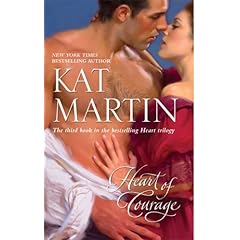
Review: Heart of Courage by Kat Martin


A murderer is stalking prostitutes in Regency England but until Lindsey's brother is accused, this doesn't touch her at all, despite the fact that she is a gossip columnist crusading for higher moral standards at a local newspaper. When her wastrel brother admits that he was with two of the women before they were killed and that he has no alibi for when they actually died, Lindsey springs into action, deciding to use her investigative skills to ferret out the real killer and exonerate her brother. But what she is getting involved in is dangerous. And so her employer and friend asks her strong, silent brother-in-law Thor to watch over Lindsey. Thor is a Viking from a northern island who has very definite ideas about the kind of woman with whom he will eventually settle down. Of course, he and Lindsey already have a relationship marked by acute awareness to each other as well as acute antagonism. Thor definitely doesn't approve of Lindsey's investigations. He thinks he's proved his point when he rescues her from an attempted rape. Not so, of course. As Lindsey comes closer to the killer, she and Thor give in to their mutual attraction but they are still not on the same path for the future. Will they get there before the killer strikes at Lindsey?

Lindsey as a character is a mix of exasperatingly stubborn and naive. She instinctively goes to bat for her brother despite not knowing him terribly well. And her insistence on making excuses for him did get a little old. Certainly she had to maintain her belief in his innocence, but it was overdone here. Thor was fairly stereotypical: strong, silent, muscle-bound, good in bed, etc. There was very little to explain why Lindsey might fall for him beyond the physical, especially as she didn't bother to get to know him before they tumbled into bed together. Just having characters ache to be in each others' arms is not enough. Perhaps the premise was overdone. Perhaps I was just in the wrong mood when I read it, but this book didn't do much for me. Overall, not one I can recommend even for readers of the genre.

Saturday, July 4, 2009

Review: The Lady Flees Her Lord by Michele Ann Young


Not exactly your typical Regency-set historical romance, this novel has a countess escaping her dissolute, abusive husband by pretending to be a soldier's widow and a penniless nobleman who was wounded in the war, both physically and emotionally. The two cross paths when Lucinda and the foundling she's adopted are found renting the dower house on Hugo, Lord Wanstead's estate. What makes this a not exactly typical novel is not that the two main characters don't fight their attractions to each other (they do), nor that they don't fall into bed together (they do), nor that they fall in love with one another (they do), nor that they each have secrets that threaten to tear them apart (they do). What makes this non-typical is that not only does Lucinda give in to her desires and sleep with Hugo, but that she does it while still married to the odious, very much alive Lord Denbigh. And furthermore, she feels no guilt over her infidelity. That's quite a departure.

But Lucinda is an unusual heroine in many ways. She is not the tiny thing that often populates romances, nor is she statuesque and willowy. Instead, she a solid woman who likes to eat, tall and Rubenesque. In running from the abusive all-around horrid Lord Denbigh, she finally asserts herself and nothing and no one, including Hugo, will ever be able to rein her in again. She has invested money carefully, giving herself something to live on and it is the fact that she paid to rent the dower house in cash that means the reclusive Hugo, impoverished as his estate is, cannot turf her out like he would prefer. Once Lucinda's good heart forces her to confront Hugo for the good of his tenants, they start developing a relationship. She pulls him out of his shell, slowly convincing him to interact with his people again. But she cannot heal the biggest hurt of all, his belief that he is responsible for both his mother and his wife's deaths. Even worse, she has led him on by not telling him that she is a married woman.

The denouement of the novel is fairly conventional despite the originally unconventional bits. But that ending is just what fans of the genre want and expect so it works. It felt a bit rushed though and Hugo as a character was never fully fleshed out, aside from his clearly mistaken sense of guilt. Young's focus seemed to be on Lucinda and drawing a heroine who would be believable to historical romance readers while still infusing her with many 21st century ideals and opinions. This mostly succeeded although witnessing Lucinda's transformation from cowed victim to strong lead could have been better developed and shown. Overall an interesting entry in the Regency-set historical romance genre.

Thursday, May 28, 2009

Review: Duke Most Wanted by Celeste Bradley


The third in the Regency set historical Heiress Bride series, I don't think I've read the first or second offerings by Bradley. In the series, grandfather Pickering has left his considerable fortune to the first of his granddaughters to marry a duke. Sisters Phoebe and Deirdre find their loves in the previous two books and with one of the men being the heir to a dukedom, it seems as if cousin Sophie has less than no chance to inherit her grandfather's fortune. But that's fine with her as she's been secretly in love with her best friend, Graham, for ages and he's just the third son with no expectations of inheriting. But fate has other plans, as Graham's father and dumb as posts brothers all die on a safari, leaving the terribly impoverished dukedom to Graham. Now he needs an heiress and while he doesn't know of Sophie's potential inheritance, she knows she is just what he needs. Of course, as Graham grapples with his inheritance, Sophie is busy being transformed from ugly duckling to swan, drawing notice from all the ton. She really only wants to captivate Graham although she won't trust even him with her deepest secrets. Can she marry him, claim the inheritance, and live happily ever after?

While this is a well-written romance, as Bradley's works generally are, I can't get over the huge plot twist she throws into the works, making the interior thoughts of one of the characters completely and patently untrue. Unless the author's intention was drawing said character as completely unhinged, believing in their own concocted story, this didn't really work. I was reading along happily, enjoying Sophie's long-suffering love for Graham and his dawning attraction (could it be love?) towards her when I was walloped in the face with this enormous twist, placed in the narrative solely to push the happily ever after out farther and to require some convoluted wrangling to make that ending still happen. I. Didn't. Appreciate. It. At. All. And not because I am averse to well done plot twists. I'm not. This one came out of thin air (one small foreshadowed comment on page one doesn't make it believable) and made the character in question completely suspect, especially since this immense twist was never acknowledged, even when the character was speaking internally. The resolution of this enormous plot twist was well done but I can't get over being rankled by its necessity. Color me grumpy but as a result, I can't wholeheartedly recommend this one.

Sunday, May 3, 2009

Review: My Fallen Angel by Pamela Britton


A paranormal Regency-set historical romance opening with a sea battle between hero Garrick Asquith-Wolf and pirate Tully St. Clair, our hero defeats the pirate but pays the price of his bold pronouncement that he is invincible as he is struck by lightning and pitched off the deck of his ship. As the reader finds out once the prologue is over, Garrick is now an angel tasked with protecting Lucy Hartford and the boy she's found and believes to be the long-lost, believed dead heir to the Earl of Selborne. Of course, keeping them safe is not going to be as easy as Garrick hopes given that Lucy is a walking disaster waiting to happen and that he is instantly attracted to her but must not touch her under the terms he's been given in heaven. This historical romance is chock full of wild, madcap adventures from kidnappings, to pirate battles, to visits from the devil and the unveiling of a scheming countess. The physical comedy can be a bit much as Lucy is incapable of doing anything gracefully or at the very least, without incident but at least it keeps the plot rocketing along. The attraction between the main characters is instantaneous (ie there's no development involved, it just is) and their fevered grapplings usually occur right before some other dramatic bit of plot bursts in and cools them down. While there are too many threads to juggle here, overall it's not a bad sort of read: fast-paced, goofy, and generally reasonably entertaining for fans of romances.

Monday, March 23, 2009

Review: Anne's Perfect Husband by Gayle Wilson


Ian Sinclair, badly wounded fighting Napolean but mostly recovered now, discovers that he has been named the guardian of the young daughter of the man who was the cause of his war injury. He plans to have nothing to do with the child since she is safely tucked away at school up north until he has an attack of conscience thinking of an abandoned waif spending Christmas alone at school. Imagine his surprise when he discovers that his ward is not a child and that he has somehow given his word to take her off and try to give her the life that her father's peripatetic military career and non-military inspired neglect never granted her. Anne Darlington, for her part, isn't sure she wants to have a London season unless she can convince Ian that the only man for her is him. As Ian is trying to keep Anne's father's cowardice and callousness from his child, he is trying to keep her at arm's length as well. An interesting take on the concept of "the sins of the father" and "the child of mine enemy," this is, of course, a romance and so such old chestnuts will be overcome by true love. Anne's attachment to Ian seems fairly sudden and without enough evidence while Ian's love for Anne is shown growing over the course of the story. Perhaps this is because the reader can see him struggle with his feelings, but it made for more interesting reading than Anne just declaring to herself out of the blue that if she can't have Ian, she'd go back to school and take up the teaching post offered to her. So half satisfying, this could have used a bit more fleshing out.

Saturday, March 14, 2009

Review: The Lost Duke of Wyndham by Julia Quinn

When highwayman Jack Audley stops a coach to rob the occupants, he has little idea of how his life and that of everyone connected to the people in the carriage is going to change because he is robbing the Dowager Duchess of Wyndham and her companion, the impoverished gentlewoman, Grace Eversleigh. He is fascinated by Grace after the robbery and unreasonably bothered by the fact that the Dowager thinks he is the child of her much beloved middle son. He vows to leave the area without pursuing any of the things that are troubling him but he hasn't reckoned on the strength of will to be found in his presumptive grandmother, who has him kidnapped and brought to her. There he finds the intriguing and long-suffering Grace as well as the current Duke of Wyndham, who will lose his title if Jack's birth is proved to be legitimate. As the mystery of whether or not he is the actual Duke unfolds, Jack and Grace fall in love. A smaller subplot between Thomas, the current Duke of Wyndham, who stands to lose everything if Jack is proven legitimate, and Amelia, the woman he's been bethrothed to since childhood is left unresolved and is the focus of the second Wyndham book.

I generally like Julia Quinn's regency set romances and this was no exception. They are light and fun and good escapism. The obstacles her heros and heroines have to overcome to be together don't cross the line into the realm of the impossible and like Jack and Grace, in this book, they have good chemistry together. I do wish that the ubiquitous "immediate attraction" thing would fall by the wayside because I am skeptical of a touch from a stranger being burned into your consciousness but that's a fairly minor quibble here and one that, in any case, seems to be standard for the genre regardless of my personal preferences. Overall, exactly the read I wanted and was expecting here.

Wednesday, February 11, 2009

Review: The Viscount's Bride by Ann Elizabeth Cree

A Regency-set historical romance, this book is fairly substantially different than the back cover copy describes. I only mention this because I think other readers, like me, expect books to have more than a passing resemblance to their jacket copy and this one comes perilously close to nto doing so. It is also a sequel, although that is not noted on the book and a lack of knowledge of the previous story did leave me at a bit of a disadvantage, although as is the case with most romances written today, it stood alone well enough aside from a few references to backstory. This is the story of Chloe, who is visiting her late brother's wife and her new husband at teh same time Brandt, Lord Salcombe, her chief nemesis. She spends much of her time during the visit either sparring a little peevishly with Brandt or trying to determine if the local lord, who is a safe and friendly sort, is the man for her. When Chloe's guardian writes to tell her of his plans to marry her off to a disgusting, old reprobate, Chloe decides that the time has come to force Sir Preston's hand and she manages to find herself in a compromising situation with him, not that any sparks fly or that anything untoward happens. At this point a whole comedy of errors ensues, leading to Chloe's engagement not to Sir Preston but to Brandt, Lord Salcombe, who might turn out to be the perfect man for her in the end. The story is a light and fluffy bit of fleeting entertainment that didn't turn out to be terribly memorable as I had to flip back through the book in order to write this review. I didn't love the immature heroine who went from self-involved to consciously caring of others' feelings in the space of a paragraph and I wondered at the chemistry between the main characters. Not the best romance I've read but not the worst either.

Popular Posts