Wednesday, February 26, 2014

Waiting on Wednesday

This meme is hosted by Breaking the Spine and is meant to highlight some great pre-publication books we all can't wait to get our grubby little mitts on.

My Wish List by Gregoire Delacourt. The book is being released by Penguin on March 25, 2014.

Amazon says this about the book: The #1 bestselling international phenomenon that asks, If you won the lottery, would you trade your life for the life of your dreams?

Jocelyne lives in a small town in France where she runs a fabric shop, has been married to the same man for twenty-one years, and has raised two children. She is beginning to wonder what happened to all those dreams she had when she was seventeen. Could her life have been different?

Then she wins the lottery—and suddenly finds the world at her fingertips. But she chooses not to tell anyone, not even her husband—not just yet. Without cashing the check, she begins to make a list of all the things she could do with the money. But does Jocelyne really want her life to change?

Tuesday, February 25, 2014

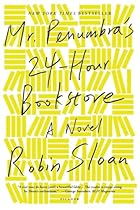
Review: Mr. Penumbra's 24-Hour Bookstore by Robin Sloan

It wouldn't take a genius to be able to peg my reading interests, even when I feel like I am going off script. Secret society, conspiracy, code breaking, computers and technology. All of these things would generally leave me cold. But take them and set the story in a bookstore. Oh boy! When can I read it? Can I read it now? I held out longer than usual with Robin Sloan's Mr. Penumbra's 24-Hour Bookstore but eventually the bookstore angle pulled me in (and I convinced my book club to read it so I would definitely get to it). And I am so glad it did because despite the tech angle to it, there is a reverence for old fashioned books and their continuing place in our world that is simply enchanting.

Clay Jannon lost his job when the San Francisco bagel company for whom he did marketing and web design went under. He had no idea that his next job would be so very different than what he was used to but on his ramblings through the city, he stumbled on a tall, narrow bookstore whose window had a Help Wanted sign in it. Mr. Penumbra's 24-Hour Bookstore was nothing like any bookstore Clay had ever experienced before and he was fairly certain that it was a front for something else. After all, it sold almost no books, ever. Even adjusting for the fact that Clay staffed the store overnight, they sold next to nothing. And then there were the strange older people who came in and borrowed books from the store. Borrowed, not bought. And the books themselves were strange; aside from a few shelves at the front of the store with regular books, the books for borrow were unreadable. Without much to occupy himself, Clay decides to try and see if he can uncover the mystery of the books and the people who are slowly working their way through them. He uses his computer and modeling programs and what he and his friends uncover is just the beginning.

The beauty of this story is that it isn't really all that far fetched. It's not fantasy or set in a future world. It is now and it acknowledges and celebrates the interconnectedness of the long enduring technologies of the past and the rapidly changing technologies of right now. It is a paean to the possibilities of the future and the vast reaches to which our own human imaginations can push the machines we have but without declaring the premature death of the things that have given us joy and information for centuries. And in the end, the novel holds up human genius as the ultimate thing. Like Kat, the enthusiastic Google employee, we project into the future carried along by our passions to discover and to invent but we not only pay homage to the past, we integrate it into our future, cherishing it, if only for the pleasure it brings. We are indeed a very online world anymore but that is not all we are and as this book suggests, there's much benefit to disconnecting and to seeing technology as only one tool among many in our happy lives. Immortality, however you define it, may be the end goal for each individual person, but there are many, many valid permutations of it and even more ways to find it.

Reading this novel is easy and smooth. There are some awfully convenient bits and an unbelievable scene or two but over all, this is well done without the need for pyrotechnics or outlandish situations. It is very much a book of our time right now and might come to feel dated but in this very immediacy, it captures beautifully the dichotomy of old knowledge (books) and new knowledge(computers) at a historically significant crossroads. Will the new overtake and snuff out the old? Or will they be able to coexist, and even if we don't have Google or certain computer programs or apps ten years from now, we will still look back to these years as those that determined the course of our path to knowledge and human ingenuity, making the story more timeless than its pop culture references might suggest. The mystery of the purpose of the bookstore and the unveiling of the final answer drives the story, pleasantly sweeping the reader through its pages. If a tale so heavily dependent on technology can capture me, an avowed Luddite, it should appeal to anyone who loves and cherishes books. And the final, lovely line of the book is sure to resonate with all readers everywhere.

Monday, February 24, 2014

It's Monday! What Are You Reading?

This past week was a difficult one. I wasn't doing much reading at all for whatever reason. And then my grandmother died. And I couldn't do anything but read because it kept me from having to think about the new and permanent hole in my life. It does seem however, as if every book I picked up to read this week (and even the ones that came in the mail) all had death in them to a greater or lesser extent. Not fair. Not fair at all. This meme is hosted by Sheila at Book Journey.

Books I completed this past week are:

Fallen Beauty by Erika Robuck
The House of Memories by Monica McInerney
Eyestone by D. R. MacDonald
Mister Owita's Guide to Gardening by Carol Wall
The Pleasures of Autumn by Evie Hunter

Bookmarks are still living in the middle of:

Quiet by Susan Cain
Clever Girl by Tessa Hadley

Reviews posted this week:

The Taste of Apple Seeds by Katharina Hagena
Under the Wide and Starry Sky by Nancy Horan
Fallen Beauty by Erika Robuck

Books still needing to have reviews written (as opposed to the ones that are simply awaiting posting):

Mr. Penumbra's 24-Hour Bookstore by Robin Sloan
The House of Memories by Monica McInerney
Eyestone by Dr. R. MacDonald
Mister Owita's Guide to Gardening by Carol Wall
The Pleasures of Autumn by Evie Hunter

Monday Mailbox

This week's mailbox arrivals:

Mister Owita's Guide to Gardening by Carol Wall came from LibraryThing Early Reviewers.

A memoir about a white woman who hired an African man to tend her yard and ended up with a friend, this sounds lovely.

Bread and Butter by Michelle Wildgen came from Doubleday.

A novel about food and family, rivalry and change, this one sounds completely delicious.

Animal Madness by Laurel Braitman came from Simon and Schuster.

How fascinating to look into the ways we try to cure animals of the same sorts of mental illnesses we get.

The Dead Wife's Handbook by Hannah Beckerman came from Penguin.

A novel about a woman who died a year ago and finds that she can't let go of the family she left behind, even if it is painful to see them moving on without her, this sounds emotional and poignant and heart breaking but also good.

Delicious by Ruth Reichl came from Random House and TLC Book Tours for a blog tour.

I've drooled over her memoirs so I am anxious to see what she does with a novel.

If you'd like to see the marvelous goodies in other people's mailboxes, make sure to visit Mailbox Monday and have fun seeing how we are all doing our part to keep the USPS and delivery services viable.

Sunday, February 23, 2014

In memorium for my lovely, gentle grandmother

Eleanor Schweikert 4/9/1920-2/20/2014

I didn't want to write this post but I find I can't write anything else without acknowledging the terrible gut wrenching loss of my beloved grandmother this week. I didn't expect to lose her. I know; that's a ridiculous statement. She's been frail for years. She was more than 50 years older than I am and I'm no longer any spring chicken myself. So the fact that I am stunned that she is gone is completely irrational. I know that. And yet... And yet...

I have been obsessively looking around the internet for poems to help ease the grief. Because words help heal, right? Only they don't. She's gone and I don't want her to be a ship sailing out of sight, or a rose growing on the other side of the wall, or any number of lovely nature images. I do not want to miss her and let her go. I just want her to be here, no matter how selfish that is. She's in a better place. But I don't care. I just want her here. Not there. Here.

These are things I know: I was very lucky to have my grandmother in my life for so long; and my children were lucky too, to know their great grandmother so well. Of course, she had already lived a lifetime before we came along and we didn't know that person. I didn't know her as a child, a young woman, or a new mother. I only knew her as my grandmother, the presence of pure, unconditional love.

She was the one who sat and fed the goldfish in the pond with me. She was the one who brushed dead leaves away from a tree trunk in the woods to show me the purple of new spring violets. With my grandfather, she was the one who taught me to swim out in front of the cottage. She was the one who showed me the hidden space beneath the branches of the towering stand of pines in the side yard that was perfect for a child and her imagination. She gave big hugs that often hurt because she'd forget that her glasses were on a chain around her neck and they'd inevitably poke you in the chest. Actually, she lost her glasses all the time, finding them perched on top of her head or on that chain but dangling down her back instead of her front. She made tapioca pudding for us. I love tapioca pudding. Her macaroni and cheese casserole can't be beat. She loved chocolate. And peanut butter. And she was the first person to teach me to eat peanut butter on a spoon straight from the jar. She sometimes left things so long in her fridge that they were fuzzy and unrecognizable when they were finally pulled out. She read a lot. She picked books off of her own shelves for me to read and took me to the library, encouraging my habit. She loved dogs, especially the one she permanently borrowed from my parents. She fed birds and tried to outwit squirrels. She hugged teddy bears. She loved tiny, decorative, little trinket boxes. She cherished my children. She danced with my oldest son in his Johnny-Jump-Up. She let my stand-offish child, the one who inherited her curls, warm up to her great-grandmother on her own terms. She was thrilled when this same child did what I did as a baby in her arms, giggling as she tugged on her great-grandmother's curls. She read the same book over and over and over again to my youngest, never tiring of it and always looking at him with a special sparkle in her eye. She was incredibly caring, working for decades as a hospital volunteer. She was a member of the Women's Power Squadron and could strip down an engine and drive a boat. She built stone walls and transplanted snow on the mountain and wore great straw hats. She personified grace and loyalty and love. She was beautiful inside and out. If I wrote for a hundred years, I could never capture everything that she was and I am, without the shadow of a doubt, the poorer for her loss.

For a couple of years when I was small, we lived near to my grandparents and on weekends we would hike nature trails as a family with my grandmother sometimes joining us. One of those years we lived close, when I couldn't have been any older than 9, I had a school assignment that must have been something like "What I Did on My Summer Vacation" and I wrote about our hiking. The final line told the reader that all of us had hiked the whole trail, "even my old grandma." I'm so very grateful that "my old grandma" had so many more years after that with me, years in which to truly grow old. And although I know that hiking with me was decades in her past and that she's now reunited with my grandfather and her parents and all those who went before her and who loved her long before I did, I would give anything for one more hike, one more hug, one more word with my old grandma.

I will love and miss you forever, Eny.

Saturday, February 22, 2014

Review and Giveaway: Fallen Beauty by Erika Robuck

What could be more fitting on Pulitzer Prize winning poet Edna St. Vincent Millay's 122nd birthday than a book about the poet herself and the young woman who so understood the heart of Millay's poetry that she created the exquisite costumes that Millay wore on her readings around the country.

It's 1928, the middle of Prohibition, the Roaring Twenties and the era of flappers, a seemingly wild and giddy time where licentiousness laughs and thumbs its nose against the strict convention and staid morals of much of the era. Laura Kelley is just nineteen. She works in the dress shop that her parents started in the sleepy little town of Austerlitz, NY. She's generally a good daughter, but she has one secret. She's in love with a man she cannot have. And as the novel opens, she sneaks out of the home she shares with her widower father and her younger sister to meet this man and to see the scandalous Ziegfeld Follies. The evening is magical and Laura is swept up in it.  But it has repercussions that last forever.

Edna St. Vincent Millay, who preferred to be called Vincent, is living nearby to Austerlitz at Steepletop House. Neither she nor her husband cares to hide the parties and debauchery that take place there from the judgmental town, bringing friends and lovers to their mountaintop retreat as often as the muse requires. Vincent is in search of a new lover who will inspire her words and enflame her body. She finds such a lover in a young poet named George Dillon but he is neither as compliant nor as accommodating to the famous poet as her previous lovers have been.

A couple of years further on in the midst of the Great Depression, Laura is struggling to support her daughter in the dress shop and is still keeping the baby's father's name secret. She has retreated from the town as much as the town has branded her for her indiscretion. Vincent glimpses Laura on the day that her sister marries. She is standing to the side of the bride and groom with a lonely and melancholy expression on her face and she captures the imagination of the poet, who is still struggling with her lover's intransigence. Eventually introduced to Laura's sister Marie and her husband, Everette, a rising politician, Millay invites them to Steepletop to one of her famous parties where she intentionally entices Everette into her bed, an invitation he does not refuse. And with this action, she forges a bond between herself and Laura, one built on anger and loyalty but also ultimately desperation and creative desire.

Robuck has drawn Millay as a sensuous, extravagant, demanding woman. She lives a bohemian life without care for the mores of society but she feels deeply and is easily wounded. She loves with her whole heart but can be unthinking and capriciously cruel. She is a study in opposites. Laura, on the other hand, is a mostly conventional woman whose only transgression ends up defining her. She dreams of more but is bound first by the opinion of the town and then by her loyalty and love for her family, so she pushes that dream down under the more prosaic need to feed and clothe herself and her daughter. Her capacity for love is boundless but she has been damaged by her secret lover's silent disavowal of her and their daughter, losing the ability to trust openly and learning to fear the withholding of forgiveness.

Robuck has taken two very different, and yet in some ways similar, "fallen beauties" whose lives intersected in interesting ways and contrasted them with each other. Even the structure of the novel reflects that contrast, narrated in the first person first by Laura and then by Vincent in each chapter. This gives the reader insight into what drives each character and how they view not only their own lives but those of the people around them. And it showcases both the cost of convention and the cost of creative freedom. Robuck has done a good job of describing and detailing what it cost women in particular to live in the 1920s and 30s. She's created a surprisingly sympathetic portrait of Millay, who despite her oftentimes selfish and unthinking excesses flouting society's tight rules, was actually a fragile and emotionally insecure genius who craved love and devotion. Although each woman's back story was necessary, especially to show Laura's fierce determination to avoid Millay and then extreme reluctance to do as bidden despite her desperate financial straits, in terms of narrative pace, it took too long for the women to meet. Once they did though, the pacing picked up and although the reader knew that Laura must eventually ignore her scruples and make the luscious creations asked of her, the tension of the interactions between Laura and Vincent and how their relationship would eventually play out was compelling. A tale of creativity, redemption, and convention, readers intrigued by Millay and her scandalous lifestyle as well as those who are fascinated by the cost that society extracts on those who ignore its rules will quite enjoy this historical fiction.

For more information about Erika Robuck and the book, check out her website, her Facebook page, follow her on Twitter, take a look at her historical fiction blog, Muse, or read her contributions to the fiction blog Writer Unboxed. And look at the amazon reviews for others' thoughts and opinions on the book.


Would you like to win your very own copy of this book?

a Rafflecopter giveaway

Please be sure to check out the other stops on the blog tour for more reviews and additional chances to enter to win a giveaway copy of Fallen Beauty:

February 17: A Patchwork of Books and Maurice On Books
February 18: Jenn’s Bookshelves, Burton Book Review, and Leah's Thoughts
February 19: Great New Books
February 20: Chick Lit Plus and Girls Just Reading
February 21: Book Dilettante, Chefdruck: French, and Bookfoolery
February 22: Entertainment Realm and Two Classy Chics
February 24: Laura's Review Bookshelf and Crystal Book Reviews
February 25: Literally Jen and Confessions of a Book Addict
February 26: Literate Housewife and LitChat
February 27: Anita Loves Books, To Read or Not To Read, and Kayla's Reads and Reviews
February 28: Silver's Reviews, A Novel Review, and The Write Teacher(s)
March 3: Alison's Book Marks
March 4: Biblio File, Sincerely Stacie, Minding Spot, and Bookalicious Mama
March 5: Teresa's Reading Corner, Book Addict Katie, and So Many Precious Books, So Little Time
March 6: Entomology of a Bookworm, Steph The Bookworm, and Kritters Ramblings
March 7: My 5 Monkeys and Traveling With T

Thanks to Courtney from Berkley/NAL for sending me a copy of the book for review.

Thursday, February 20, 2014

Review: Under the Wide and Starry Sky by Nancy Horan

I read Treasure Island as a child and was completely captivated by it. It was a magnificent adventure tale that fired my imagination. And although I didn't search out much about author Robert Louis Stevenson's life, somehow it entered my knowledge base that he had traveled extensively, eventually dying and being buried on a mountain in Samoa under an inscription of his own writing. More thrillingly romantic information. So when I heard about Nancy Horan's fictionalized tale of Stevenson and his American wife, Fanny's life together, I couldn't resist the chance to learn more about this intriguing man and the woman he loved.

Opening in 1875 before the married Fanny Osbourne met the younger, aspiring novelist Robert Louis Stevenson, the novel delves deeply into Fanny's life and her relationship with the man who would become her second husband. Fanny Osbourne fled California to escape the soul destroying cheating and philandering of her first husband, taking her three children to Antwerp so that she and her daughter, Belle, could study art and so that they could all start a new life. But the prejudices of the time thwarted her artistic dreams and then, more tragically, young Hervey Osbourne sickened with TB and died. It was when Fanny took her surviving children, Belle and Sammy, to the French countryside in an effort to recover from the grief and strain of Hervey's long death that she met a rowdy and engaging group of artists and writers, one of whom was the Scotsman, Robert Louis Stevenson.

Louis Stevenson fell for Fanny immediately but she was more reserved about this young man more than ten years her junior in age and even younger than that in experience. Eventually she fell for him as well though, first embarking on an affair with him, and then after a failed attempt at reconciliation with her husband, obtaining a divorce in order to marry Louis. Their marriage was a peripatetic one as they traveled around trying to find the perfect atmosphere for the sickly and often deathly ill Louis.  Fanny, a vibrant, strong, and artistic woman herself, repressed many of her own wants and needs in caring for her fragile, talented husband. She repressed her own artistic ambitions to nursemaid Louis, often serving as his best, first reader and muse as well as ensuring his bodily health. They were not without conflict and stress in their relationship though. Louis's casual and cruel dismissal of Fanny's talent, her sometimes volatile conflicts with his friends, and their always looming financial difficulties caused discord and disharmony between them.

The story focuses mainly on Fanny; she is the character most alive on the page. Her famed husband is mostly seen through her eyes and oftentimes comes across as a particularly obstinate child. The story of their life and their travels is comprehensive but perhaps because there was so much time and ground to cover, the tale dragged in places and yet skimmed lightly through other times that seem like they should have carried more weight. Horan has captured the alternating tension and loving care between Fanny and Louis that was evident throughout the story and the ending is as heart breaking as Stevenson's epitaph has always made it seem. But I still missed the high emotion and gripping narration that I expected. And maybe that's unfair since this is a book about Fanny and Louis and not one of his riveting own tales. If it didn't quite satisfy completely, I did appreciate learning more about Stevenson's life and the woman who completed it.

For more information about Nancy Horan and the book, check out her website, her Facebook page, or take a look at her Pinterest boards. Follow the rest of the blog tour or look at the amazon reviews for others' thoughts and opinions on the book.

Thanks to Lisa from TLC Book Tours and the publisher for sending me a copy of the book for review.

Popular Posts