Wednesday, April 10, 2013

Review: The J.M. Barrie Ladies' Swimming Society by Barbara J. Zitwer

Are you the same person now that you were five years ago? Ten? Fifteen? Twenty? We all change and adapt over time and sometimes that means that we are very different than we once were. But what happens to a life long friendship when each of the friends has changed? Is it something to fight for or is it something to let go of, holding only memories of the past? These questions and more are at the heart of Barbara Zitwer's charming new novel The J.M. Barrie Ladies' Swimming Society.

Joey Rubin is an architect who rarely gets full or even some credit for the phenomenal work that she does, putting in crazy hours and sacrificing any semblence of a personal life for her job. Her last relationship was with a coworker who wanted to keep their relationship a secret and she's drifted away from all of her friends. She is truly the definition of a workaholic but one who never gets the glory, entirely a behind the scenes workaholic. So when her boss is injured in an accident and Joey has to run the presentation on converting Stanway House in England, the lovely estate where J.M. Barrie wrote Peter Pan, into a hotel, a presentation on which she's done most of the work, she is a nervous wreck. But she hits it out of the park with her homage to Barrie and her ideas merging preservation and improvement and she is tapped to go to England to oversee the initial stages of the conversion, a trip that not only gives her the chance to live in a place instrumental in the writing of her favorite book but also to visit with her childhood best friend now living in England.

When Joey arrives in England, she reconnects with Sarah and finds herself surprised at how different the two of them are from the once inseparable, closer than sisters friends they used to be. She is a dedicated career woman while Sarah has settled into chaotic domesticity. They just don't seem to speak the same language anymore. And when Joey goes out to Stanway House to start her project and encounters a group of elderly ladies swimming in a freezing cold pond in the middle of winter, through her connection with them and their example of lifelong friendship and the work behind it, she will come to realize that it isn't her differences from Sarah or their physical distance from each other but her isolation and lack of care in maintaining their relationship that has caused her to forget how to be a friend. With the help of Aggie, Meg, Gala, Viv, and Lilia of the J.M. Barrie Ladies' Swimming Society, Joey will not only plunge into the waters of the pond, but she will plunge back into life, with all the connection, messiness, and relationship work that it implies.  Ultimately, Joey's trip to England refreshes and renews her. It gives her confidence in herself. And it helps her achieve a better, more satisfying balance between the personal and professional, teaching her the importance of relationships.  Maybe she'll even open herself up to the possibilities with Ian, the dour Stanway House caretaker.

This is a truly lovely book about women's friendships. It is lighthearted and enjoyable but it doesn't shy away from the truth that a real friendship, one worth holding on to, takes work, hits bumps in the road, and faces roadblocks but is ultimately worth it for the love and support and vital connection that it provides. The characters are all quirky and delightful. Joey can be a bit irritatingly obtuse at times but that just makes her realistic.  The love story woven through the plot and complicated by her burgeoning friendships with the elderly ladies is a bit abrupt but in this novel's Neverland, it is the love between friends rather than romantic love that is really the main focus. An escapist read, fans of women's fiction will thoroughly enjoy this gentle and appealing novel.

Thanks to the author for sending me a copy of the book for review.

Waiting on Wednesday

This meme is hosted by Breaking the Spine and is meant to highlight some great pre-publication books we all can't wait to get our grubby little mitts on.

Someday, Someday, Maybe by Lauren Graham. The book is being released by Ballantine Books on April 30, 2013.

Amazon says this about the book: From Lauren Graham, the beloved star of Gilmore Girls and Parenthood, comes a witty, charming, and hilariously relatable debut novel about a struggling young actress trying to get ahead―and keep it together―in New York City.

It’s January 1995, and Franny Banks has just six months left of the three-year deadline she set for herself when she came to New York, dreaming of Broadway and doing “important” work. But all she has to show for her efforts so far is a part in an ad for ugly Christmas sweaters, and a gig waiting tables at a comedy club. Her roommates―her best friend Jane, and Dan, an aspiring sci-fi writer―are supportive, yet Franny knows a two-person fan club doesn’t exactly count as success. Everyone tells her she needs a backup plan, and though she can almost picture moving back home and settling down with her perfectly nice ex-boyfriend, she’s not ready to give up on her goal of having a career like her idols Diane Keaton and Meryl Streep. Not just yet. But while she dreams of filling their shoes, in the meantime, she’d happily settle for a speaking part in almost anything—and finding a hair product combination that works.

Everything is riding on the upcoming showcase for her acting class, where she’ll finally have a chance to perform for people who could actually hire her. And she can’t let herself be distracted by James Franklin, a notorious flirt and the most successful actor in her class, even though he’s suddenly started paying attention. Meanwhile, her bank account is rapidly dwindling, her father wants her to come home, and her agent doesn’t return her calls. But for some reason, she keeps believing that she just might get what she came for.

Someday, Someday, Maybe is a story about hopes and dreams, being young in a city, and wanting something deeply, madly, desperately. It’s about finding love, finding yourself, and perhaps most difficult of all in New York City, finding an acting job.

Monday, April 8, 2013

It's Monday! What Are You Reading?

I was having a pretty good week all the way around what with the kids on spring break and few commitments to do anything. It was a little bit blissful. And then I fell and split my head open. Stitches, aches, and pain killers later, the week ended on a less than upbeat note. :-P This meme is hosted by Sheila at Book Journey.

Books I completed this past week are:

Paris in Love by Eloisa James
The House at the End of Hope Street by Menna van Praag
Beautiful Ruins by Jess Walter
Ghost Moth by Michele Forbes

Bookmarks are still living in the middle of:

Better Than Fiction edited by Don George
The Mermaid of Brooklyn by Amy Shearn

Reviews posted this week:

And Then She Fell by Stephanie Laurens
Vaclav and Lena by Haley Tanner
Sacred Hearts by Sarah Dunant

Books still needing to have reviews written (as opposed to the ones that are simply awaiting posting):

The J.M. Barrie Ladies' Swimming Society by Barbara Zitwer
Life After Life by Jill McCorkle
Paris in Love by Eloisa James
The House at the End of Hope Street by Menna van Praag
Beautiful Ruins by Jess Walter
Ghost Moth by Michele Forbes

Monday Mailbox

Some books I expect and others are exciting surprises. This week was a week of exciting surprises and I couldn't be happier. This past week's mailbox arrivals:

The Butternut Tree by Maureen Richards Kostalnick came from Meryl Moss Media Relations.

A child judged by their small Ohio town for her mother's perceived sins vows to live a different life. This sounds like it could be heartbreaking.

Z: A Novel of Zelda Fitzgerald by Therese Anne Fowler came from St. Martin's Press.

Since my dogs' names are Daisy and Gatsby, I might have a bit of a Fitzgerald obsession. And Zelda is such an enticing figure!

The Book fo Someday by Dianne Dixon came from Sourcebooks.

Three women connected by a mystery, each about to face something that will change the course of their lives, this sounds terrific and intriguing.

The One-Way Bridge by Cathie Pelletier came from Sourcebooks.

Strife, petty and large, in a small town in Maine, written by the incomparable Pelletier, could this get any more appealing?

If you'd like to see the marvelous goodies in other people's mailboxes, make sure to visit MariReads as she is hosting this month's Mailbox Monday and have fun seeing how we are all doing our part to keep the USPS and delivery services viable.

Sunday, April 7, 2013

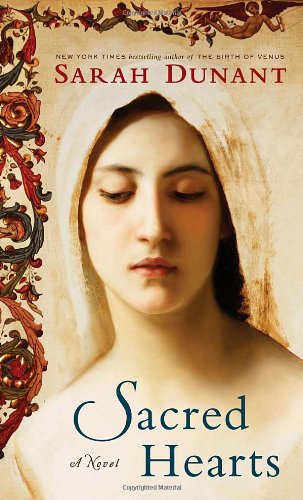
Review: Sacred Hearts by Sarah Dunant

The church was long considered a profession rather than a calling and those who entered into service to it were not necessarily called there by God or because of their piety and spirituality. And although this was true for men, especially those who were not likely to inherit from their fathers, it was doubly true for women, sent off to a convent for a multitude of reasons that had nothing to do with religion. Even Shakespeare wrote "Get thee to a nunnery" in Hamlet, when Hamlet exhorts Ophelia to give up thoughts of marrying him. And for many young women without marriage prospects, those who had sinned against society's mores, the not quite mentally intact, the physically imperfect, and those whose families didn't have the funds or inclination to offer them a dowry, the nunnery was in fact where they ended up, often times against their will. In Sarah Dunant's novel Sacred Hearts, Serafina, the newest novice in Santa Caterina, rages against her fate, incarcerated by her family, forever punished for her "crime," trapped and desperate.  Unlike many of the others who have unwillingly gone before her though, she is combustible and wily enough to affect the convent and all who live within its walls even as the convent faces the changes and tightening up within the church that governs it.

Told from two perspectives, that of the angry and bitter novice Serafina and the calm and soothing Suora Zuana, the dispensary mistress, this novel charts the course of a very young woman fighting tooth and nail against her family's draconian but completely acceptable solution to her disobedience. There are various reasons the young novice ended up at Santa Caterina outside the city of Ferrara rather than closer to home, not least of which is that she has the voice of an angel and this particular convent is famed for its singing and performances. But she fights so hard when she first arrives that Zuana must be called to calm her through herbal intervention. Despite herself, this learned Sister is fascinated by the strength and vehemence she finds in Serafina's resistance to her unequivocal fate and her faith that she can in fact escape the life to which she's been doomed.

Assigned to assist Suora Zuana in the dispensary until she regains her voice after her screaming fits, Serafina shows quick intelligence, skill, and a facility for observation that all suggest she has an impressive and agile mind. And that fact alone makes her determined rebellion that much more dangerous to the already fracturing equilibrium inside the cloister's thick walls. As Zuana comes to know Serafina, she reflects on her own entrance into the convent, the loss of her own hopes and dreams, and ultimately the compensations she came to accept and appreciate once she was allowed to put her father's medical training into practice in the dispensary. But her own past also allows her to sympathize with Serafina's reaction to the total restriction into which she's been thrust and the anguish she feels at the loss of her lover. And it is this understanding and compassion from Zuana which drives the story and keeps the reader questioning what Serafina's ultimate fate will be.

Dunant has captured very well the outward serenity and unchanging routine of a 16th century Italian convent even as it roils with its own internal political intrigue mirroring the politics of the church and the secular world outside its walls despite the supposed almost complete sequestering of its inhabitants. She has drawn young Serafina as realistically willfull and quietly scheming but still incredibly sympathetic. The reader feels her visceral reaction to her fate and the way in which she rages against it. And Suora Zuana is a poignant, accepting character, yet strong and intutitive and fully congnizant of the impact Serafina's presence, either as a desperately unhappy novice or as one devoutly pious and searching for the light in God, has on all the other nuns and novices living in Santa Caterina. Dunant has beautifully captured a tale of trust and betrayal, of women's options, of love and loyalty, and of sacrifice. The story is slow but mesmerizing, thoroughly researched and completely captivating.   The best sort of historical fiction.

Thanks to the publisher for sending me a copy of this book to review.

Friday, April 5, 2013

Review: Vaclav and Lena by Haley Tanner

Do you believe in soul mates? Not the kind glorified in romances but a deep down to the bone connection that goes beyond love to your very existence and without which you might as well forget how to breathe?  Haley Tanner's touching and melancholy debut novel, Vaclav and Lena, captures this kind of intense and focused connection, one forged in childhood, enduring separation, and able to pick up again as if nothing (and everything) had changed.

Both Vaclav and Lena are just children when the novel opens, living in the heart of the Russian community in Brighton Beach. They are the closest of friends, two Russian-American children who attend the same ESL class at school and who are as inseparable as only two otherwise lonely children can be. Vaclav dreams of being a famous magician and having Lena be his lovely assistant and the two of them meet in Vaclav's apartment to practice their act and to be cared for by Vaclav's indomitable, doting, and overprotective Russian immigrant mother, Rasia. But underneath this sweet childhood friendship, there are much darker tones. Vaclav is an only child and much treasured but Lena is an orphan, unwanted and uncared for by her aunt who is a strip club dancer and prostitute. Little Lena is neglected and ignored and has learned to lie and steal and keep secrets, even, or perhaps especially, from those who would care for and protect her.  When Rasia witnesses something she cannot ignore, Lena disappears overnight from Vaclav's life, leaving him bereft and yearning for her. Always in his thoughts, he superstitiously still wishes her a good night every night, for the entire seven years she is gone from his life, from the age of ten to seventeen.

The years of being apart change both Vaclav and Lena as they grow and mature separately. And the narrative follows them through this time of absence, fleshing out not only what goes on in their respective lives in the intervening years but also filling in Lena's babyhood and the early experiences that shaped her into the little girl who was for the child Vaclav as necessary as breathing. And then the narrative moves on again and focuses on the teenaged Vaclav and Lena, their rediscovery of each other, and the endurance of their connection as they come together once again.  And it at this point that Vaclav, ever mindful of his love's fragility, spins some real and tender magic in Lena's new and much changed life.

The novel is a triptych with its three distinct phases in the relationship of our eponymous characters. And impressively, the narrative voice changes in each of the three sections. In the first, much of the dialogue is written just as Russian immigrants to this country would construct sentences given Russian grammar. In the second, there is a coming of age, a maturing voice as both Vaclav and Lena assimilate into American culture in ways that Vaclav's parents have been unable to do fully. And in the third, they are both typical teenagers and yet so very different because of their awareness of who they are and how they fit together. Some of the portrayals of Russian immigrants and culture is cliched but the poignancy of immigrants trying to achieve the American dream through their children (in this case specifically through Vaclav) balances these moments out. And while this tale of soul mates and an abiding love might sound lighthearted, the novel tackles some incredibly dark and terrible topics: abuse, neglect, and abandonment among them. Vaclav and Lena are generally well drawn and while they are precocious beyond their years in the beginning, they end by coming across as much more age appropriate. The ending itself was unexpected but completely in character given how thoughtful and protective Vaclav was from the age of five onward. Tanner has crafted an ultimately engaging novel here.

Thursday, April 4, 2013

Review: And The She Fell by Stephanie Laurens

Marrying for love is a very modern idea. In the past people married for political, economic, or dynastic reasons. Love never entered into the equation. Now love and compatibility as a reason to get married rules the day in this country. But even as recently as the 19th century, love was not always the driving factor in contracting a marriage as the heroine of Stephanie Laurens' newest Regency-set historical romance, And Then She Fell, knows.

Henrietta Cynster is known in society as The Matchbreaker. Young ladies come to her to find out the real motives behind the men courting them. And because of who Henrietta is, a Cynster, a lady in her late twenties, and a discreet listener, she can in fact discover the reasons behind a man's matrimonial ambitions and what lies in his heart, truths which have led to a number of relationships broken off for both party's mutual benefit. But when Henrietta intervenes and tells a friend that James Glossup, from a good family, one of Henrietta's brother's close friends, and fairly comfortable financially, doesn't love her but in fact needs to marry quickly for additional financial considerations, she has broken one match too many and James confronts her about her interference. In explaining to her the reason behind his haste to find a wife, he elicits her sympathy so while she has no remorse about saving both James and her friend from a marriage unlikely to be happy she agrees to help him find a wife who will suit him better and allow him to still meet his time constraints.

Of course, as Henrietta accompanies James in his mission to find a suitable bride, she comes to appreciate him greatly herself, finding his decency, loyalty, and forthrightness to be incredibly attractive. And for his part, James, who has been acquainted with Henrietta for years, finds a strong, beautiful, and alluring woman in her. As they each learn more about the other, they realize that neither of them wants James to find someone else, they want to be together although there are numerous misunderstandings before the sharing of that mutual realization. Once they have acknowledged their love (although not in so many words), the plot takes a more thrillerish turn with so-called accidents to Henrietta being recognized as the life threatening assassination attempts they are and from which the very ardent James steps in to save her time after time. Figuring out why a murderer is out for Henrietta's life and then the cat and mouse game by which he is revealed and caught completely eclipses the already resolved love story between James and Henrietta.

Henrietta as a character is non-typical for an historical romance, having stayed unmarried for so long and having such a degree of independence, indeed such a powerful standing and influence given the social structure of the time. James is no alpha hero. He's quietly genuine and honorable without any large displays of bravado. But somehow this combination of characters strikes very little spark together. They seem fond and comfortable and doggoned nice but the consuming passion and electric attraction that characterizes romances is missing or tepid at best. The pacing of the book is uneven with the developing romance being teased out slowly in the first half and the search for the murderer tearing through the second half at breakneck speed. This difference added to the feel that this was in fact two stories mashed together rather than one seamless whole. As a reader who prefers my romances free of dead bodies or attempted killings, the bipartite plot unfortunately decreased my enjoyment a bit and the lack of spectacular connection between James and Henrietta made this only a moderately satisfying read.

For more information about Stephanie Laurens and the book check out her website. Follow the rest of the blog tour or look at the amazon reviews for others' thoughts and opinions on the book.

Thanks to Trish from TLC Book Tours and the publisher for sending me a copy of this book to review.

Popular Posts