Tuesday, February 26, 2019

Review: The Last Romantics by Tara Conklin

There are events in life that shape people, forge them, become an integral piece of who they are. Sometimes these events are seemingly insignificant and other times they are clearly big, life-changing occasions. In Tara Conklin's newest novel, The Last Romantics, two of these huge, defining events happen back to back, leading inexorably toward an outcome and an ending that feels fated, determined by the past and written from the beginning.

Ellis Skinner was 34 when he died suddenly, leaving behind 4 children, ranging in age from 11 to 4, and a wife who had no idea of the dismal state of their finances until her dentist husband is gone. Mother Noni falls into an all consuming depression that lasts for years and that the children call The Pause, during which they must fend for themselves, running a little feral and solidifying each of them into the person she and he will grow to be as adults. Renee is the oldest, driven to take on the responsibility of her younger siblings, taking care of others before herself. Eight year old Caroline is the worrier, leaning into family, although not to her own family but to the Duffy crew the Skinner kids meet that first summer. Seven year old Joe is the golden child, beloved by everyone but whose troubles are either hidden, ignored, or explained away, leaving him searching for what he's missing, first through baseball and then through alcohol. And four year old Fiona, the baby of the family is the observer, coming to hold the family story close and finally to record it through her poetry, to give it voice. The children persevere and survive and eventually Noni comes out of her crushing depression but the siblings always wonder about her emotional resiliency and protect her from any unpleasantness until there is no way to protect her or their own hearts.

The story is framed, and occasionally interrupted, by celebrated poet Fiona Skinner at a reading in 2079, answering audience questions, one of which leads her to tell her family's story, continuing on even during a power outage that seems to stretch on and become slightly sinister. Fiona, now 102 years old and quite famous, narrates the majority of the story in the first person, slowly revealing long held secrets and highlighting the enduring bond that grew between the four Skinner siblings in the aftermath of their father's death and their mother's retreat. The narration occasionally shifts to third person when Conklin wants to show the reader a closer look at what is going on with the other three siblings that Fiona could not have known. The shifts are smooth but sometimes they are so subtle, it takes the reader a minute to adjust to the fact that the focus has changed.

The sibling relationships are the anchor of this novel. They are messy and sometimes frayed, but the strength of the Skinners' history with each other keeps them forever tethered no matter how far they may roam. The conceit of the future setting seems unnecessary as there are only small hints of the reality of life in 2079; the real story is that of Fiona's childhood into adulthood, perhaps even as far as middle age.  The beginning is a little slow but the occasional allusions to further tragedy will keep the reader engaged in the story and invested in these flawed but oh so real feeling siblings. The end comes quickly, even as events come fast and furious, each sibling's life wrapped up in just a few sentences once Fiona has revealed what she has lived with for so long.  Each character is scarred, perhaps not visibly like two of the minor characters, but marked nonetheless, forever carrying proof of the pain they endured but eventually allowing it to heal and be relegated to the past. This is a sensitive, well-written look at love, responsibility, addiction, mental health, and grief in a family fractured and mended over and over again and fans of sibling books and of families struggling but ultimately uniting will enjoy this for sure.

For more information about Tara Conklin and the book, check out the author's website, like hr on Facebook or follow her on Twitter or Instagram. Check out the book's Goodreads page, follow the rest of the blog tour, or look at the reviews for others' thoughts and opinions on the book.

Thanks to Trish from TLC Book Tours and Harper Collins for sending me a copy of the book for review.


Monday, February 25, 2019

It's Monday! What Are You Reading?

This meme is hosted by Kathryn at Reading Date.

Books I completed this past week are:

The Baghdad Clock by Shahad Al Rawi
100 Dives of a Lifetime by Carrie Miller and Brian Skerry

Bookmarks are still living in the middle of:

America's First Daughter by Stephanie Dray and Laura Kamoie
Metis Beach by Claudine Bourbonnais
Smoke by Dan Vyleta
Coco Chanel by Lisa Chaney
The Resurrection of Joan Ashby by Cherise Wolas
The Bottom of the Sky by Rodrigo Fresan
A Breath of Snow and Ashes by Diana Gabaldon
The Confessions of Young Nero by Margaret George
The Last Romantics by Tara Conklin

Reviews posted this week:

The Forgotten Guide to Happiness by Sophie Jenkins
The Sisters Hemingway by Annie England Noblin
In Another Time by Jillian Cantor
Surviving Paradise by Peter Rudiak-Gould

Books still needing to have reviews written (as opposed to the ones that are simply awaiting posting):

Winter Garden by Kristin Hannah
An Elderly Lady Is Up To No Good by Helene Tursten
The Girl Who Smiled Beads by Clemantine Wamariya
Red, White and Royal Blue by Casey McQuiston
Rules of Surrender by Christina Dodd
The Magnetic Girl by Jessica Handle
Tiny Americans by Devin Murphy
Oh, Tama! by Mieko Kanai
The Red Address Book by Sofia Lundberg
The Baghdad Clock by Shahad Al Rawi

Monday Mailbox

This past week's mailbox arrival:

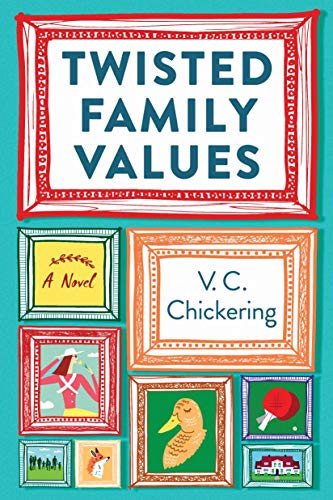
Twisted Family Values by V. C. Chickering came from St. Martin's Griffin.

I do love a good dysfunctional family novel, especially one set in a privileged family so this one should be interesting to say the least.

If you want to see the marvelous goodies in other people's mailboxes, make sure to visit Mailbox Monday and have fun seeing how we are all doing our part to keep the USPS and delivery services viable.

Sunday, February 24, 2019

Review: Surviving Paradise by Peter Rudiak-Gould

If you were marooned on a small island, what would you want to have with you? I've come up with the only food I would require, the five books I'd take with me, and so on. And hopefully I'll never be marooned with or without these things. But there's something a little romantic about daydreaming about no longer being tied to all our (unnecessary) material possessions and to the always-on digital world we live in these days, right? It might be thoughts like this that inspires some people to sign up to volunteer for organizations like the Peace Corps or WorldTeach but as Peter Rudiak-Gould makes clear in his book Surviving Paradise: One Year on a Disappearing Island, the reality is far more complicated than it seems, especially if you are marooned inside a whole different culture.

Rudiak-Gould signed up with WorldTeach after he graduated from college and asked to be assigned to a truly remote place. He got his wish. Not only are the Marshall Islands remote as a whole, but he was sent to tiny Ujae (1/3 square mile), one of the most remote of the islands in the island chain. He faced culture shock on a grand scale. There to teach English, very few, if any of his students or their families placed much import on education. And he didn't walk into the expected traditional culture but into an uneasy amalgam of the traditional and modern imported American culture. But this is not just a memoir of his experiences living so remotely, it is an examination of his own cultural biases, sometimes embracing them, sometimes pushing against them, but always accepting them and yearning to get back to the familiar.

The personal anecdotes of this memoir and anthropological tale were more interesting than the generalizations, which inclined to more descriptive than active. There's actually quite little about his experience in the classroom and teaching here, as if that was of little importance in his year--and maybe it was given the islanders' attitudes toward school but it seems odd in a memoir of his time teaching on the island. It is clear how much Rudiak-Gould comes to care for some of the people he meets even if he never quite comes to grips with certain aspects of their culture. In fact, learning such a different culture from his own makes him reflect all the more on how much he himself is a product of American culture. Interspersed with his own experiences are musings on the phrasings and the language of the islands, the curious customs, and the structure of the society, of which the foreign teacher will never truly be a part. He tells his tale with humor and frustration and finishes up with a look at the very real danger the islands face from rising sea waters. It sounds as if Rudiak-Gould values his experience with on Ujae but that he wouldn't be so very quick to sign up for another round, even as he wants to protect this unique place before it is gone forever. Armchair travelers and those who enjoy peeks at other cultures will enjoy reading this one.

Thanks to the publisher for a review copy of the book.

Wednesday, February 20, 2019

Review: In Another Time by Jillian Cantor

Would you have left Germany in the years leading up to World War II? It's easy to sit at this historical remove and declare that you would have seen the imminent danger and the toxic, spreading hate and left. But so many people didn't leave. For those with the money and the ability to go, especially the Jews with the money and ability to go, why didn't they? What kept them tied to a Germany becoming increasingly hostile to them? Jillian Cantor's newest novel looks at one young Jewish woman who chose to stay and the young Christian man who loved her and vowed to protect her.

In 1931, when bookstore owner Max Beissinger stumbles into the wrong auditorium at the Lyceum, he is transfixed by the magical violin music he hears and the lovely young woman playing it. Despite her horror at his accidental intrusion on her practice session, they eventually come together and fall in love. Their road is not an easy one though. Hanna is a Jew and Max is not. Max disappears for weeks and months at a time with no contact beyond a simple goodbye letter, never telling Hanna where he has been nor inviting her to join him. But they manage to come back together each time something tears them apart, seemingly fated to be with each other, in defiance of the rising anti-Semitism as Hitler gains more and more power. Max begs Hanna to leave Germany as freedom after freedom is curtailed but she refuses, saying that she is a German, Germany is her country too, and as an aspiring concert violinist, she will come to no one's notice. Max worries until he opens a forbidden closet in his bookstore. What's inside convinces him he can keep Hanna safe.

When Hanna opens her eyes in a cold field in 1946, she is convinced that she had just been in the bookstore with Max when four SA men broke into the shop.  How she got to the field and where Max is are both mysteries.  In fact, it's been a decade since that night and she has amnesia. Taken in by a kindly nun and then her older sister who thought she'd died in the Holocaust, Hanna struggles with the missing decade of her life and whatever happened to Max. Her violin is the only thing she has to hold onto and she works towards making a living as a musician even as it strains her relationship with her sister. Healthy in body but with her traumatic amnesia seemingly permanent, she has to bring herself back to life through the music that still lives within her. She will always love Max, searching for him in the memories she cannot access, playing her violin like fire, and finding the passion within her.

The novel is told moving back and forth in time between Max and Hanna. Hanna's story only starts in 1946 as she tries to build a new life without knowing her past. Max's chapters start in 1931 and tell the story of the two of them meeting and falling in love as Max tracks Hitler's rise. Nothing that Max tells illuminates Hanna's missing years, leaving the reader as in the dark about her whereabouts during the war as she is. He tells of the years of their pre-war relationship and the reason behind his occasional months long absences that threaten to break them up. But he never tells Hanna why or where he's gone thinking she will never believe him. Their two stories work towards a crescendo of memory, loss, and enduring love in their two different timelines.

Cantor knows how to write engaging stories and this is no exception. Max and Hanna's relationship is occasionally volatile but their love feels real and strong. The mystery of Hanna's missing ten years and Max's whereabouts underpins almost the entire story and the reader is eager to find out the answers to these two questions as well as whether they can find each other and be together "in another time."  There is a speculative fiction piece to the story that feels out of place in this otherwise captivating novel. This piece is underdeveloped and comes rather out of the blue. It does offer another potential answer to Hanna's missing years but it sits strangely beside the otherwise realistic and emotional story of two lovers facing the coming danger of the Holocaust. Hanna and Max are well drawn and the secondary characters anchor them in time and place. This is a well-written and affecting, very different look at both pre-war Germany and post-war London and Europe and the people whose lives were rent apart by a terrible war.

Thanks to LibraryThing Early Reviewers for sending me a copy of this book to review.

Waiting on Wednesday

This meme was hosted by Breaking the Spine and is meant to highlight some great pre-publication books we all can't wait to get our grubby little mitts on. I'm choosing to continue the tradition even though she has stopped.

The Promise of Elsewhere by Brad Leithauser.

The book is being released by Knopf on March 26, 2019.

The book's jacket copy says: A comic novel about a Midwestern professor who tries to prop up his failing prospects for happiness by setting out on the Journey of a Lifetime.

Louie Hake is forty-three and teaches architectural history at a third-rate college in Michigan. His second marriage is collapsing, and he's facing a potentially disastrous medical diagnosis. In an attempt to fend off what has become a soul-crushing existential crisis, he decides to treat himself to a tour of the world's most breathtaking architectural sites. Perhaps not surprisingly, Louie gets waylaid on his very first stop in Rome--ludicrously, spectacularly so--and fails to reach most of his other destinations. He embarks on a doomed romance with a jilted bride celebrating her ruined marriage plans alone in London. And in the Arctic he finds that turf houses and aluminum sheds don't amount to much of an architectural tradition. But it turns out that there's another sort of architecture there: icebergs the size of cathedrals, bobbing beside a strange and wondrous landscape. It soon becomes clear that Louie's grand journey is less about where his wanderings have taken him and more about where his past encounters with romance have not. Whether pursuing his first wife, or his estranged current wife, or the older woman he kissed just once a quarter-century ago, Louie reveals himself to be endearing, deeply touching, wonderfully ridiculous . . . and destined to find love in all the wrong places.

Tuesday, February 19, 2019

Review: The Sisters Hemingway by Annie England Noblin

I jumped at this book because of the title. I know some people don't like Hemingway. But I fell in love with his The Old Man and the Sea when I first read it in school (junior high? high school?). And I have been fascinated by his complicated, ultimately tragic life ever since. So I might have felt a small stab of disappointment that there's nothing really Hemingway about the book other than the nod to Hemingway's multiple wives in the names of the main characters. But I got over the disappointment as I sank into the story of this messy family, the dysfunction amongst the adult sisters, the tragedy that set them on their respective paths, and the secrets, long buried and of newer province both, that were uncovered in the course of Annie England Noblin's newest novel.

Hadley, Pfeiffer, and Martha have all come home to the tiny Missouri Ozark town that they grew up in for the first time in years. They're back for the funeral of their Aunt Bea, the great aunt who stepped into their lives when their mother and youngest sister died in a tornado. Their father having died young of cancer, the sisters' lives were full of tragedy and sorrow. As each grew up in turn, they all moved away from town, never going back to visit, as much their own choice as because Aunt Bea, who hadn't spoken a word since her own girlhood flight from the town, didn't want them to come back. But each of them returns to pay tribute to the woman who stepped up for them and returned to the town she had left so long ago without a second thought. And each of the estranged sisters comes home bearing secrets and baggage she's keeping from her sisters.

Oldest sister Hadley is polished and poised, married to a Senator. She's incredibly worried about appearances, an uptight, unhappy cold fish but she's hiding the fact that her less than happy marriage has been over for a long time. Pfeiffer had gone to New York to be a writer but ended up as a successful senior editor, certain of her taste and opinions until she passed on the biggest, most successful book to come out in years, doing so in spectacular fashion and ending up by getting herself fired, something she's not willing to share with her sisters just yet. And Martha, the youngest, shot to fame as a country singer in Nashville, marrying another huge star who took credit for her songwriting. When her marriage failed, assuming she'd be nothing without her talented husband her label dropped her, and she sank into alcoholism. Now she's just out of rehab and trying to rediscover herself. Each of the sisters is at rock bottom and it will only be by relying on each other and old friends who have always cared about them to find a second chance, especially when Aunt Bea's journal surfaces and a secret far older than the sisters is uncovered in their own front yard.

The novel rotates among the sisters' perspectives so the reader knows each of the womens' secrets long before her sisters do. This style of narration highlights each sister's frustrations, fears, insecurities, and vulnerabilities very clearly and shows the slow building of trust as the sisters learn to rely on each other and to address the truth and tragedy of their shared past. The resolutions for the sisters are appropriate after all of the healing they faced together and although several of the plot lines, including the reveal surrounding the decades old family secret, are fairly predictable, this is still a likable story of family, resilience, and second chances. Fans of women's fiction and sister stories will gulp this down in no time at all.

For more information about Annie England Noblin and the book, like the author on Facebook or follow her on Twitter or Instagram. Check out the book's Goodreads page, follow the rest of the blog tour, or look at the reviews for others' thoughts and opinions on the book.

Thanks to Trish from TLC Book Tours and Harper Collins for sending me a copy of the book for review.

Popular Posts