Wednesday, April 8, 2015

Review: A Reunion of Ghosts by Judith Claire Mitchell

We are often told that children become the people you tell them that they are. So if you consistently tell a child she is bad or dumb, she will believe this no matter how untrue it may be. Conversely, a child told she is smart or good will also believe these things to be true about herself. But what if a child is told that she is cursed, drinking in this knowledge with mother's milk, and that she cannot escape the family legacy except through that other dark familial predilection for suicide? Will children believe this as much as children believe these other things? In Judith Claire Mitchell's new novel, A Reunion of Ghosts, they certainly do.

Lady, Vee, and Delph Alter are cursed. They are the last of the Alters, the fourth generation of a family plagued by history and suicide. The three sisters are in their forties as the end of the twentieth century approaches and they have decided that they will go out with the millennium. Yes, all three of them intend to commit suicide and finally end the curse that has followed their family since their great-grandfather's scientific discoveries were perverted to evil uses. Their mother told all three of her girls that "the sins of the father are visited upon the children to the third and fourth generations" offering them a grim biblical truth as their enduring life philosophy. But they don't just have a life philosophy, they have a death philosophy as well, that of suicide. And if that must be pithily defined, it would surely sound something like: pick your poison and choose your time.

The Alter family tree is chock full of suicides (the sisters know because they have a chart posted on the back of one of the bedroom doors detailing each one) but not a one of these long dead souls has ever left a suicide note. This is where the sisters are going off of the family script. This novel is their suicide note, and what a note it is. Before they make their final exit, drinking smoothies no less, Lady, Vee, and Delph want to record their family history all the way back to their great-grandfather and the genesis of everything. Because the novel is a collective suicide note, it is told in the first person plural "we" which lends it an interesting and unusual communal voice. The sisters are all very different and well defined and yet this group telling works wonderfully. The narrative jumps back and forth from the family history, where the Alters are intimately connected to important world history and some of the big names in it, to the sisters' lives both past and present.

If a novel about three women intending to commit suicide with the novel itself purporting to be the suicide note sounds incredibly depressing, readers should know that this couldn't be further from the truth. The sisters are witty, quick with a snappy comeback, fond of word play, smart, and entertaining. Certainly they embrace death, but casually and unafraid. There's a fair bit of truly funny gallows humor as they recount the defining tragedies in their own lives and those of their ancestors. And there's been quite a lot of tragedy, some greater and some smaller. Great-grandfather Lenz Alter, the originator of the family curse, is based in part on the real life Fritz Haber, a German Jewish scientist who converted to Christianity and won the Nobel Prize for Chemistry for his discovery synthesizing ammonia from nitrogen and hydrogen, a process that in turn led to the development of fertilizers and explosives. Considered the father of chemical warfare for his weaponizing of chlorine gas in WWI, another of his discoveries led to Zyklon B, the gas used in the Nazi gas chambers in WWII, and he might or might not have been the first to synthesize the drug Ecstasy. It is with the legacy of Haber's real life accomplishments that the fictional Lenz Alter dooms his family, at least according to the sisters. But the novel is not just the record of one dysfunctional family as its last surviving members troop inexorably towards their own carefully planned deaths in their apartment's Death and Dying Room. There are twists and turns, surprises and shocks too, that ask the question of whether there can ever be redemption or if we are definitively trapped by fate or long-held belief. There are no actual ghosts here but the telling of the tale is indeed a reunion, the collective noun for a group of ghosts, of the ghosts who have haunted the sisters forever. The novel is quirky and rich, literary and accessible. There are a few bits that drag but in general, the sisters and their history are engaging enough to keep the reader engrossed in the story, wondering how it can, and indeed must, end.

For more information about Judith Claire Mitchell and the book, take a look at her website, like her Facebook page, or check out the book's Goodreads page. Follow the rest of the blog tour or look at the amazon reviews for others' thoughts and opinions on the book.

Thanks to Trish from TLC Book Tours and the publisher for sending me a copy of the book for review.

Waiting on Wednesday

This meme is hosted by Breaking the Spine and is meant to highlight some great pre-publication books we all can't wait to get our grubby little mitts on.

The Art of Baking Blind by Sarah Vaughn. The book is being released by St. Martin's Press on May 5, 2015.

Amazon says this about the book: There are many reasons to bake: to feed; to create; to impress; to nourish; to define ourselves; and, sometimes, it has to be said, to perfect. But often we bake to fill a hunger that would be better filled by a simple gesture from a dear one. We bake to love and be loved.

In 1966, Kathleen Eaden, cookbook writer and wife of a supermarket magnate, published The Art of Baking, her guide to nurturing a family by creating the most exquisite pastries, biscuits and cakes. Now, five amateur bakers are competing to become the New Mrs. Eaden. There's Jenny, facing an empty nest now that her family has flown; Claire, who has sacrificed her dreams for her daughter; Mike, trying to parent his two kids after his wife's death; Vicki, who has dropped everything to be at home with her baby boy; and Karen, perfect Karen, who knows what it's like to have nothing and is determined her facade shouldn't slip.

As unlikely alliances are forged and secrets rise to the surface, making the choicest pastry seems the least of the contestants' problems. For they will learn--as as Mrs. Eaden did before them--that while perfection is possible in the kitchen, it's very much harder in life.

Monday, April 6, 2015

It's Monday! What Are You Reading?

Big reading week again. And per usual, the reviewing didn't keep pace. Story of my life. ;-) This meme is hosted by Sheila at Book Journey.

Books I completed this past week are:

A Reunion of Ghosts by Judith Claire Mitchell
Read Bottom Up by Neel Shah and Sky Chatham
About a Girl by Lindsey Kelk
The Penderwicks in Spring by Jeanne Birdsall

Bookmarks are still living in the middle of:

A Fiery Cross by Diana Gabaldon

Reviews posted this week:

The Love Book by Nina Solomon
The Precious One by Marisa de Los Santos
Head Case by Cole Cohen

Books still needing to have reviews written (as opposed to the ones that are simply awaiting posting):

Wide-Open World by John Marshall
Children of the Jacaranda Tree by Sahar Delijani
The Year My Mother Came Back by Alice Eve Cohen
A Reunion of Ghosts by Judith Claire Mitchell
Read Bottom Up by Neel Shah and Sky Chatham
About a Girl by Lindsey Kelk
The Penderwicks in Spring by Jeanne Birdsall

Monday Mailbox

This past week's mailbox arrivals:

Orhan's Inheritance by Aline Ohanesian came from Algonquin.

I thoroughly enjoy books about family secrets, especially when they have roots in a rich history like this tale of a young man who inherits his grandfather's business but not the family home, which has been left to a stranger in an LA nursing home. I can't wait!

Circling the Sun by Paula McClain came from Ballantine Books.

Out of Africa, Beryl Markham, and the British expats in 1920s Kenya from the author of The Paris Wife, how could this one be anything short of engrossing?

If you'd like to see the marvelous goodies in other people's mailboxes, make sure to visit Mailbox Monday and have fun seeing how we are all doing our part to keep the USPS and delivery services viable.

Saturday, April 4, 2015

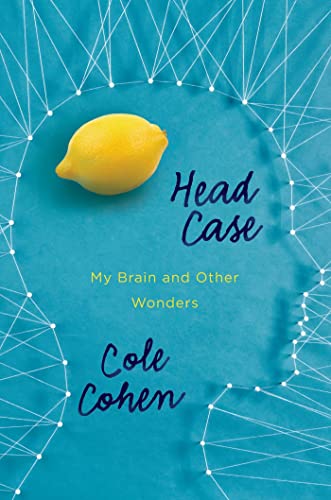
Review: Head Case by Cole Cohen

We all have things we do well and things we don't do as well. I am an English and Humanities girl while my sister is a Math and Science girl. This is just the way we are, the way our brains work. When I read about Cole Cohen's inability to tell her right from her left, the way she's spent her whole life getting lost or disoriented, that she has no sense of time, and that she gets math problems wrong in new and unique ways each time she attempts them, among other things, I realized I was reading about a kindred spirit. My own issues with these difficulties are of a much smaller magnitude than hers though, as her memoir, Head Case, about the discovery that she has a large hole in her brain where her parietal lobe should be makes clear. Mine are clearly just quirks, sometimes annoying quirks for sure, but hers is a documented case of complete absence.

All her life Cole Cohen has had trouble with things that other people learn with ease. As a child, her spatial and temporal difficulties were chalked up to a changing list of learning disabilities. But none of these diagnoses were the right one as she discovers when she is on the verge of leaving for graduate school. In an effort to get to the bottom of why she is completely incapable of learning to drive or to handle her own finances, in addition to the other problems she's had to fight to overcome or mitigate with coping strategies for her entire life, Cole submits to many tests but no one is more shocked when an MRI shows that she has a hole the size of a lemon in her brain. If this had been the result of a stroke or an accident, it would likely have rendered her incapacitated, but because it seems to have happened organically, she is spared the otherwise likely devastation, a strange ray of light in an otherwise baffling situation.

The first half of the memoir recounts Cohen's difficulties and the long search through the medical community for answers, the many misdiagnoses and finally the completely astounding correct diagnosis. The second half of this slight book focuses on the way she continues to be impacted, how she feels about all of it, and how she lives her life with the knowledge of her disability. She recognizes the lifelong way in which her disability has driven her sometimes difficult relationship with her parents and sisters, knowing that an inordinate amount of attention has had to be paid to her over the years and will continue to be necessary to help her in those problem areas she'll likely never master. She discusses the series of jobs she has had and the reasons she has struggled to hold onto those jobs. And a large portion of this latter half of the book looks at the on and off romantic relationship Cohen had and how the reality of her situation played out in it as well. The memoir is very introspective but it meanders a bit. Cohen doesn't slip into self-pity about her condition although there is some wistfulness for the easy life she'll never lead. Her story is interesting for its uniqueness but perhaps because it is so unusual as to have no real documentation, it feels a bit repetitive by the end. The amazing thing turns out not to be the hole in Cohen's brain but that she has accomplished all that she has, not least of which is writing this generally readable book.

Thanks to the publisher and LibraryThing Early Readers for sending me a copy of this book for review.

Wednesday, April 1, 2015

Review: The Precious One by Marisa de los Santos

We are all shaped by our families. We not only learn our traditions and histories from them but we internalize our own self worth from them. Certainly people can overcome what they've learned, but it isn't easy or smooth when something has been so ingrained for so long. In Marisa de los Santos' addicting newest novel, The Precious One, she captures the way in which family molds and shapes a person, for better or worse.

Eustacia Cleary is 35 years old when she wakes up to a phone call from her father. This would not be remarkable except for the fact that the brilliant and cold Wilson Cleary left his family, Taisy, her twin brother Marcus, and their mother, for another woman 17 years prior and has had very little contact with his children ever since, all by his own choice. He's called to tell her he's had a heart attack and to ask her to move into his home with his artistic but seemingly spacey wife, Caro, their 16 year old daughter, Willow, and him so that Taisy can write his life story. Because Taisy makes her living as a very successful ghost writer. Although he couches it in non-emotional terms, Taisy can't resist him, the father whose withheld approval she's ached for her whole life.

But if Wilson has his own reasons for wanting Taisy around, and Caro is perfectly accepting of her stepdaughter's presence, Willow, the doted on, adored, precious daughter, isn't so sure she wants to share her beloved father or the title of daughter. Her world has come crashing down on her since her father's heart attack. Homeschooled by Wilson using an incredibly reductive curriculum of his own design and isolated from other kids her age because of his belief that she is too smart and special for them, Willow is a strange mix of highly intelligent and socially innocent, something that doesn't serve her well when she is enrolled in a local private school while Wilson recuperates. On top of having to navigate the unfamiliar channels of school for the first time, she has to cope with her suspicion over Taisy's sudden and unwanted presence in her life, her fears that her father won't recover, and the fear that she could ever lose his love and approval, something that she is certain has happened to Taisy.

This novel is really about Taisy and Willow coming together, to know each other and to learn what it means to be the others' sister. Each of them have experienced such different families because of Wilson's enormous difference within those families but they still have a lot to teach each other about learning to let go and be happy on their own terms. Even though Taisy has given up everything for her father, she must get past her craving for his approval or she will not be able to reclaim the love she once turned her back on for him. Taisy is an interesting character and her evolution from the young woman so hurt by her father's inexplicable outright rejection to a confident, determined woman who can defy his wishes and dig into his hidden past as a means to understand and forgive him in the present despite the years of happiness he's cost her is a slow and believable one. Willow's character is rather bratty but she's a threatened teenager even if she is certain of being loved. Her complete lack of street smarts and inability to sense danger is frustrating and her hostility to Taisy makes the reader want to shake her. But she's generally a believable, if appallingly naïve, sixteen year old under a lot of stress.

The novel's narrative switches back and forth between first person accounts from Taisy and Willow so the reader is always certain where their respective mental states are. Their voices are incredibly different and easily distinguishable and the gradual change each undergoes, not only with regard to the other but also in terms of their views of the secondary characters, is well detailed. The secondary characters, including acerbic Marcus, flaky but perhaps ultimately triumphant Caro, wary Ben, intense and honest Luka, and flamboyant Trillium come across as charmingly quirky if not always fully developed. The writing is lovely and the emotion is true and deeply felt. This is a warm, touching, and insightful look at learning to live and love for yourself and to find the value in family, both the one you are born into and the one that you create around yourself.

For more information about Marisa de los Santos and the book, take a look at her website, like her Facebook page, follow her on Twitter, or check out the book's Goodreads page. Follow the rest of the blog tour or look at the amazon reviews for others' thoughts and opinions on the book.

Thanks to Trish from TLC Book Tours and the publisher for sending me a copy of the book for review.

Waiting on Wednesday

This meme is hosted by Breaking the Spine and is meant to highlight some great pre-publication books we all can't wait to get our grubby little mitts on.

Her Name Is Rose by Christine Breen. The book is being released by St. Martin's Press on April 14, 2015.

Amazon says this about the book: People used to say Iris Bowen was beautiful, what with the wild weave of her red hair, the high cheekbones, and the way she carried herself like a barefoot dancer through the streets of Ranelagh on the outskirts of Dublin city. But that was a lifetime ago.

In a cottage in the west of Ireland, Iris--gardener and mother to an adopted daughter, Rose--is doing her best to carry on after the death of her husband two years before. At the back of her mind is a promise she never intended to keep, until the day she gets a phone call from her doctor.

Meanwhile, nineteen-year-old Rose is a brilliant violinist at the Royal Academy in London, still grieving for her father but relishing her music and life in the city. Excited but nervous, she hums on the way to an important master class, and then suddenly finds herself missing both of her parents when the class ends in disaster.

After the doctor's call, Iris is haunted by the promise she made to her husband--to find Rose's birth mother, so that their daughter might still have family if anything happened to Iris. Armed only with a twenty-year-old envelope, Iris impulsively begins a journey into the past that takes her to Boston and back, with unexpected results for herself and for Rose and for both friends and strangers.

Intimate, moving, and witty, Her Name is Rose is a gorgeous novel about what can happen when life does not play out the way you expect.

Popular Posts