Friday, January 4, 2013

Review: Parlor Games by Maryka Biaggio

Is Baroness May de Vries really, as the Pinkerton Agency dubbed her, The Most Dangerous Woman in the World, a con-artist and swindler of the first degree or is she simply a successful gold-digger unjustly accused and hounded by the famous agency?  Based on an actual historical figure, Maryka Biaggio's novel Parlor Games brings this fascinating, opportunistic, and possibly criminal woman to life.  When the novel opens, she is standing trial for extortion in her hometown of Menominee, Michigan.  The charges are not being brought against her by one of her many inamoratos but instead by a female friend, Miss Frank Slater, who is accusing May of running through Frank's entire inheritance and then dropping her like a hot potato once the money was gone.  How will the jury rule when faced with this glamorous, titled, once native daughter and the facts of the case?
 
Born May Dugas, to a tavern keeper and a seamstress, she's spent her life striving for the good and easy life, reaching for wealth and expensive baubles, champagne and caviar, European travels and the men who would provide the niceties for her, always looking for the bigger, better, wealthier sugar daddy. As the novel opens, she confidently declares that she intends to tell her story to the reader, certain that we readers will exonerate her from any wrongdoing whatsoever. Alternating between the testimony of the two week long trial and the events of her entire 48 years, May tells her story her way in both parts of this double-stranded narrative.  As she tells her tale though, it becomes quickly and eminently clear that she is the epitome of an unreliable narrator.  She blows through men, drawn only to the wealthiest in any given milieu starting with the son ofone of Menominee's first families whom she tells she's pregnant to the son of the wealthy Chicago family which first exposes her unscrupulous behaviour to the Pinkerton Agency to her Dutch Baron husband and many other men besides. 
 
After her false pregnancy, she turns to high class prostitution to earn a living, thinking only of sex as a means to an end.  Because May is incredibly resourceful and crafty, she parlays the gifts from her clients into a facade of money and finagles her way into high society, where she uses her abundant charm and sexuality to entrap young men of money into gifts, promises, and engagements.  Trailed by Pinkerton detective Reed Dougherty across multiple continents and through many different countries, May continues her pattern of reeling in a wealthy paramour and extracting favors and money before being driven ever onward by Dougherty.  She is aided in her adventures and travels by a competent and thorough companion, Daisy Emmett.  But when she uses Miss Frank Shaver to fund her extravagances, she might have met her match.  May's contention to the reader is that she is truly driven by love or affection for these boys and men and that it is only the unearned haranguing and harrassing by the Pinkerton detective that causes her to move on.
 
May tells her story in a positively charming and chatty manner, always careful to suggest that while she was certainly interested in money and living a good life, that she was driven by the need to support her widowed mother, shiftless but handsome and engaging younger brother, and her stolid and unimaginative older brother.  She embellishes and paints herself completely sympathetically in her telling of her own exploits, playing up her family responsibilities and the inexplicable ways in which men shower her with things out of their own initiative.  Despite the fact that she comes across as quite conscienceless and self-centered, she is still eminently appealing to the reader.  As the end of the book and the trial draw near, it is almost impossible to escape racing through the final pages to find out the outcome.    If the end is completely riveting, the beginning is a bit slow going with the constant back and forth from the trial to May's early life making it difficult initially to settle into the story.  The scandals left in May's wake are not particularly unique as she perpetrated the same thing time after time after time but it is interesting to see how many people she took in over a twenty or so year span and how events conspired to keep her untouchable for so long.  Over all, this was a very enjoyable read, well-written and entertaining.  Fans of historical fiction certainly will thrill to a ride through May Dugas' busy and chic life.
 
Thanks to the publisher for sending me a copy of this book for review.

Thursday, January 3, 2013

Review: Three Men in a Boat by Jerome K. Jerome

I have long had this book sitting on my shelf.  Actually, it's been sitting on the "recommended for a laugh" shelf for years now.  And I scraped a price tag off of it that tells me I bought it way back in 2001.  So for an appallingly long time, I haven't touched a book that came highly recommended, about which I occasionally hear very positive things even from people not inclined to read a whole lot.  I don't know whether I was afraid it wouldn't live up to everything I'd heard or what exactly had slowed me down from reading it, but I have to say to anyone else out there with Jerome K. Jerome's Three Men in a Boat sitting neglected on a shelf: take it down and settle in to a very enjoyable read, one that will make you smile and chuckle and even break out into a full fledged laugh that will make others in public look at you strangely and move their seats as far from you as possible.

Written in 1889, this novel is an hilarious travel narrative peppered with small amounts of English history.  Jerome, two of his equally hypochondriac friends, and Montmorency, a fox terrier, decide to scull up the river Thames for a fortnight.  They are looking for a bit of a rest from their apparently strenuous lives, lives the reader soon discovers are mostly indolent and non-taxing in the extreme.  The fresh air will certainly cure them of their imagined ills.  And so they head off on their boating holiday.  As they row upriver, Jerome takes the opportunity to tell brief bits of important (and sometimes not so important) history that occurred in the towns on the banks of the river.  But in and amongst these serious pieces of information, he also chronicles the misadventures of their inept, bumbling, and lackadaisical trio using the sort of ascerbic and dry wit that is a hallmark of a certain kind of British humor.  From J., George, and Harris's slapstick occurrences on this present trip to flashbacks of previous trips and completely tangential but hysterically funny stories (I defy you to read about the stinky cheese without worrying you're going to wet your pants laughing), the tale is entertaining and, despite its age, completely accessible.  The three main characters are irritable and crotchety, averse to hard work, goofy, and yet incredibly adroit at telling appealing and laugh-inducing tall tales.  Their teasing and good natured interactions with each other, despite all the bollocksing up they do is delightful and the humor is ultimately self-effacing, gentle, and wonderful.  The book, designed to be a travelogue rather than a plot-driven read, is pleasant, funny, and marvelous and now that I know what a small gem I have on my shelf, I fully intend to take it down and enjoy it again and again.

Wednesday, January 2, 2013

Review: His Mistress by Christmas by Victoria Alexander

Widowed Lady Veronica Smithson and famous explorer and lady's man Sir Sebastian Hadley-Attwater are at cross-purposes.  Veronica has been widowed for several years and she misses physical companionship.  While she misses the sex, she is uninterested in getting married again, afraid of losing her independence and having to conform to a husband's rules, not that her first husband restricted her in any way.  Sebastian, despite his reputation as a rake, is eminently ready to give up his globe-trotting, marry, and settle down.  And he's certain that the enticing Veronica is the woman for him.  Veronica, meanwhile, is certain that the handsome, intelligent, and roguish Sebastian will be the perfect lover for her.  It's not often in a romance that the heroine wants an affair and the hero wants marriage but this latest Victorian set historical romance of Victoria Alexander's has just this very unusual situation.

Both Veronica and Sebastian are very determined to make the other see sense and fall in with the plans they each seperately espouse.  With a view to convincing the other than their own plan is the smartest, the two of them retire to Sebastian's newly purchased country home just before Christmas.  Veronica is determined to seduce Sebastian while there and he's intent on making her his wife.  If it was just a tale of these two, the story wouldn't be nearly as entertaining as it is though.  Before they leave town, Sebastian, certain that no woman will hold out against his proposal of marriage for long, tells his sisters of his plans to marry.  And so, citing the fact that it has been years since Sebastian has been home for the holidays, his entire family descends on his home where he and Veronica are now faced with utter chaos, the question of how to behave, and a charade.  This leads to some very humorous situations.  And things get even more complicated when Veronica's father, batty grandmother, and quite feminist aunt, who raised her after the early death of her mother, also arrive at Sebastian's home having heard the rumor of Veronica marrying again.

There is a lot of witty banter here but not as much "can't keep their hands off of each other" lust as might be expected, especially given that the heroine is no virginal miss.  The initial attraction is rather rushed but if it then developed into a believable enduring love, that would be fine.  As it is though, there's no real display of what makes Veronica and Sebastian love each other and that's too bad.  The novel is an entertaining and unusual romance and the by-play between the characters is enjoyable even if the chemistry is a little on the low side and the final misunderstanding that threatens to drive them apart is ridiculous.  Romance readers will, on the whole, find this a reasonably fun, quick read.

Waiting on Wednesday

This meme is hosted by Breaking the Spine and is meant to highlight some great pre-publication books we all can't wait to get our grubby little mitts on.

Jujitsu Rabbi and the Godless Blonde by Rebecca Dana. The book is being released by Amy Einhorn Books on Jan. 24, 2013.

Amazon says this about the book: The ultimate fish-out-of-water tale . . .

A child who never quite fit in, Rebecca Dana worshipped at the altar of Truman Capote and Nora Ephron, dreaming of one day ditching Pittsburgh and moving to New York, her Jerusalem. After graduating from college, she made her way to the city to begin her destiny. For a time, life turned out exactly as she’d planned: glamorous parties; beautiful people; the perfect job, apartment, and man. But when it all came crashing down, she found herself catapulted into another world. She moves into Brooklyn’s enormous Lubavitch community, and lives with Cosmo, a thirty-year-old Russian rabbi who practices jujitsu on the side.

While Cosmo, disenchanted with Orthodoxy, flirts with leaving the community, Rebecca faces the fact that her religion—the books, magazines, TV shows, and movies that made New York seem like salvation—has also failed her. As she shuttles between the world of religious extremism and the world of secular excess, Rebecca goes on a search for meaning.

Trenchantly observant, entertaining as hell, a mix of Shalom Auslander and The Odd Couple, Jujitsu Rabbi and the Godless Blonde is a thought-provoking coming-of-age story for the twenty-first century.

Monday, December 31, 2012

It's Monday! What Are You Reading?

A wonderful Christmas with family meant not as much reading and reviewing but that's what the holiday is all about. :-) This meme is hosted by Sheila at Book Journey.

Books I completed this past week are:

My Bookstore edited by Ronald Rice
A Different Kind of Normal by Cathy Lamb
A Land More Kind Than Home by Wiley Cash
I Want to Kill the Dog by Richard Cohen
The Missing Manuscript of Jane Austen by Syrie James

Bookmarks are still living in the middle of:

On the Map by Simon Garfield

Reviews posted this week:

Never Hug a Nun by Kevin Killeen
An Extraordinary Theory of Objects by Stephanie LaCava
Charlotte Street by Danny Wallace
My Bookstore edited by Ronald Rice
Seducing Ingrid Bergman by Chris Greenhalgh
The Embers by Hyatt Bass
Buddy by Brian McGrory

Books still needing to have reviews written (as opposed to the ones that are simply awaiting posting):

His Mistress by Christmas by Victoria Alexander
The Lighthouse Road by Peter Geye
Happily Ever Madder by Stephanie McAfee
Rules of Civility by Amor Towles
I Married You For Love by Lily Tuck
The Book of Neil by Frank Turner Hollon
How to Tame a Willful Wife by Christy English
The Crying Tree by Naseem Rakha
Saturday Night Widows by Becky Aikman
Yours Affectionately, Jane Austen by Sally Smith O'Rourke
Vanity Fare by Megan Caldwell
A Different Kind of Normal by Cathy Lamb
A Land More Kind Than Home by Wiley Cash
I Want to Kill the Dog by Richard Cohen
The Missing Manuscript of Jane Austen by Syrie James

Monday Mailbox

Going out of town always worries me. What if books get delivered while I'm gone? They might think I don't want them if I don't take them into the house immediately. (Yes, I anthropomorphize my books. So what?) But after a nice Christmas with family, I'm home and reveling in the book that arrived in my absence, letting it know just how wanted it really is. :-) This past week's mailbox arrival:

All the Lonely People by Jess Riley came from the author. (This arrived with the cutest felted mitten ornament too.)

A novel about a woman who realizes after her mother's death that she doesn't like her siblings causing her to advertise for a new family for Christmas, this sounds like it will be fantastic, especially for those of us who have just spent two holidays with family. ;-)

The Hope Factory by Lavanya Sankaran came from The Dial Press.

I do so love novels set in India and this one about the realities of lives in Bangalore either as one on the verge of making it or as a have not looks like it will be a wonderful read.

All This Talk of Love by Christopher Castellani came from Algonquin.

An international "you can't go home again" novel, I can't wait to read about this Italian-American family and everything that gets stirred up when they have to travel back to their native Italy and face the family they left so long ago.

As always, if you'd like to see the marvelous goodies in other people's mailboxes, make sure to visit Suko's Notebook as she is hosting this month's Mailbox Monday and have fun seeing how we are all doing our part to keep the USPS and delivery services viable.

Sunday, December 30, 2012

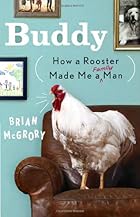
Review: Buddy by Brian McGrory

My uncle kept chickens when I was small.  We'd go to visit him and be given the task of collecting eggs from the coop.  This sounded like a great and fun thing to do until we remembered the rooster.  He probably had a name but I don't recall it.  All I know is that he was pure evil, gleefully attacking defenseless children.  At least until we got smart and started wielding the 2x4 kept just inside the chickens' enclosure.  A few swipes (and maybe a hit or two) as he charged and he was wary about pecking, buying us enough time to collect the couple of eggs and get out.  It was with this image in my head and a whole lot of skepticism that I opened up Brian McGrory's new narrative non-fiction, Buddy: How a Rooster Made Me a Family Man.

The title and the cover are slightly misleading though as the book really details a large chunk of McGrory's life rather than being purely a memoir of his life with Buddy the rooster.  Journalist McGrory was divorced and single, living in downtown Boston with his beloved dog Harry.  He was an urbanite to the core and happy in his more than comfortable life in the city.  His lovely, devoted golden retriever Harry was a joy with him for only ten short years, succumbing to cancer and leaving McGrory bereft.  Through Harry's final illness, McGrory grows closer to Harry's vet Pam, finding her a sympathetic person and kindred spirit in the care of his much loved dog.  It is only some time after Harry's death that Pam's marriage dissolves and she and McGrory ultimately fall in love.  And that brings about the biggest changes in McGrory's life thus far: a move from the city to full-on suburbia, stepdaughters, and a menagerie of animals not of his own choosing, including Buddy the rooster.

Buddy does not like McGrory, aggressively attacking him to protect his flock (Pam and her girls).  And the feeling is mutual, with McGrory disliking Buddy in equal measure.  But more than his conflict with this territorial chicken, this is a memoir about compromise, the re-making of a family, the nature of devotion, and change at mid-life.  While McGrory doesn't come off as particularly appealing here, the others in the book come off worse.  Pam's daughters seem to be entitled, spoiled brats who are never called to account for their obnoxious behaviour.  Pam, as a vet, is strangely oblivious not only to Buddy's needs as a chicken but over the top indulgent of his bad behaviour.  McGrory himself spends a lot of time bemoaning the loss of his formerly uneventful and pleasant single life in the city and he portrays himself, perhaps unintentionally, as a doormat, subsuming his own happiness in lieu of keeping his new life on an even keel.  There seems to be little to no recognition of this new marriage as a partnership.  At least in the case of Buddy, it is all about Pam's love for this rather nasty seeming rooster.  And that's exasperating as a reader.

Nothing about adding a new person to a family is easy, especially when the person being added has spent years on his own, living life without anyone to whom to be accountable, and ordering his existence with only a thought to his own happiness.  But McGrory seems to head 180 degrees the other way in trying to forge a new married life with stepchildren  It is all about Pam and the girls' happiness completely at the cost of his own.  The third of the book that is a love letter to his dog Harry is lovely and heartfelt.  His subsequent struggle to become part of a larger family is less lovely.  All of it is well-written but the unevenness of interest in the narrative handicaps the book as a whole.  That said, there is heart here and although I personally would have had fried chicken long ago with Buddy featuring as the main dish, it is interesting what McGrory claims to have learned from the obstreporous chicken and how he has changed (willingly) as a man and a husband as a result.  Readers who enjoy any sort of pet memoir will find humor and pathos in equal measure here but readers looking for one that is centered solely on the chicken on the cover need to know that Buddy isn't really the main focus here.

Thanks to the publisher for sending me a copy of this book for review.

Popular Posts