Monday, July 31, 2017

It's Monday! What Are You Reading?

This meme is hosted by Kathryn at Reading Date.

Books I completed this past week are:

The Best of Us by Joyce Maynard
Meantime by Katharine Noel
The Portrait by Antoine Laurain

Bookmarks are still living in the middle of:

A Well-Made Bed by Abby Frucht and Laurie Alberts
The Children's Crusade by Ann Packer
The Lake House by Kate Morton
Shelter by Jung Yun
The Center of the World by Jacqueline Sheehan
A Manual For Cleaning Women by Lucia Berlin
The Beauty of the End by Debbie Howells
Country of Red Azaleas by Domnica Radulescu
A Hard and Heavy Thing by Matthew J. Hefti
Paint Your Wife by Lloyd Jones
The Company They Kept edited by Robert B. Silvers and Barbara Epstein
No One Can Pronounce My Name by Rakesh Satyal
Lily and the Octopus by Stephen Rowley
Thousand-Miler by Melanie Radzicki McManus
Dear Fang, With Love by Rufi Thorpe
Close Enough to Touch by Colleen Oakley
America's First Daughter by Stephanie Dray and Laura Kamoie
Hope Has Two Daughters by Monia Mazigh
After the Bloom by Leslie Shimotakahara
Metis Beach by Claudine Bourbonnais
So Much Blue by Percival Everett
The Clay Girl by Heather Tucker

Reviews posted this week:

Nuclear Family by Susanna Fogel
Her Royal Spyness by Rhys Bowen

Books still needing to have reviews written (as opposed to the ones that are simply awaiting posting):

The Invention of Wings by Sue Monk Kidd
The Woman Next Door by Yewande Omotoso
Breaking Up Is Hard to Do But You Could've Done Better by Hilary Fitzgerald Campbell
To Love the Coming End by Leanne Dunic
Make Trouble by John Waters
The Peculiar Life of a Lonely Postman by Denis Theriault
A Loving, Faithful Animal by Josephine Rowe
City Mouse by Stacey Lender
Cutting Back by Leslie Buck
Siracusa by Delia Ephron
The Wife, the Maid, and the Mistress by Ariel Lawhon
A Narrow Bridge by J.J. Gersher
The Never-Open Desert Diner by James Anderson
The Heart of Henry Quantum by Pepper Harding
The Hearts of Men by Nickolas Butler
Dance of the Jakaranda by Peter Kimani
How to Survive a Summer by Nick White
Bramton Wick by Elizabeth Fair
The Finishing School by Joanna Goodman
Meet Me in the In-Between by Bella Pollen
All Grown Up by Jami Attenberg
The Island of Books by Dominique Fortier
Lights On, Rats Out by Cree LeFavour
Salt Houses by Hala Alyan
Him, Me, Muhammad Ali by Randa Jarrar
What Are the Blind Men Dreaming? by Noemi Jaffee
Girl in Snow by Danya Kukafka
The Lying Game by Ruth Ware
The Talker by Mary Sojourner
When the Sky Fell Apart by Caroline Lea
The Seven Husbands of Evelyn Hugo by Taylor Jenkins Reid
'Round Midnight by Laura McBride
The German Girl by Armando Lucas Correa
The Tea Girl of Hummingbird Lane by Lisa See
The Jane Austen Project by Kathleen A. Flynn
Last Things by Marissa Moss
All Our Wrong Todays by Elan Mastai
Civilianized by Michael Anthony
The Redemption of Galen Pike by Carys Davies
Woman No. 17 by Edan Lepucki
In the Woods of Memory by Shun Medoruma
Before the Wind by Jim Lynch
Dinner with Edward by Isabel Vincent
Inhabited by Charlie Quimby
Pachinko by Min Jin Lee
One Good Mama Bone by Bren McClain
The Excellent Lombards by Jane Hamilton
The Long Run by Catriona Menzies-Pike
You and I and Someone Else by Anna Schachner
The Best of Us by Joyce Maynard
Meantime by Katharine Noel
The Portrait by Antoine Laurain

Wednesday, July 26, 2017

Waiting on Wednesday

This meme is hosted by Breaking the Spine and is meant to highlight some great pre-publication books we all can't wait to get our grubby little mitts on.

Woman Enters Left by Jessica Brockmole.

The book is being released by Ballantine Books on August 8, 2017.

Amazon says this about the book: In the 1950s, movie star Louise Wilde is caught between an unfulfilling acting career and a shaky marriage when she receives an out-of-the-blue phone call: She has inherited the estate of Florence “Florrie” Daniels, a Hollywood screenwriter she barely recalls meeting. Among Florrie’s possessions are several unproduced screenplays, personal journals, and—inexplicably—old photographs of Louise’s mother, Ethel. On an impulse, Louise leaves a film shoot in Las Vegas and sets off for her father’s house on the East Coast, hoping for answers about the curious inheritance and, perhaps, about her own troubled marriage.

Nearly thirty years earlier, Florrie takes off on an adventure of her own, driving her Model T westward from New Jersey in pursuit of broader horizons. She has the promise of a Hollywood job and, in the passenger seat, Ethel, her best friend since childhood. Florrie will do anything for Ethel, who is desperate to reach Nevada in time to reconcile with her husband and reunite with her daughter. Ethel fears the loss of her marriage; Florrie, with long-held secrets confided only in her journal, fears its survival.

In parallel tales, the three women—Louise, Florrie, Ethel—discover that not all journeys follow a map. As they rediscover their carefree selves on the road, they learn that sometimes the paths we follow are shaped more by our traveling companions than by our destinations.

Tuesday, July 25, 2017

Review: Her Royal Spyness by Rhys Bowen

As a rule, I don't generally read a lot of mysteries. I happily buy them for other members of my family, all of whom seem to have a thing for whodunits but they have never been my genre of choice. Part of it is that I object to dead bodies in my reading. I prefer happily ever after to "Miss Scarlet in the conservatory with a wrench" (although both the board game and the movie are hugely entertaining). But every now and again, I break my own rules. When a mystery features a minor royal from Scotland and is set in the 1930s like in Rhys Bowen's Her Royal Spyness, well, I am more than happy to break that rule.

Lady Victoria Georgiana Charlotte Eugenie, the daughter of the late Duke of Glen Garry and Rannoch and thirty-fourth in line for the throne, lives with her brother Binky, the current Duke, his parsimonious wife, Fig, and their small son in a drafty castle in Scotland. She flees to London after she overhears Binky and Fig discussing a house party they've been instructed to throw by the queen in order to get Georgie engaged to a distasteful foreign prince. Although she's living in Binky's town home in London, cut off from any allowance, she has no money to speak of and no way to request any either, the family being rather in the weeds financially. As she schemes for ways to survive without having to resort to the very boring solution of being a lady-in-waiting to the last surviving daughter of Queen Victoria's (Georgie's great aunt), she starts her own housekeeping business, meets a scrummy but destitute Irish noble, crashes quite a few parties, spies on Wallis Simpson for Queen Alexandra, and, oh yes, finds a dead man in the tub in her house in London, a murder she must solve without implicating her brother, compromising her reputation, or ending up dead herself.

This is the first of the Her Royal Spyness Mysteries cozy mystery series. As the first book, there is quite a bit of scene setting before the plot really gets going but getting to know Georgie and her circumstances is highly entertaining all on its own. Bowen's writing is rife with dry humor and well researched period details. She has created a character who is not anomalous for her time, even if she is striking out on the edges of a rather fast set. In the course of staying generally true to the time period, Georgie's spying is really "spy lite" and the mystery is alsovery much a light one. The murderer is pretty easy to uncover and it's surprising that it takes Georgie as long as it does to figure it out herself. But this book is exactly as it appears, a delightful, quick, breezy, and fun mystery and those readers who enjoy romps with royals or favor the early 1930s socialite scene will be charmed by Georgie and crew.

Monday, July 24, 2017

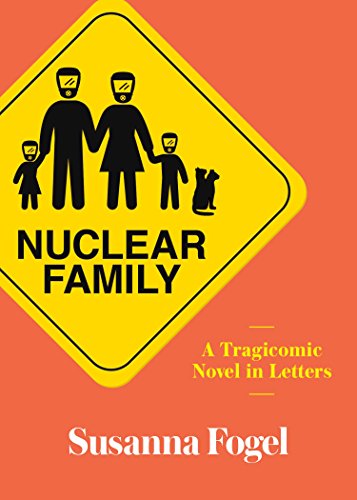
Review: Nuclear Family by Susanna Fogel

Oh, how I love a good epistolary novel! And despite appearances otherwise (how many ways can you really change letters?), there are multiple ways to shape an epistolary novel. It can be letters, emails, notes, etc. from both the main character and secondary characters. It can be solely missives written by the main character. And it can be composed of letters and emails from others to one main character whose responses remain unwritten. Susanna Fogel's hilarious, crazy epistolary novel of a dysfunctional family, Nuclear Family, is the latter of these options.

Julie Fellers' extended Jewish family is nuts in its own special way. Over the course of twenty plus years, she receives letters, emails, and notes from many of the members of her family. Her father is a neurologist, her mother a therapist. She hears from them, as well as her grandmother, her immature younger sister, her mother's goddaughter, her stepmother, her precocious half-brother, her uncle, a couple of ghosts, a few inanimate objects that have cause to know her well, and more. The letters serve to illuminate everything that is going on in the family's life, revealing their authors with surprising clarity, as well as addressing Julie's life even though the reader never sees a response from her. The letters form the portrait of a fractured family but one that has stayed connected to each other, even when they drive each other round the bend.

Fogel manages to infuse healthy doses of humor, neuroses, perfect passive aggressiveness, self-centeredness, cluelessness, and family loyalty and love in the very distinct, well-developed voices she's created here. True emotions peek out from between the lines of all the characters' writings no matter what the actual content of the letter is and that's an impressive feat.  The inanimate objects and ghosts weighing on Julie's life may be a little bit over the top but since there's no other good way to introduce some of the things they know about Julie, they do serve a purpose.  Each letter is headed with a title that captures the tone and content of the following letter beautifully (and many of the headings will cause readers to snort with laughter). At first glance, there seems to be little plot driving the story beyond the passage of time and Julie's long deferred dream of writing a novel but when you reach the end and realize what Fogel has done, you will snicker with appreciation. Truly, the book is quite clever and a joy to read. Heaven forbid you recognize your own family in the book, but at least if you do, you'll know you're not alone and have the chance to laugh at the crazy other people are keeping hidden, except in their letters, too.

Thanks to LibraryThing Early Reviewers and the publisher for sending me a copy of this book to review.

It's Monday! What Are You Reading?

This meme is hosted by Kathryn at Reading Date.

Books I completed this past week are:

The Almost Sisters by Joshilyn Jackson
You and I and Someone Else by Anna Schachner
Her Royal Spyness by Rhys Bowen
Nuclear Family by Susanna Fogel

Bookmarks are still living in the middle of:

A Well-Made Bed by Abby Frucht and Laurie Alberts
The Children's Crusade by Ann Packer
The Lake House by Kate Morton
Shelter by Jung Yun
The Center of the World by Jacqueline Sheehan
A Manual For Cleaning Women by Lucia Berlin
The Beauty of the End by Debbie Howells
Country of Red Azaleas by Domnica Radulescu
A Hard and Heavy Thing by Matthew J. Hefti
Paint Your Wife by Lloyd Jones
The Company They Kept edited by Robert B. Silvers and Barbara Epstein
No One Can Pronounce My Name by Rakesh Satyal
Lily and the Octopus by Stephen Rowley
Thousand-Miler by Melanie Radzicki McManus
Dear Fang, With Love by Rufi Thorpe
Close Enough to Touch by Colleen Oakley
America's First Daughter by Stephanie Dray and Laura Kamoie
Hope Has Two Daughters by Monia Mazigh
After the Bloom by Leslie Shimotakahara
Metis Beach by Claudine Bourbonnais
Meantime by Katharine Noel

Reviews posted this week:

The Almost Sisters by Joshilyn Jackson
The Young Widower's Handbook by Tom McAllister

Books still needing to have reviews written (as opposed to the ones that are simply awaiting posting):

The Invention of Wings by Sue Monk Kidd
The Woman Next Door by Yewande Omotoso
Breaking Up Is Hard to Do But You Could've Done Better by Hilary Fitzgerald Campbell
To Love the Coming End by Leanne Dunic
Make Trouble by John Waters
The Peculiar Life of a Lonely Postman by Denis Theriault
A Loving, Faithful Animal by Josephine Rowe
City Mouse by Stacey Lender
Cutting Back by Leslie Buck
Siracusa by Delia Ephron
The Wife, the Maid, and the Mistress by Ariel Lawhon
A Narrow Bridge by J.J. Gersher
The Never-Open Desert Diner by James Anderson
The Heart of Henry Quantum by Pepper Harding
The Hearts of Men by Nickolas Butler
Dance of the Jakaranda by Peter Kimani
How to Survive a Summer by Nick White
Bramton Wick by Elizabeth Fair
The Finishing School by Joanna Goodman
Meet Me in the In-Between by Bella Pollen
All Grown Up by Jami Attenberg
The Island of Books by Dominique Fortier
Lights On, Rats Out by Cree LeFavour
Salt Houses by Hala Alyan
Him, Me, Muhammad Ali by Randa Jarrar
What Are the Blind Men Dreaming? by Noemi Jaffee
Girl in Snow by Danya Kukafka
The Lying Game by Ruth Ware
The Talker by Mary Sojourner
When the Sky Fell Apart by Caroline Lea
The Seven Husbands of Evelyn Hugo by Taylor Jenkins Reid
'Round Midnight by Laura McBride
The German Girl by Armando Lucas Correa
The Tea Girl of Hummingbird Lane by Lisa See
The Jane Austen Project by Kathleen A. Flynn
Last Things by Marissa Moss
All Our Wrong Todays by Elan Mastai
Civilianized by Michael Anthony
The Redemption of Galen Pike by Carys Davies
Woman No. 17 by Edan Lepucki
In the Woods of Memory by Shun Medoruma
Before the Wind by Jim Lynch
Dinner with Edward by Isabel Vincent
Inhabited by Charlie Quimby
Pachinko by Min Jin Lee
One Good Mama Bone by Bren McClain
The Excellent Lombards by Jane Hamilton
The Long Run by Catriona Menzies-Pike
You and I and Someone Else by Anna Schachner
Her Royal Spyness by Rhys Bowen
Nuclear Family by Susanna Fogel

Thursday, July 20, 2017

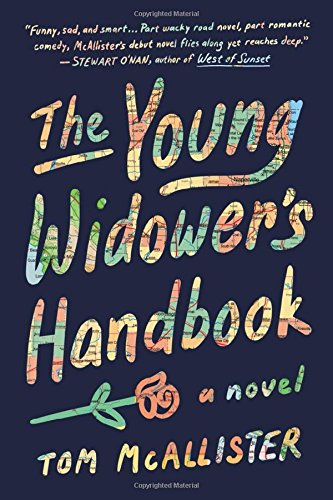
Review: The Young Widower's Handbook by Tom McAllister

When you say your wedding vows, you expect to spend the rest of your life with that person, til death do you part. But what happens if death comes sooner rather than later? What if you are still young when the one person you love the most in the world, the one person who believed in you over everything, dies suddenly, leaving you alone? How do you go on? How do you define yourself? Who are you now that you're not part of a couple? Tom McAllister's touching novel The Young Widower's Handbook asks these questions even if it can't quite answer them.

Hunter Cady is a little bit aimless and unmotivated. His wife Kait is the one person who believes in him and makes him want to be better. So when she dies unexpectedly while they are still in their twenties, he is set completely adrift. Her crazy, thuggish family blames him for her death following an ectopic pregnancy and they want to claim her ashes. Instead, Hunter takes off with them, embarking on a cross country tour, visiting the places that he and Kait had jokingly suggested they might move to one day. Sunk in his grief, he tells no one where he's gone or where he's headed, just sends photographs of himself holding Kait's ashes at stops along his way to family and friends via social media to reassure them he's still out there. As he travels the country without any clear plan, he runs into quirky people, has odd encounters, and gains some insight into their marriage and the love that he still has for her while trying to learn how to go on without her.

Hunter as a character is not always good and he doesn't always make the best decisions but he's grieving an unimaginable loss and is understandably gutted and numb after Kait's sudden death. In fact, Hunter is completely and totally human, flaws and all, and while this sometimes makes him unsympathetic, most of the time, the reader can understand his thoughtless actions and his lack of consideration for anyone else who cared for Kait. The road trip itself, with its random, unplanned stops and detours, is clearly a metaphor for the emotional journey he's on but it never verges on cliched. The pacing of the novel and the revelations of Hunter and Kait's life together and their now lost plans for the future are woven together well into a lovely and coherent whole. The writing here is beautifully done; the story itself is bittersweet without being sentimental and the ending will tear your heart out with its beauty and its rightness.

Thanks to the publisher for sending me a copy of this book for review.

Wednesday, July 19, 2017

Review: The Almost Sisters by Joshilyn Jackson

The South has long been a hotbed of racism. I don’t think this is news to anyone. It has a terrible history with issues of race, the raw wounds of which continue to bleed into its present. And there’s no shortage of novels, tv shows, and movies that focus on this still rampant racism. Joshilyn Jackson’s latest novel, The Almost Sisters, tackles this issue from the inside and is told with Jackson’s signature humor, eccentric characters, and unpredictable plots.

Leia Birch Briggs is a famous comic book artist. She is well known for her creation, Violence in Violet, and has signed on to write a prequel for this fan favorite, the origin story for Violence, a bloody, destructive, and vengeance minded character. At a Comic Con where the prequel is announced, Leia has a drunken one-night stand with a fan. She doesn’t remember his name, calling him Batman, for the costume he wore in the bar where they met and her major recollections of him are of his eyes and his smile and the fact that he’s black. When it turns out that she’s pregnant from this encounter, she makes peace with the fact that her child, who will be biracial, will not have a father, because how do you locate a stranger in a costume whose name you don’t know? Her bigger concern is telling her family that she’s pregnant and unwed. But just as she works up the nerve to do that, the lives of those she loves go to hell in a handbasket. Perfect step-sister Rachel kicks her husband out. Niece Lavender witnesses her parents’ ugly blow-up. And even more concerning, Leia’s ninety year old paternal grandmother Birchie, who she spent every summer with as she was growing up, causes a very uncharacteristic scene in church, a clear sign that something is not right with her. Swallowing the secret of her pregnancy, Leia hightails it to Birchville, Alabama, to the town that her family founded, to uncover what is going on with her beloved Birchie. What she eventually uncovers shows her a side of this small Southern town that she has never seen before and which makes her question the reality her unborn child will face, especially in the South.

As is usual in Jackson’s novels, there is a great deal of humor and kookiness on display here. Most of the characters are richly drawn and balanced in their characterizations. Birchie and her best friend and companion, Wattie, are wonderful. Rachel and Lavender are very real, flawed and good-hearted both. The biggest contradiction to the idea of fully fleshed out characters is Batman himself. He’s certainly unknown while Leia herself remembers nothing about him but as he is revealed to her, he stays a rather flat character to the reader, only as a real as a superficial Facebook profile is. The novel has a multitude of storylines, corresponding to the multiplicity of secrets the characters hold, and sometimes they tangle around each other. Other times they complement or mirror each other and add to the complexity of the issues weaving through the novel. Just as Leia is trying and struggling to discover the origin story for Violence, she is discovering the sometimes hidden, and not always pretty, origin stories of the town, its families, and her family in particular. The novel flows easily and the story is just the kind of zany that Jackson’s readers have come to expect but there are a few sections, mainly when Leia starts musing to herself, where it becomes heavy-handed, bordering on preachy about racism in the South. In fact, it’s strange that as smart as Leia is, she never noticed the dichotomy of the two different Souths before she got pregnant with Digby. Call it an oddly belated awakening. Over all though, this novel is a nutty and engaging romp of a story. Jackson’s fans and readers who like solving old mysteries, enjoy offbeat stories and quirky characters, and want a little more substance to their beach reads will enjoy this funny, disturbing, and eminently readable novel.

For more information about Joshilyn Jackson and the book, check out herwebsite, like her on Facebook, or follow her on Twitter. Check out the book's Goodreads page, follow the rest of the blog tour, or look at the amazon reviews for others' thoughts and opinions on the book.

Thanks to Trish from TLC Book Tours and Harper Collins for sending me a copy of this book to review.

Popular Posts