Showing posts with label Just For the Love of It Challenge. Show all posts

Wednesday, May 13, 2009

Review: Cordelia Underwood: Or the Marvelous Beginnings of the Moosepath League by Van Reid


Originally written in serial format, this novel of Victorian Maine is chock full of characters, plot lines, and just plain fun. As the subtitle implies, this is the first book in a series about the Moosepath League. However, instead of starting out focused on the creation of said club, it opens with Cordelia Underwood, a sweet, young, redheaded woman, finding out that she has inherited a parcel of untamed land land well to the north of Portland from her ship's captain uncle. This inheritance starts a whole crazy chain of events, including some that are ridiculously coincidental but somehow work in this wacky, madcap adventure story.


The Underwood family meets and befriends many strangers along the way as they travel north to examine Cordelia's property. Those strangers meet and befriend their own plethora of strangers and the connections and characters grow and grow. There are three goofy male characters who seem to be the literary equivalent of the Three Stooges. There's Tobias Walton, who becomes the leader de facto of the Moosepath League (not that this comes into existence until late in the book). There's the charming and ever-present John Benning. There's a circus bear who stands on her head, an ascentionist in a hot air balloon and an "attractive suit of tights." There's attraction and love. There's the rumor of buried treasure, a kidnapping, and a runaway horse carrying illegal booze. In short, this book is chock full of action and entertainment.

Because of the serial nature of the book, the chapters are short and often end with a teaser. Subsequent chapters often skip to another of the many characters in the book and to start with, this makes it very hard to differentiate between storylines (the characters themselves are all very different from each other) and to become fully engrossed in the story. But upon perseverance, the reader is richly rewarded as the climax of the novel nears and the seemingly disparate plot lines coem together to finish a delightful romp. Unlike many series books, this one feels complete in and of itself, not requiring the reader to go on to further books to feel a sense of closure. But I suspect that the main characters (Cordelia and her family) do not reappear in later Moosepath books, unless tangentially, and so their stories are full and satisfying when you come to the end of this first book. Walton and the three bumbling musketeers surely appear in later books but that doesn't detract from the wrap-up here. I will be eager to read the following books now that I've gotten into the groove of this one. I'm very interested to see what happens to the Moosepath League members next.

Sunday, May 3, 2009

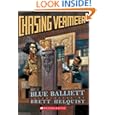
Review: Chasing Vermeer by Blue Balliett


I had been coveting this children's book since it was released in hardcover, trying to convince my children that they wanted to read it, thereby granting myself permission to buy it. I haven't managed to convince them yet but when it arrived on the table at the school book sale, it was my duty to buy it to support the school library, right? And now that I've read it, I will be pushing the kids even harder to read it. A truly delightful and inventive tale, this had overtones of From the Mixed Up Files of Mrs. Basil E. Frankweiler or The Westing Game. Calder Pillay is mourning the loss of his best friend, who has moved out of state, when a strange book about unexplained happenings brings Calder together with Petra, a fellow student with a keen eye for coincidences. Petra and Calder build a friendship as they try to unravel the several mysteries: that of an elderly neighbor, that of their teacher's sudden nervousness and distractability, and of course, that of the missing Vermeer painting to which they feel a kinship connection. As the mysteries unfold, Calder and Petra race to find the painting before it is too late as they also seek to explain the other more minor mysteries. The plot abounds with leads, intuitions, and wrong turnings and the reader delights in following these endearing, slightly eccentric kids as they work their way through the clues, both intentionally and unintentionally uncovered. Everything about the book is meticulously done and the puzzle pieces are slotted together so expertly that I only figured out the connections slightly ahead of the characters, which either points to my thickheadedness or their genius (or both). But the true genius here is Balliett, in drawing such an appealing and engrossing story for both boys and girls, one that celebrates intelligence and friendship and perserverence and all those things that can easily cause a less accomplished book to come across as moralistic and dull. This book is anything but that and should be recommended to any and all children in your orbit.

Thursday, March 26, 2009

Review: The Lost Years of Jane Austen by Barbara Ker Wilson


I have a weakness for all things Jane Austen so when I saw this novel purporting to fill in the missing time in our knowledge of Austen, I snapped it up. Wilson imagines that Austen traveled with her aunt and uncle Leigh Perrot to Australia during this gap of time, drawing a well done portrait of the penal colony in the beginning of the 1800's. Starting with Aunt Jane Leigh Perrot being arrested and falsely accused of stealing lace (based on a true incident in which Mrs. Leigh Perrot spent some months in jail before being brought to trial and exonerated), Wilson imagines that Austen's uncle, an amateur lepidopterist, fixates on the idea of the strange and wonderful natural life in the Antipodes should his wife be inexplicably found guilty and transported. Meanwhile, Austen herself is in Bath with her family and falls in love with every expectation of marriage. But a letter telling her of Elliott Fordwick's untimely demise ends these happy imaginings and it takes Jane a considerable amount of time to stop grieving. With her future completely changed from all expectation, Jane jumps at the chance to accompany her aunt and uncle on the trip to Australia about which her uncle has never quite relinquished hope of taking. Many are the characters introduced in the book before and during the journey as well as once the Leigh Perrots and niece Jane arrive in Sydney; some are historic figures and some are fictional. And despite the billing on the jacket copy of the book, this is not a book about hushing up a failed romance that Austen had while Down Under. It is a well done, interesting, and unusually imagined guess at what Jane Austen could have been doing during the years there was such a dearth of letters to her sister Cassandra.

I was impressed by how well Wilson managed to invoke the language of the time, something so many post-Austen writers fail to do. I enjoyed her characterizations and the way she set up little clues for careful readers to explain things that later found themselves in Austen's actual works. She widened the focus beyond just Austen herself, fleshing out the Leigh Perrots quite extensively, which helped to give the novel a bit more heft and while that generally worked, I felt it did go on just a bit too long, given the dearth of things to do in the colony for a gently reared young lady. But the budding society in Parramatta and Sydney were well described and interesting, especially the details about the former convicts. Overall, a satisfying read that will probably appeal to most Jane-ites, despite the seeming incongruity of Austen in Australia.

Review: Merry Hall by Beverley Nichols


The first in a trilogy, this lovely book chronicles Nichols' search for and purchase of a country freehold not too far from London where he can garden. Taking place not too long after the end of the Second World War, not only is this a delightful and enchanting book about plants and gardening, but it is awonderful snapshot of a time long since past. Nichols' garden is his main focus but he also introduces the reader to his eccentric neighbors, his elderly gardener, and various other people about the place. He discusses the folly and joys that came with purchasing his estate. And he generally injects enough light humor in all areas that this was a wonderful, completely appealing read. There are certainly instances that firmly place this in its time period but it has aged well and was a wonderfully diverting book to cozy in with for an afternoon. I have to actually physically restrain myself from jumping immediately into the second book in the trilogy, wanting to draw out the pleasure a bit by savoring the anticipation of an equally lovely amount of time spent with it. And don't skip over this book thinking that you aren't a gardener and don't want to read about gardening. Anyone who lights a hedge on fire on purpose and scorches the heck out of his new albeit slightly dilapidated home should be able to entertain any and all non-fiction readers with ease.

Monday, March 23, 2009

Review: Spies by Michael Frayn


Opening with narrator Stephen Wheatley smelling a vaguely unpleasant smell that triggers the memory of a fateful time in his childhood, this story tells of boys Keith and Stephen, their friendship and what their curiousity during WWII cost them and others. As Stephen travels back to the Close he lived on during the war years, he remembers Keith as being the driving force behind all that the two boys did together and the catalyst for their fateful game of spying on Keith's mother whom Keith avers is a German spy. The two boys hide out in a thick privet bush, thinking they are unobserved, trying to mark Mrs. Hayward's comings and goings, and eventually tailing her as best they can. Older narrator Stephen interjects occasionally and the reader is comfortably sure that he or she knows more than young Stephen so when the denouement occurs, it is a somewhat unexpected twist (although we do know it a step ahead of Stephen). It is what our narrator casually reveals after the story of the imagination of young boys that somehow shocks the reader even more.

Frayn builds tension slowly and inexorably throughout the narrative, skillfully adding a slight menace to every action observed or taken. As the reader, you are addressed in the second person, as if older Stephen is narrating his story directly to you and this technique serves to make you a confidante, an insider in the novel itself. Stephen is definitely a more sympathetic character than Keith, not surprising given that Stephen is our narrator. But Frayn also reveals enough about Keith for the reader to understand and feel somewhat sorry for the stoic, rather condescending and unpleasant boy he is. A remarkably surprising book, this is one that will probably stay with me for quite a while thanks both to an unusual plot and to the masterful writing although I'm still not sure I particularly liked it.

Sunday, March 15, 2009

Review: Fork It Over by Alan Richman


This is a collection of columns previously written by Richman for GQ and other sources about his life as a professional eater and restaurant reviewer. The columns have been arranged into a menu of sorts: amuse-bouche, appetizers, palate cleanser, entrees, palate cleanser, sides, cheese, palate cleanser, wine, and gratuity. Richman is well written and funny and the columns pleased this readers palate. Of course, I do generally enjoy the literary equivalent of what we here sometimes call "food porn" but I think this is of interest to most people. It isn't too specialized or restaurant-centric so that only those who have eaten at the place in question will enjoy the associations Richman makes as he travels from the nostalgia of his mother's kitchen to the palate stirring pleasures of a gourmet meal. One of my favorite comedic bits in the book comes from one of the palate cleansers, Ten Commandments For Diners and headed "5. Pass on the Omelette Station." It reads: "You're on vacation, ready to splurge. That means the hotel's $39.95 Sunday buffet brunch. There's salmon, sushi, crab claws, shrimp, and eggs Benedict. You head straight for the omelette station, where a guy in a Hawaiian shirt who has never been to cooking school is making fluffy four-egg omelets with scallions, peppers, Bac'Os, and a grated cheese product. Nice going. You've just filled up on an egg dish that costs $3.99 at Denny's." After you stop giggling, you recognize that the man really is correct. (And I felt inordinately glad I hate eggs so I knew without doubt I've never fallen into that brunch pitfall.) Good fun, this was well worth the read.

Monday, February 23, 2009

Just For the Love of It Challenge


The Just For the Love of It Challenge is one of the choose your own books kind of challenges that sound like such a good, easy idea and yet when you sit down to compile the actual list, you are surprisingly stumped. Perhaps part of my problem is that one of the rules is that you should only read books you just can't wait to read. Every book in my house falls under that category at some point and time and heaven knows that there's no hope for me to read all of them sometime between now and the end of April! But, because I love compiling lists and fondling my books debating whether to put them on the list or not is always an enjoyable exercise for me, I'm signing up for this one anyway. I decided not to make the list retroactive to January 1 so it'll be a much shorter version of what I would have written then. Here's the tentative list:

1. Fork It Over by Alan Richman
2. Spies by Michael Frayn
3. The Lost Years of Jane Austen by Barbara Ker Wilson
4. Merry Hall by Beverley Nichols
5. The Tale of Desperaux by Kate DiCamillo
6. Chasing Vermeer by Blue Balliott
7. Cordelia Underwood by Van Reid

I'm sure I'll be adding more as the next two months roll along!

Popular Posts