Showing posts with label Art History Reading Challenge. Show all posts

Wednesday, March 31, 2010

Review: One Vacant Chair by Joe Coomer

I discovered Joe Coomer's books years ago through another reading friend's recommendation. Then I chose one of his books for my summer book club last summer to help spread the word a bit farther. There's just something wonderful about the quirky characters he creates and the way in which he can tackle deep philosophical issues in the guise of a humorous, thinking novel that makes his work shine. One Vacant Chair is the latest I've read and thoroughly enjoyed.

This novel opens with the Hutton family gathering for the memorial service to bury their mother and grandmother. Edna, an unmarried school cafeteria worker and artist who paints portraits of chairs had taken care of her cantankerous, bedridden mother for twenty odd years. But Edna (and grandma) lived lives that would have surprised the rest of the family and after the reading of the will where grandma asked for her ashes to be scattered in Scotland, a place she'd never been, the details of their lives start to emerge. Sarah, Edna's niece, reeling from her husband's infidelity, offers to stay and help her aunt pull together all the lose ends involved in international travel for those who have never left home. She also has the chance to observe her aunt's artistic process and to get in touch her own artistic roots while in the presence of a wonderful artist, one who will be revered posthumously as small comments scattered throughout Sarah's telling of the story make clear. While living with Edna and then traveling with her to Scotland, Sarah learns the secrets, large and small, of her aunt's life and comes face to face with the delicate realities of living and dying.

On the surface, a quirky tale filled with unusual characters, Coomer has a knack for delving deeply into the things that drive our lives. Here the examination is not only of life and death as points on the same continuum but also of the place of family and love on our own personal time lines. With Sarah telling the story from the benefit of hindsight, the reader knows much of the territory that the narrative will cover but that doesn't make it dismissively predictable. Instead, it freights the conversations between Sarah and aunt Edna with more portents than perhaps would have been possible otherwise. And still there are major twists that are surprising in their deviation from the expected. As the two women travel through Scotland doling out ashes in the places they have chosen, they each struggle with the path their lives are on, trying to find the right thing for themselves in balance with those surrounding them. The book is never preachy and always accessible but it is full of the symbolic and the philosophical. It is beautifully presented and entertainingly drawn, well-written and appealing. You'll warm to the characters, ache with their indecision and weaknesses, and laugh with their eccentricities. You might even learn something about art and art process (I sure did). Readers looking for an unusual story will be richly rewarded with this one. It's a gem.

Sunday, December 27, 2009

Review: Mademoiselle Benoir by Christine Conrad


American Tim Reinhart, a former math professor, moves to France to pursue his lifelong dream of becoming an artist. In addition to renovating his somewhat ramshackle farmhouse in the South of France, he also meets an aristorcratic French woman almost two decades his senior with whom he falls in love. An epistolary novel this is mostly the story of Tim and Catherine as they negotiate the waters of love and marriage in France despite her disapproving relatives and the arcane laws apparently designed to keep them from marrying. The letters are for the most part between Tim and his mother and sister with a few between Catherine and her sisters and other assorted people caught in the web created by this unconventional marriage.

The premise is charming but the execution didn't live up to my expectations. There was something a bit off in the voices in the letters here, making the characters not as likable as they should have been. In addition, this falls into the pitfall of many epistolary novels in that it is heavy on explanation, as would be expected in correspondance with someone removed from the situation, but it seems unnecessarily heavy-handed here. On the plus side, there is a lot of interesting information about French inheritance law, how marriages take place (or are prevented) in France, and general information about the country and its people. The love between Tim and Catherine is sweet, if a bit underrepresented in the letters and their quest to marry starts to take on a farcical aspect. As to Tim being an artist, there's little enough here, with the personal taking over the professional just about completely. Ultimately there's not much plot to this novel and the characterizations are thin but it is a quick and easy, feel good sort of read for those times when something like this is needed.

Sunday, May 3, 2009

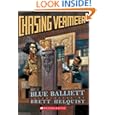
Review: Chasing Vermeer by Blue Balliett


I had been coveting this children's book since it was released in hardcover, trying to convince my children that they wanted to read it, thereby granting myself permission to buy it. I haven't managed to convince them yet but when it arrived on the table at the school book sale, it was my duty to buy it to support the school library, right? And now that I've read it, I will be pushing the kids even harder to read it. A truly delightful and inventive tale, this had overtones of From the Mixed Up Files of Mrs. Basil E. Frankweiler or The Westing Game. Calder Pillay is mourning the loss of his best friend, who has moved out of state, when a strange book about unexplained happenings brings Calder together with Petra, a fellow student with a keen eye for coincidences. Petra and Calder build a friendship as they try to unravel the several mysteries: that of an elderly neighbor, that of their teacher's sudden nervousness and distractability, and of course, that of the missing Vermeer painting to which they feel a kinship connection. As the mysteries unfold, Calder and Petra race to find the painting before it is too late as they also seek to explain the other more minor mysteries. The plot abounds with leads, intuitions, and wrong turnings and the reader delights in following these endearing, slightly eccentric kids as they work their way through the clues, both intentionally and unintentionally uncovered. Everything about the book is meticulously done and the puzzle pieces are slotted together so expertly that I only figured out the connections slightly ahead of the characters, which either points to my thickheadedness or their genius (or both). But the true genius here is Balliett, in drawing such an appealing and engrossing story for both boys and girls, one that celebrates intelligence and friendship and perserverence and all those things that can easily cause a less accomplished book to come across as moralistic and dull. This book is anything but that and should be recommended to any and all children in your orbit.

Tuesday, March 24, 2009

Review: The Painter From Shanghai by Jennifer Cody Epstein


Pan Yuliang, Chinese ex-pat artist. Have you heard of her? I hadn't either but this novel limns a fascinating and believable life for this not particularly well known historic figure. Orphaned young and raised by an opium addicted uncle, Pan Yuliang is sold into prostitution in her teens. She is bought out of her contract by a government offical whom she ultimately marries, becoming his concubine or "second wife." Amazingly, given the political climate in China during her lifetime, she is not only allowed to study at a prominent art school in Shanghai, but she also wins a scholarship to go to Paris and study there. Her work is post-Impressionist and both Asian and European in feel with her most famous and controversial paintings being of nudes, and very commonly of herself nude. While in France, she meets and associates with other young Chinese (Zhou Enlai is one such person) who will ultimately help to change the face of their homeland and drive people like Pan Yuliang from the China racing headlong towards the Cultural Revolution.

This was a completely engrossing novel which kept me reading long past when the light should have been out. Epstein has drawn a very believable story for Pan Yuliang, from her beginnings as a maid in a brothel all the way to being at the nadir of the post-impressionist art movement in China. She's a warm and sympathetic character who faces set-backs with a bit of fatalism and a steely resolve, an intriguing mix in a character. Although this is billed as novel about Pan Yuliang the artist, it is quite far along in the narrative before she tries her hand at any drawing at all, which I had not expected. And while her early life was fascinating, I read with a small sense of "let's get to the painting part" nagging at the back of my mind. Pan Yuliang is very definitely the main character here, with few other characters appearing and lasting in the novel. There are no throw-away characters and no outside tangents to take the reader's attention from the major story, allowing the reader to crawl more fully into Yuliang's skin and experience the highs and lows of her life with her. I went searching on the internet for pictures of her work once I finished the book and obviously Epstein did a good job describing them as they weren't startlingly different from what I had imagined. They aren't particularly to my taste but the book definitely was. I recommend it for those who enjoy historical fiction, art history, or just a plain old good story that will keep you reading past your bedtime.

Monday, March 23, 2009

Review: Johanna by Claire Cooperstein


Johanna van Gogh worked tirelessly after her brother-in-law Vincent's death to help establish his reputation as a pre-eminent artist. Without her, his work would likely have faded into obscurity or worse yet, destroyed. And yet she promoted van Gogh's work entirely out of love for her late husband, who succumbed to mental illness and died (of syphilis) not long after his much loved older brother's death. Cooperstein has imagined Johanna's diary and letters as it might have told the story of her brief marriage to Theo van Gogh and her subsequent quest to find the fame he had worked for so diligently on his brother's behalf. There is an actual diary written by Johanna but the van Gogh family has refused all requests by authors and historians to view it. Cooperstein has created a credible character in her Johanna, showing her frustrations, sorrows, and joys, before and during her marriage and subsequent long widowhood as well as in her second marriage. There are known historical details peppered throught this mostly epistolary novel (Johanna continues to write letters to her late husband as a means of communicating with him--really just as a way to clarify her own thoughts) and while the bulk of the novel deals with the seemingly insurmountable hurdles to having van Gogh recognized as the brilliant avant guarde artist he was, we also see the gathering political clouds over Europe. Cooperstein's Johanna is a progressive and strong woman as the real Johanna must have been to have perservered in her causes, both for van Gogh's art and for womens' rights. This was an interesting book and illuminated a story I hadn't realized existed behind van Gogh's art. My biggest quibble with the book was the frankness of the discussion of sex by Joahnna's second husband when writing to his father. Perhaps this was indeed a cultural thing, as he himself notes in his letter, but it seemed gratuitous, and honestly out of place, in this novel. Other than a few bits like this, though, an enjoyable read. Perhaps someday, we'll be allowed to see the contents of Johanna's diary and we can see how well and closely portrayed Cooperstein's Johanna is. In the meantime, Cooperstein's Johanna is worth spending some time with: passionate, devoted, and determined.

Popular Posts