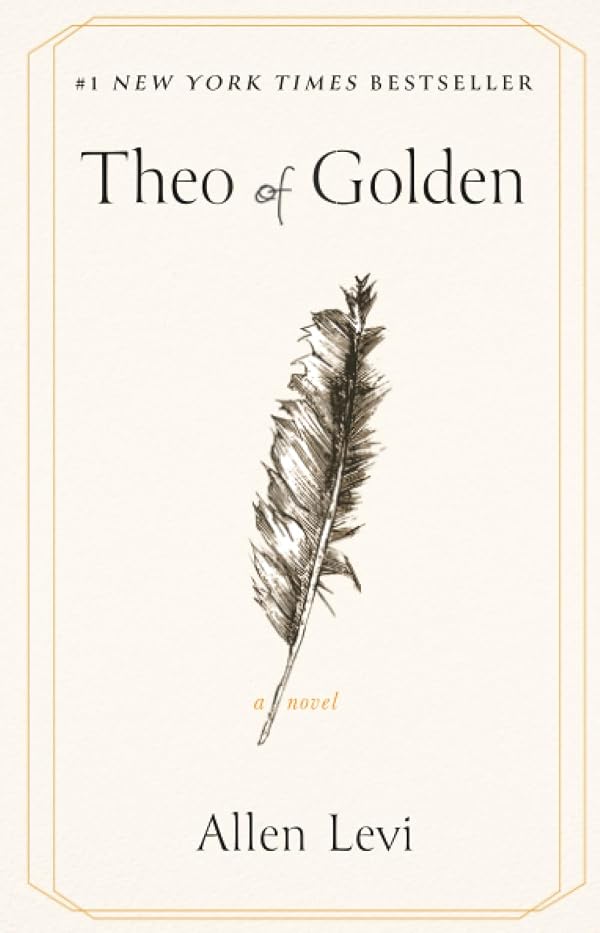
An elderly man named Theo arrives in a smallish southern city called Golden. He offers no reason for coming to this place, doesn't give his last name or any information on who he is, but he settles into the town quietly, staking out a favorite park bench and frequenting the local coffeehouse. When he sees a series of pencil portraits of local people for sale on the walls of the coffeehouse, he decides that he will buy them and gift them to the people who are the subjects of each one. As he gives the portraits to the people, he learns about them and their lives, he eventually connects with the artist, and he ingratiates himself in the daily life of the town folks, like the bookseller and the man from whom he rents his apartment (and who is the only person with whom Theo shares his identity and his reason for being in Golden).
The premise sounds heartwarming enough but the execution moves beyond heartwarming and straight to saccharine treacle. Every person this genial old man gives a portrait to instantly offers him their innermost thoughts and feelings, telling him personal and private information about their lives without reservation. The only person who doesn't happily accept the gift is a woman whose abusive boyfriend intercepts the letter and the portrait. The instant acceptance and lack of skepticism about this man, and the immediate opening up of the recipients strains credulity more than a little. The characters Theo meets are all simple, uncomplicated, and flat, caricatures rather than complex human beings. His secret is telegraphed long before the end of the book, making the revelation anticlimactic. The tales of the portrait people went on far too long, making this reader incredibly tired of the boring inhabitants of Golden. The writing was overly descriptive, to the point of being florid, and repetitious. OK, we've got it, there are ninety-two portraits. You don't have to keep repeating this fact. (But there actually aren't only ninety-two as Asher, the artist, replaces the portraits with others as they sell to Theo.) There is a lot of heavy-handed Christian theology in here as well, despite no mention of this in the blurb, which seems dishonest in the marketing of the book (and the author had a large hand in the choice of marketing so this can be laid at his feet rather than the publisher's). The Theo character is alternately presented as a Jesus figure and as a saintly disciple, neither of which felt comfortable even in an obvious parable such as is presented here. There is only the slightest hint of a plot with the bulk of the book being long philosophical, Christian-coded conversations between Theo and the people to whom he's giving the portraits. In the end, the only thing I liked about this book was that other people (including my entire book club) liked it and felt that it offered them hope for the future (I don't see it, but this is what they told me). As for the book itself, it was poorly written, one dimensional, and far, far, far too long. I cannot recommend it.


No comments:
Post a Comment
I have had to disable the anonymous comment option to cut down on the spam and I apologize to those of you for whom this makes commenting a chore. I hope you'll still opt to leave me your thoughts. I love to hear what you think, especially so I know I'm not just whistling into the wind here at my computer.