Thursday, November 30, 2017

Review: A Hundred Small Lessons by Ashley Hay

Life transitions are hard. Good ones and sad ones, they are all stressful and loaded with emotion. Having a child is a big life change. So is moving homes. Both disrupt life and force change. Characters in Ashley Hay's new novel, A Hundred Small Lessons, are facing major life changes and taking stock of their lives in this lovely, quiet, character driven, domestic novel.

When elderly Elsie Gormley falls and breaks a hip, her children, in their seventies themselves, decide that after rehab she can't return to the house she's lived alone in for thirty-seven years, instead placing her in a local retirement home. Cut adrift from the house that carried the memories of most of her life, her marriage, her motherhood, and her widowhood, she starts to drift between past and present in her mind, losing her place in the present and reality slowly, so slowly. Lucy Kiss, her husband Ben, and their one year old son Tom have moved to Brisbane, the city of Ben's childhood, buying Elsie's home. Although they have lived all over the world, Lucy really struggles with the move to Brisbane, the distance from her family, and motherhood suddenly being her only job. As Lucy tries to settle in and make Elsie's house her own, she conjures up the old woman, whom she has never met, as a sort of touchstone or imagined friend. In fact, Lucy is certain that Elsie has come back to the house to watch her several times, a fixation Ben finds ridiculous and frustrating.

The story moves from Lucy's present to Elsie's remembering of the life she spent in the house with husband Clem and twins Don and Elaine. The switches in narrative focus are often triggered by Lucy finding something of Elsie's or of thinking that Elsie has looked in on the house. There is a slow and mesmerizing feel to the narrative as it focuses on snapshots of ordinary life and the small moments of that life. Both Lucy and Elsie face struggles with motherhood: Lucy with the isolation and vulnerability of raising a child and Elsie with the relationship she never could seem to get right with her daughter Elaine. The intersections and parallels, as well as the divergences, of Elsie and Lucy's lives weave throughout the novel, forming the backbone of the minimal plot. The writing here is lyrical and moody and the setting is beautifully evoked in all of its wet and close glory. A meditation on aging, motherhood, house as home, and the passing of time, this is a deep and nostalgic read.

For more information about Ashley Hay and the book, check out her website or like her on Facebook. Check out the book's Goodreads page, follow the rest of the blog tour, or look at the amazon reviews for others' thoughts and opinions on the book.
Thanks to Lisa from TLC Book Tours for sending me a copy of this book to review.

Wednesday, November 29, 2017

Review: The Woman in Cabin 10 by Ruth Ware

Thrillers are not my usual reading choice. In fact, I don't think I've ever read one that I haven't been pushed to in one way or another. The Woman in Cabin 10 by Ruth Ware, billed as the next Girl on the Train, would definitely not ever have been on my radar if my book club hadn't chosen it as our monthly book. And because I try to let book club push me out of my usual reading (sometimes), I gamely picked this up.  Sadly, it confirmed that thrillers are not the genre for me.

Laura (Lo) Blacklock is a travel writer who can't quite commit all the way to her relationship with her boyfriend, Judah. Already struggling emotionally, Lo wakes up one night convinced that she isn't alone in her apartment. She's right. Traumatized by this terrifying home invasion, she jumps at the chance to get away by taking her boss's place on the maiden voyage of the Aurora, an exclusive luxury cruise ship traveling through the Norwegian fjords. The cruise ship only has ten guest cabins and is meant as an experience for the super rich after this first press junket. Still anxious and on edge as a result of the break-in, Lo is drinking too much and taking anxiety medication. When she hears a scream in the middle of the night and witnesses a person thrown overboard from the balcony beside hers, she is certain she's witnessed a murder. Except no guests or crew members are missing from the ship. Lo can't let it go, certain she saw what she saw, and she presses for an investigation even though, trapped on the ship as they are, the murderer must be among them.

Lo's increasingly paranoid first person account is interrupted every now and again by her boyfriend's worried emails, first to her and then to more and more people. The emails from Judah felt oddly out of place in the plot time line so instead of ramping up the tension, they were easily dismissed by the reader. In theory, given the plot, this novel should have been an amazing, tense, and thrilling tale, right? Well, there are some real problems with it. Although the reason Lo takes anxiety medication is well handled (the previous break-in), the fact that our heroine is constantly drunk to the point of being sick and is completely incautious about throwing around her murder theory, bumbling through an investigation, such as it is, make the story less intense. Sure, she's panicked and on edge after her own pre-cruise experience, but would a woman who is that traumatized seriously push back that hard on a murder no one else can corroborate? Add this unlikely scenario to the fact that Lo as a character is whiny and irritating and has zero aptitude as an investigator and you have a very unlikable, questionable main character. Lo may not be able to figure out the murderer until her back is against the wall, but the reader knows almost from their introduction on the page who it will be.

There were small irritants as well like Lo seeing the ship for the first time at the docks and noting how surprisingly small it was but then each and every time she entered a room on the boat, she remarked on how spacious it was, also commenting on the idea that she could get lost below decks. So was the boat large or small? It can't be both at once. And the coincidences. Puh-lease!  (spoiler ahead--highlight the following blank if you want to see the text.)  The guest who was supposed to be in cabin 10 stayed home because he too had a break-in occur at his house. Really? Worse yet, this is just coincidence and has nothing to do with the plot. One break in to establish a mental state works. A second one just to keep a character from appearing in the story, well honestly, that feels sloppy on the author's part. There's no other credible reason someone might skip a cruise? ::sigh:: On the plus side, there was a rising sense of claustrophobia that would be likely when you're trapped on a boat with a murderer and there's no phone or wifi to contact the outside world (although again, most boats nowadays use satellites to navigate so she really couldn't get a signal on her phone, ever?). And if the murderer was never in question, the actual details of the crime were in fact surprising, unlikely and out of the blue, but surprising nevertheless. Because of the first person narration, there were long repetitious stretches where we are told Lo's suspicions and then she repeats them again to the crew member assigned to help her question the crew in an unneeded by the reader second telling. The ending of the novel was frustrating (Lo's dimwittedness was on display again) and stretched belief (another spoiler ahead) (she plunged into the water forty feet--yes, forty feet *under* water--and had zero repercussions as she struggled to surface? That's five atmospheres down. Not a depth I'd want to hit without a decompression stop on the way up). Quite honestly the worst thing about this book for book club was that there was nothing in the book to discuss as a group so we were reduced to nitpicking at things like this.  And others had other details that bothered them.  Even before the meeting though, it hadn't been the most enjoyable read for me. But I am not a thriller reader. Perhaps those who enjoy the genre will have more success with this than I did if they can overlook the crazy plot holes, coincidences, and inaccuracies.

Thanks to the publisher for sending me a copy of the book for review.

Waiting on Wednesday

This meme is hosted by Breaking the Spine and is meant to highlight some great pre-publication books we all can't wait to get our grubby little mitts on.

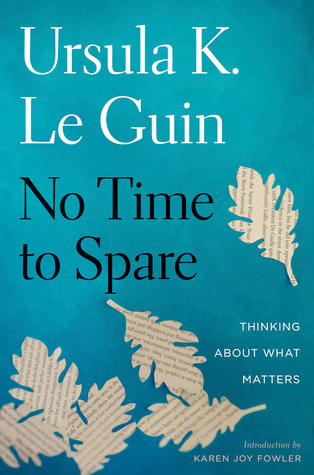
No Time to Spare by Ursula K. LeGuin.

The book is being released by Houghton Mifflin Harcourt on December 5, 2017.

Amazon says this about the book: Ursula K. Le Guin on the absurdity of denying your age: “If I’m ninety and believe I’m forty-five, I’m headed for a very bad time trying to get out of the bathtub.”

On cultural perceptions of fantasy: “The direction of escape is toward freedom. So what is ‘escapism’ an accusation of?”

On breakfast: “Eating an egg from the shell takes not only practice, but resolution, even courage, possibly willingness to commit crime.”

Ursula K. Le Guin has taken readers to imaginary worlds for decades. Now she’s in the last great frontier of life, old age, and exploring new literary territory: the blog, a forum where her voice—sharp, witty, as compassionate as it is critical—shines. No Time to Spare collects the best of Ursula’s online writing, presenting perfectly crystallized dispatches on what matters to her now, her concerns with this world, and her unceasing wonder at it: “How rich we are in knowledge, and in all that lies around us yet to learn. Billionaires, all of us.”

Tuesday, November 28, 2017

Review: Woman No. 17 by Edan Lepucki

How do you define yourself? If you are a parent, does your sense of self rely on your children? If you are a daughter, are you defined by your parents? Do you identify with your professional self before anything else? Just who do you think you are and who do others think you are? What image do you present to the world? Edan Lepucki's twisty newest novel, Woman No. 17 addresses issues of identity, motherhood, art, and relationship.

Lady Daniels is the mother of two sons. Her oldest son Seth is 18 and completely nonverbal. She is careful to note that he is not autistic nor is he a genius; he's mute for no discernible physical reason. Devin, her younger son, is a chatty, busy toddler. She and her two boys live in a large and gracious home in the Hollywood Hills; her husband has recently moved out, at Lady's request, although he would like to reconcile. Lady is supposed to be writing a memoir but she needs help with Devin in order to find the time to write. When an ad for a nanny brings S Fowler (real name Esther Shapiro) into Lady's life, she quickly hires this young woman about whom she knows next to nothing. S is an artist who creates unconventional projects. Her latest performance piece is intentionally taking on her mother's persona, a fact she does not disclose to Lady. Nor does she disclose to Lady the growing connection she and Seth are developing.  But S isn't the only one with secrets in the Daniels home.  Lady has a few of them herself.  Lady needs S, just as S needs Lady, so the reader knows early on that things can't possibly end well between them.

The novel's narration is first person and shifts between Lady and S, revealing secrets held and secrets told from two different perspectives. Both main characters are rather hard to like, being both self-destructive and self-absorbed. Both women make terrible choices in their unsettling and dysfunctional lives, a fact that leads to a rising feeling of unease as the book goes on. There are certainly moments of humor to lighten the strange obsession and dependence at play here and they are much appreciated moments for sure.  The ending sort of fizzles out but the writing remains strong and unequivocal.  A novel of what art reveals and what it hides, the facades we take on in our public lives and how they are stripped away in our private lives, this is an edgy and uncomfortable read but one that is strangely hypnotizing. Whether Lady takes advantage of S or if S takes advantage of Lady is something I'm still trying to figure out even as I'm glad I don't know either of these women in real life.

Thanks to the publisher for sending me a copy of this book for review.

Monday, November 27, 2017

It's Monday! What Are You Reading?

This meme is hosted by Kathryn at Reading Date.

Books I completed this past week are:

Books for Living by Will Schwalbe
A Hundred Small Lessons by Ashley Hay

Bookmarks are still living in the middle of:

The Children's Crusade by Ann Packer
The Lake House by Kate Morton
The Center of the World by Jacqueline Sheehan
A Manual For Cleaning Women by Lucia Berlin
The Beauty of the End by Debbie Howells
Country of Red Azaleas by Domnica Radulescu
A Hard and Heavy Thing by Matthew J. Hefti
Paint Your Wife by Lloyd Jones
The Company They Kept edited by Robert B. Silvers and Barbara Epstein
No One Can Pronounce My Name by Rakesh Satyal
Thousand-Miler by Melanie Radzicki McManus
Dear Fang, With Love by Rufi Thorpe
Close Enough to Touch by Colleen Oakley
America's First Daughter by Stephanie Dray and Laura Kamoie
Hope Has Two Daughters by Monia Mazigh
After the Bloom by Leslie Shimotakahara
Metis Beach by Claudine Bourbonnais
Smoke by Dan Vyleta
Coco Chanel by Lisa Chaney
The Amazing Story of the Man Who Cycled from India to Europe for Love by Per J. Andersson
The New York Time Footsteps by various authors
The Buried Giant by Kazuo Ishiguro

Reviews posted this week:

To Love the Coming End by Leanne Dunic
Devil's Bride by Stephanie Laurens
Emily Goes to Exeter by M.C. Beaton

Books still needing to have reviews written (as opposed to the ones that are simply awaiting posting):

The Peculiar Life of a Lonely Postman by Denis Theriault
A Loving, Faithful Animal by Josephine Rowe
City Mouse by Stacey Lender
Cutting Back by Leslie Buck
Siracusa by Delia Ephron
The Wife, the Maid, and the Mistress by Ariel Lawhon
A Narrow Bridge by J.J. Gersher
The Never-Open Desert Diner by James Anderson
The Heart of Henry Quantum by Pepper Harding
The Hearts of Men by Nickolas Butler
Dance of the Jakaranda by Peter Kimani
How to Survive a Summer by Nick White
Bramton Wick by Elizabeth Fair
The Finishing School by Joanna Goodman
Meet Me in the In-Between by Bella Pollen
All Grown Up by Jami Attenberg
The Island of Books by Dominique Fortier
Lights On, Rats Out by Cree LeFavour
Salt Houses by Hala Alyan
Him, Me, Muhammad Ali by Randa Jarrar
What Are the Blind Men Dreaming? by Noemi Jaffee
Girl in Snow by Danya Kukafka
The Lying Game by Ruth Ware
The Talker by Mary Sojourner
When the Sky Fell Apart by Caroline Lea
The Seven Husbands of Evelyn Hugo by Taylor Jenkins Reid
'Round Midnight by Laura McBride
The German Girl by Armando Lucas Correa
The Tea Girl of Hummingbird Lane by Lisa See
The Jane Austen Project by Kathleen A. Flynn
Last Things by Marissa Moss
All Our Wrong Todays by Elan Mastai
Civilianized by Michael Anthony
The Redemption of Galen Pike by Carys Davies
Woman No. 17 by Edan Lepucki
In the Woods of Memory by Shun Medoruma
Before the Wind by Jim Lynch
Dinner with Edward by Isabel Vincent
Inhabited by Charlie Quimby
Pachinko by Min Jin Lee
One Good Mama Bone by Bren McClain
The Excellent Lombards by Jane Hamilton
You and I and Someone Else by Anna Schachner
Meantime by Katharine Noel
The Portrait by Antoine Laurain
So Much Blue by Perceval Everett
The Velveteen Daughter by Laurel Davis Huber
Mothers and Other Strangers by Gina Sorell
This Must Be the Place by Maggie O'Farrell
How to Find Love in a Bookshop by Veronica Henry
Between Them by Richard Ford
Kinship of Clover by Ellen Meeropol
The Life She Was Given by Ellen Marie Wiseman
The Clay Girl by Heather Tucker
Morningstar by Ann Hood
Lucky Boy by Shanthi Sekaran
Song of Two Worlds by Alan Lightman
The Heart's Invisible Furies by John Boyne
Old Herbaceous by Reginald Arkell
The Original Ginny Moon by Benjamin Ludwig
A Season of Ruin by Anna Bradley
Incontinent on the Continent by Jane Christmas
We Were the Lucky Ones by Georgia Hunter
Broccoli and Other Tales of Food and Love by Lara Vapnyar
Sourdough by Robin Sloane
A Paris All Your Own edited by Eleanor Brown
The Rook by Daniel O'Malley
Living the Dream by Lauren Berry
Lawyer for the Dog by Lee Robinson
Lily and the Octopus by Stephen Rowley
Beginner's Guide to a Head-On Collision by Sebastian Matthews
The Woman in Cabin 10 by Ruth Ware
Little Fires Everywhere by Celeste Ng
A Well-Made Bed by Abby Frucht and Laurie Alberts
The Book Jumper by Mechthild Glaser
From Here to Eternity by Caitlin Doughty
Less by Andrew Sean Greer
Shelter by Jung Yun
Books for Living by Will Schwalbe
A Hundred Small Lessons by Ashley Hay

Monday Mailbox

This past week's mailbox arrival:

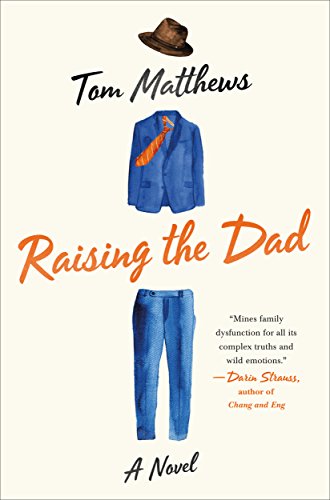
Raising the Dad by Tom Matthews came from Thomas Dunne Books.

When a dad learns an explosive secret about his dysfunctional family, everything changes. Sounds delicious, right?!

If you want to see the marvelous goodies in other people's mailboxes, make sure to visit Mailbox Monday and have fun seeing how we are all doing our part to keep the USPS and delivery services viable.

Friday, November 24, 2017

Review: Emily Goes to Exeter by M.C. Beaton

Most romances focus on the hero and heroine. M.C. Beaton's Emily Goes to Exeter, the first in the Travelling Matchmaker series, is not like most romances. Instead of centering on the couple at hand, this story takes as its main character Miss Hannah Pym, the long time housekeeper of the late Mr. Clarence of Thornton Hall. It's 1800 and Miss Pym is fascinated by the stage coach, "flying machines," that gallops past the estate every day on its way to Exeter. Upon receiving a bequest in Mr. Clarence's will and encouraged by his kindly brother, she can finally indulge her greatest romantic fantasy, travelling by said stage coach. She arranges her affairs and sets out on what turns into quite an adventure. When the coachman runs the coach into a rut and a storm blows in, the passengers of the coach are stranded at a local inn where the proprietor's wife is under the weather herself. Miss Pym proves to be a keen observer of human nature and a woman of action, taking charge of both the inn and her fellow passengers to keep things running smoothly. She has to contend with one spoiled society miss, badly disguised as a young man, trying to run away from the match her parents have made for her, the match himself, a widow fearful of life alone and the bully she's eloping with, a mild mannered lawyer, and several others as well. As she watches her fellow passengers, she quietly determines to help them along in their romantic lives.

Hannah is a mightily capable character. She's smart and compassionate and thinks the best of almost everyone. She's also a bit of a busybody and it's easy to see that she is perfect as an accidental matchmaker. Her delight in the little freedom that riding the stage coach gives her is infectious. The plot is full of hijinks and the story gives off a feel of true joie de vivre. There's nothing very complicated here and the brevity of the tale means that the other characters are of necessity sketched only in broad outlines but it's a short, light, and charming book for those who are looking for a little lovable sweetness in their historical romances.

Popular Posts